

How Can The Custom Diffuser Plate Improve Light Uniformity And Transmission?
Oct 16, 2026
Why Do Standard Light Covers Fail to Balance Uniformity and High Transmission?
Why do basic diffuser sheets create harsh LED hot spots?
Standard off-the-shelf plastic light covers lack tailored optical scattering agents designed to handle modern, high-intensity surface-mount LEDs. When placed over point-source light bars or LED arrays, basic covers fail to scatter light at sufficiently wide angles. This optical shortfall creates harsh, bright spots-known as pinholing or hot-spotting-directly above each diode, resulting in patchy, unrefined illumination across light boxes and displays.
How does heavy pigment addition choke total light transmission?
To hide visible LED chips, low-grade diffuser sheets often resort to adding high concentrations of basic titanium dioxide or chalky whitening powders. While these heavy pigments mask the underlying diodes, they absorb and bounce light back into the fixture housing. This internal light trapping chokes total optical transmission down to 50% or less, forcing systems to consume extra power to achieve target light levels.
What causes color shifting in generic plastic diffusers?
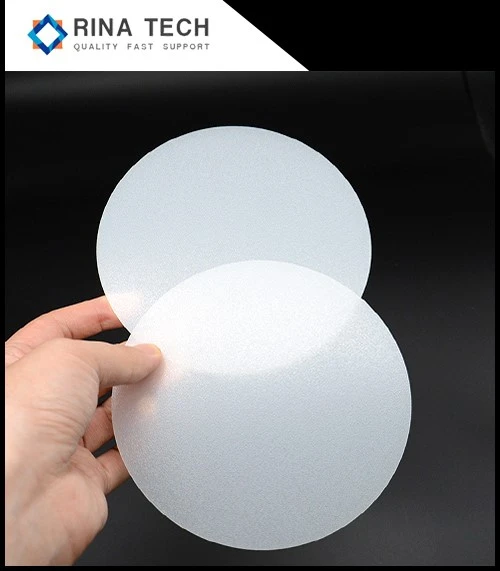
Lower-grade optical polymers absorb light unevenly across the visible spectrum. As white light passes through uncalibrated plastic covers, shorter blue wavelengths scatter differently than longer red or green wavelengths. This Rayleigh scattering effect introduces unwanted yellowing or bluish color casts across the illuminated surface, altering color temperatures and degrading rendering accuracy in color-critical environments.
What Advanced Material Innovations Enable Custom Diffusers to Boost Both Metrics Simultaneously?
How do microscopic refractive beads optimize light diffusion?
Advanced custom optical diffusers replace crude pigments with micro-spherical light-scattering beads co-extruded directly into the polymer matrix. These microscopic silicone or cross-linked acrylic beads possess a refractive index engineered to contrast precisely with the base resin. Instead of blocking light through backward reflection, the beads bend passing light rays at controlled forward angles, achieving near-perfect light diffusion while keeping transmission high.
Why is virgin optical-grade acrylic (PMMA) the ideal substrate?
Polymethyl methacrylate (PMMA) acrylic is widely recognized as the premier base polymer for high-efficiency light diffusers. Virgin PMMA features an intrinsic material clarity that permits up to 92% to 94% light transmission. When combined with precision-engineered optical diffusion beads, custom acrylic plates scatter light uniformly across the panel surface while preserving total lumen throughput.
How does polycarbonate (PC) combine high impact resistance with optical efficiency?
For environments subject to mechanical shock, vandalism, or extreme heat, polycarbonate (PC) serves as a rugged optical substrate. Engineered custom PC diffusers incorporate high-temperature optical additives that withstand temperatures above 120°C while meeting strict UL94 flammability ratings. Advanced compounding ensures that PC plates maintain light transmission levels above 85% without yellowing under heat exposure.
How Do Custom Micro-Surface Structures and Textures Re-Engineers Light Rays?
How do matte and frosted surface textures eliminate specularity?
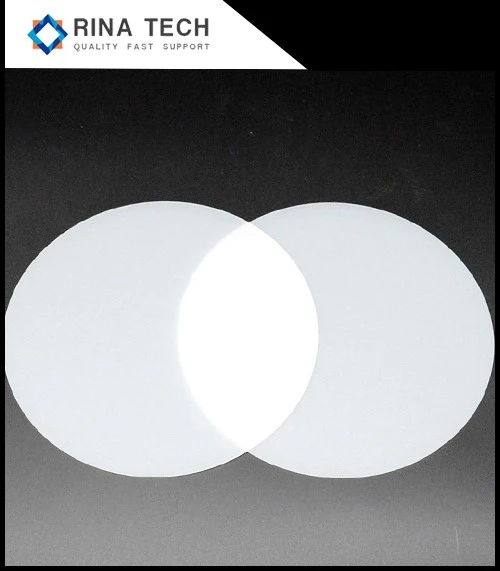
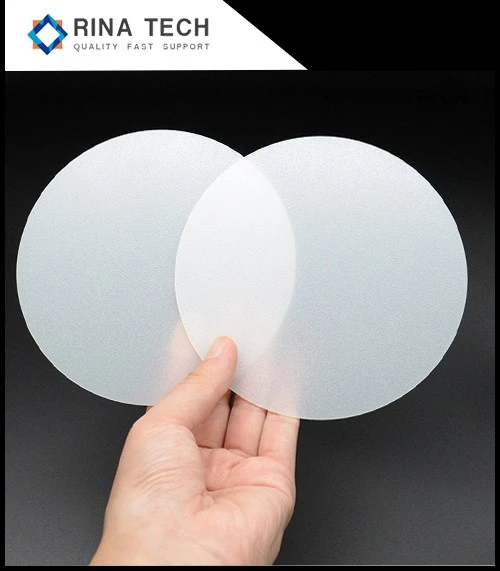
Applying single- or double-sided matte or frosted micro-textures onto a custom diffuser plate breaks up surface specularity. Rather than reflecting glare like a smooth glass sheet, micro-textured surfaces scatter ambient room light away from the viewer. Simultaneously, the textured surface blends internal LED point sources into a smooth, velvet-like plane of soft light.
How do micro-prismatic arrays control glare and UGR ratings?
In commercial office, healthcare, and educational environments, controlling unified glare ratings (UGR) is a strict architectural requirement. Custom micro-prismatic diffuser plates feature microscopic geometric pyramids or linear structures embossed onto the surface. These micro-prisms redirect high-angle glare downward toward work surfaces, maximizing useful light output while shielding eyes from harsh lateral glare.
Can custom micro-lenses shape light into asymmetrical beam profiles?
Yes. Precision optical diffusers can do far more than create circular light patterns. By customizing the physical geometry of surface micro-lenses, engineers can mold batwing, elliptical, or asymmetrical beam profiles. An elliptical diffuser plate can spread light widely along a horizontal axis while keeping it tightly focused vertically, making it ideal for wall-washing fixtures and linear LCD backlights.
How do custom optical coatings prevent static and dust attraction?
Plastic diffuser plates naturally generate electrostatic charges during handling, cutting, and operation, attracting airborne dust and fibers that cast permanent shadows inside sealed fixtures. Custom diffusers can be treated with anti-static surface coatings or conductive additives that dissipate static charges, keeping optical surfaces dust-free during assembly and long-term use.
What Design Strategies Optimize Custom Diffusers for Real-World Applications?
How do you calculate the optimal distance-to-pitch (D/P) ratio?
The distance-to-pitch ratio defines the mechanical relationship between the depth from the LED board to the diffuser plate, and the center-to-center spacing between individual LED chips. To achieve completely uniform surface illumination without hot spots, optical designers target a minimum D/P ratio-typically between 1.0 and 1.5. Custom diffusion levels can be tailored to allow lower D/P ratios in shallow fixtures.
01
Why is precision CNC and laser fabrication crucial for tight enclosures?
Custom diffuser plates must fit into complex aluminum extrusions and display frames with minimal mechanical clearance. Precision CNC routing and automated laser cutting process custom plates into intricate geometries with tight dimensional tolerances within 0.05 mm. Laser cutting produces smooth, flame-polished edges on acrylic plates, while CNC milling creates clean mounting steps and notches on polycarbonate.
02
How does cleanroom processing protect high-brightness displays?
In medical LCD displays, automotive gauge clusters, and high-spec lighting, a single microscopic dust particle trapped on a diffuser plate creates a visible dark spot under high-brightness illumination. High-specification custom diffusers are extruded, cut, and packaged inside certified cleanroom environments equipped with anti-static air ionizers to ensure pristine optical surfaces upon delivery.
03
How does selecting a high-efficiency custom diffuser lower total system cost?
Although a custom-engineered optical diffuser carries a slightly higher unit material cost than commodity plastic sheets, it lowers overall system expenses. Superior light transmission means fixtures require fewer total LEDs and smaller power drivers to hit target lumen outputs. Lower electrical wattage reduces heat generation, shrinks aluminum heat-sink requirements, and extends long-term system reliability.
04