


Looking For A Custom Diffuser Plate For LED Lighting Or LCD Backlighting?
Oct 16, 2026
What Core Optical Failures Occur When Using Generic Diffuser Plates?
Why do standard diffuser plates create visible LED hot spots?
Generic diffuser plates lack the tailored light-scattering additives needed to balance forward light transmission with wide angular diffusion. When placed over high-power point-source LEDs or narrow-pitch backlight arrays, low-grade plates fail to blend adjacent light cones. This optical mismatch causes harsh bright spots-known as pinholing or hot-spotting-to show through the front face, ruining the aesthetic uniformity of luminaires and LCD displays.
How does excessive optical haze reduce total lumen output?
To hide bright LED chips, off-the-shelf diffusers often rely on heavy, unengineered whitening pigments like titanium dioxide. While these pigments mask the diodes, they absorb and bounce excessive light internally, choking total light transmission down to 50% or less. The resulting light fixture or display backlight loses brightness, forcing systems to run at higher drive currents, generating extra heat and draining energy.
Why do off-the-shelf diffuser plates cause color shifting?
Lower-grade optical polymers absorb light unevenly across the visible spectrum. As white LED light passes through uncalibrated diffuser sheets, blue wavelengths scatter differently than red or green wavelengths. This Rayleigh scattering effect introduces unwanted yellowing or bluish color casts across the illuminated surface, altering color temperatures and degrading rendering accuracy in color-critical retail and LCD applications.
What causes thermal warping and bowing in generic optical covers?
Standard light covers installed in shallow LED fixtures or tight display modules operate close to hot circuit boards. Low-grade plastic sheets with poor thermal resistance and high moisture absorption expand unevenly when exposed to operational heat. This thermal stress causes the plate to bow or sag, altering the critical distance between the LEDs and the diffuser, which creates severe shadow lines along the edges.
What Key Polymer Materials Define Custom Optical Diffuser Performance?
When is acrylic (PMMA) the ideal choice for custom diffuser plates?
Polymethyl methacrylate (PMMA) acrylic is the gold standard for high-clarity, non-yellowing optical diffusers. PMMA offers an intrinsic light transmission rate up to 92% to 94% alongside exceptional weatherability and UV resistance. It is perfect for high-efficiency architectural LED luminaires, commercial light boxes, and premium LCD display backlights that require long-term optical clarity.
01
Why choose polycarbonate (PC) for impact and fire-rated environments?
Polycarbonate (PC) provides superior impact strength and thermal tolerance compared to acrylic. Capable of withstanding operating temperatures above 120°C and meeting strict flammability standards (such as UL94 V-0 or V-2), custom PC diffusers are essential for public transit displays, vandal-resistant architectural lighting, cleanroom fixtures, and industrial machinery backlights.
02
How does polystyrene (PS) serve cost-sensitive indoor lighting projects?
Polystyrene (PS) offers an economical, lightweight optical substrate with good dimensional stability and easy thermoforming characteristics. While less resistant to long-term UV radiation and high temperatures than PMMA or PC, custom PS diffuser plates are widely used in indoor office troffers, budget consumer LED panel lights, and temporary promotional displays.
03
What role do microscopic organic light-scattering beads play?
Advanced custom diffusers incorporate micro-spherical silicone or cross-linked acrylic light-scattering beads co-extruded directly into the polymer matrix. These microscopic beads feature a refractive index closely matched to the base resin, bending light rays at wide angles via refraction rather than reflection. This technique yields high light diffusion (haze >98%) while preserving light transmission rates above 85% to 88%.
04
What Advanced Micro-Structures and Surface Finishes Enhance Light Distribution?
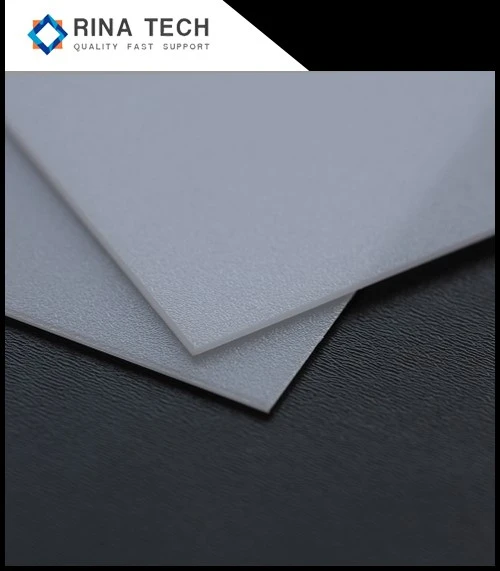
How do matte and frosted surface textures eliminate glare?
Applying double-sided or single-sided matte or frosted textures onto the diffuser plate breaks up specularity. Rather than reflecting ambient room lighting like a shiny glass sheet, textured surfaces scatter incoming external light rays, preventing annoying reflections while blending internal LED point sources into a smooth, velvet-like plane of light.
How do micro-prismatic structures control glare and lower UGR values?
In professional office and educational lighting, controlling unified glare ratings (UGR <19) is a key design requirement. Custom micro-prismatic diffuser plates feature arrays of microscopic pyramids, hexagons, or linear structures embossed into the plate surface. These micro-prisms refract high-angle glare downward toward the working surface, maximizing useful light output while shielding workers' eyes from harsh lateral glare.
Can custom micro-structures alter light beam angles?
Yes. Precision-engineered optical diffusers are not limited to circular light distribution. By customizing the geometry of internal micro-lenses, engineers can mold batwing, elliptical, or asymmetrical beam profiles. An elliptical diffuser, for example, can spread LED light widely along a horizontal axis while keeping it narrow vertically, making it ideal for wall-washing fixtures and linear LCD backlights.
What Key Design Steps Ensure Successful Custom Diffuser Integration?
What fabrication methods are available for complex custom shapes?
Custom optical diffuser plates can be processed into complex geometric shapes using precision CNC routing, automated laser cutting, thermoforming, or custom injection molding. Laser cutting produces smooth, flame-polished edges on PMMA acrylic, while CNC milling creates clean, tight-tolerance mounting steps, holes, and perimeter notches on PC and PS plates.
Why is cleanroom manufacturing critical for display backlights?
In medical LCD backlights, avionics displays, and consumer electronics, even a single microscopic dust particle trapped on or inside a diffuser plate creates a permanent dark spot under high-brightness illumination. High-spec custom diffusers are produced, cut, and packed inside certified Class 100 or Class 1000 cleanrooms equipped with anti-static air ionizers to guarantee spotless optical surfaces.
How does selecting the right custom diffuser lower system cost?
Although a tailored, high-efficiency optical diffuser sheet carries a slightly higher per-panel cost than commodity plastic sheets, it reduces overall system bill-of-materials. Higher optical transmission means light fixtures and display backlights require fewer total LEDs and smaller power supplies to hit target brightness levels. Lower wattage lowers thermal generation, simplifies heat sinks, and extends long-term system reliability.


