


Why Is The Right Diffusion Film For Laptop Backlights Important For Slim Display Designs?
Oct 23, 2026
How Do Sub-Millimeter Backlight Profiles Amplify Optical Design Vulnerabilities?
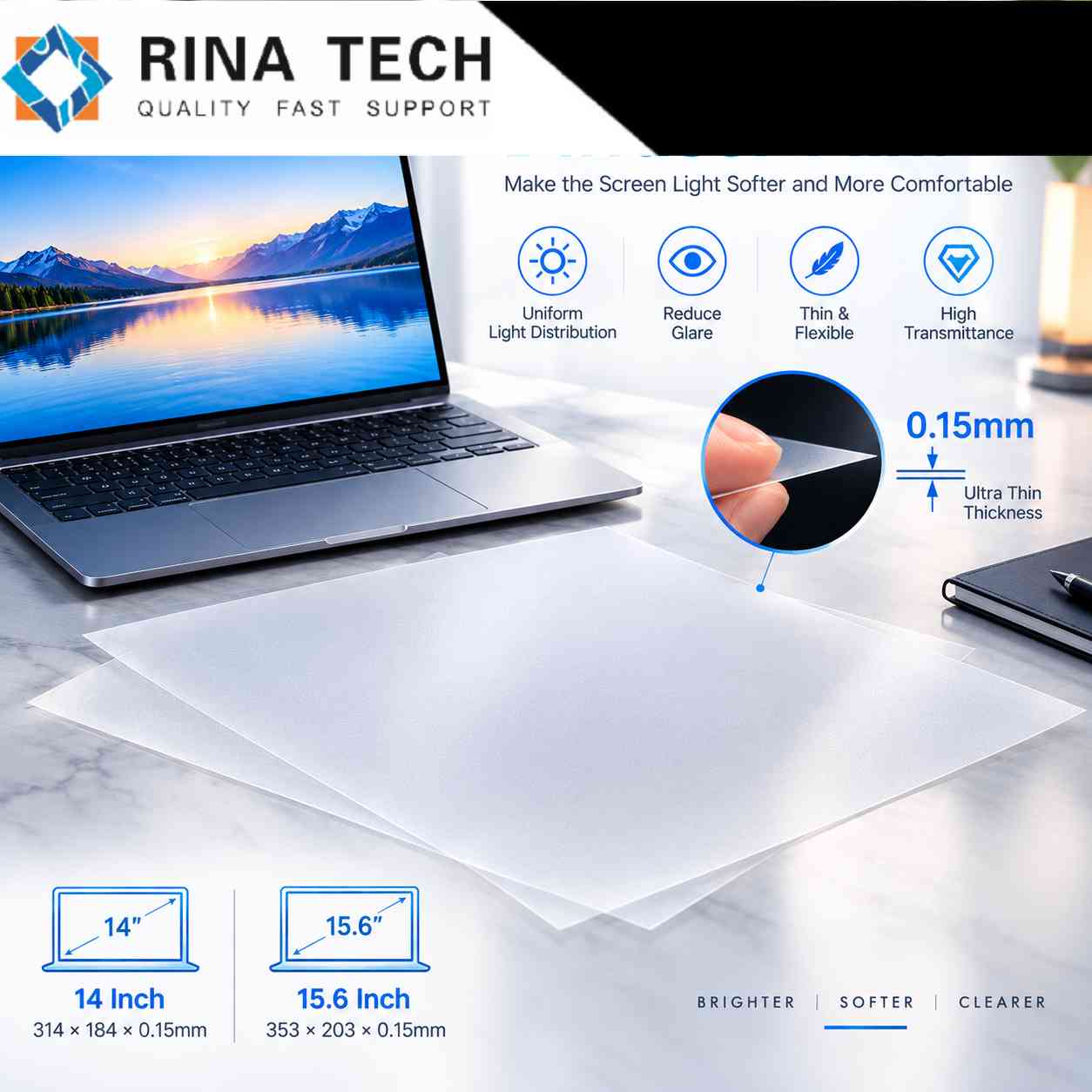
Why does shrinking the optical mixing distance create severe hot-spotting?
In conventional thick display assemblies, light rays exiting the perimeter light guide plate (LGP) or LED array have several millimeters of physical clearance-known as the optical mixing distance-to diverge, overlap, and homogenize before striking the display faceplate. In ultra-slim laptop lids, this mixing cavity is compressed to sub-millimeter scales. Without sufficient spatial depth, raw point-source LED light rays penetrate directly through the optical stack, creating concentrated brightness spikes along the bottom screen border.
How do modern edge-lit LGP micro-dots become visible to users?
Edge-lit laptop backlights rely on acrylic plates etched with millions of microscopic laser dots or V-groove structures to extract propagating light toward the viewer. When the optical stack is thinned down, the diffusion layer sits immediately adjacent to these extraction features. If the diffusion film lacks adequate hiding power, these microscopic laser patterns project onto the liquid crystal panel, displaying grainy textures and optical noise that ruin visual clarity.
Why does mechanical proximity increase the risk of Newton's rings?
Compressing optical film stacks into tight laptop enclosures forces adjacent plastic sheets into direct physical contact. When smooth optical PET sheets touch under structural pressure, optical "wet-out" occurs, creating distracting, rainbow-colored interference patterns known as Newton's rings. An unoptimized diffusion film lacking specialized anti-blocking surface micro-textures exacerbates this contact, causing visible visual artifacts across the screen.
What Key Technological Features Define Advanced Diffusion Films for Ultra-Thin Displays?
How do refractive-index-matched scattering beads optimize light control?
Advanced diffusion films utilize transparent PET base substrates coated with proprietary resins containing micro-spherical acrylic or silicone scattering beads. Optical engineers precisely match the refractive index difference between these embedded spheres and the surrounding polymer matrix. This design refracts light rays forward at controlled angles, achieving high optical haze without reflecting photons backward into the backlight assembly.
How do micro-lens surface arrays replace bulky internal pigments?
Rather than using heavy internal whitening pigments that trap light, next-generation slim diffusion films incorporate surface-relief micro-lens arrays (MLAs) or micro-prism textures embossed directly onto the film surface. These microscopic refractive structures bend passing light rays outward at precise angles. Surface micro-optics deliver uniform surface diffusion across thin profiles while keeping total light transmittance above 88% to 92%.
What is the functional division between lower and upper diffusion layers?
A high-performance laptop backlight module uses two complementary diffusion films working in tandem. Placed directly above the light guide plate, the lower diffusion film features dense scattering beads and higher haze to hide LGP extraction dots and convert point-source light into a uniform surface source. Positioned above the brightness enhancement prism sheets, the upper diffusion film features higher light transmittance and a lighter haze coat to protect delicate prism structures, suppress moiré interference patterns, and broaden viewing angles smoothly.
How Does Selecting the Optimal Diffusion Film Upgrade Laptop Performance?
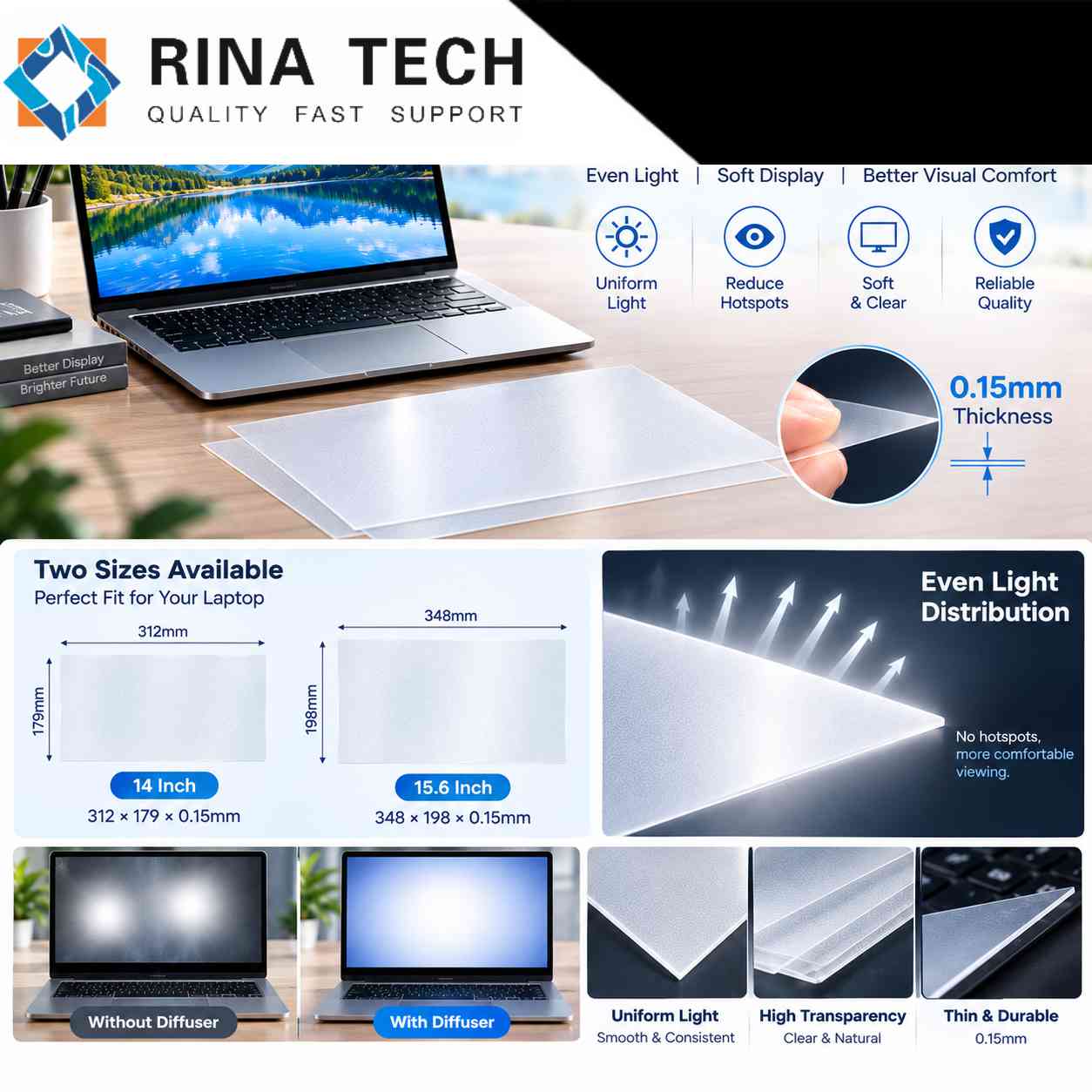
How does superior backlight uniformity sharpen text and media rendering?
A flat, uniform backlight foundation prevents localized luminance spikes from blooming through dark pixels on the LCD panel. By eliminating gradient shadows and edge glare, precision diffusion films enhance pixel-level contrast, render sharp typography, and preserve accurate color saturation across the entire screen faceplate-a necessity for color-critical creative applications.
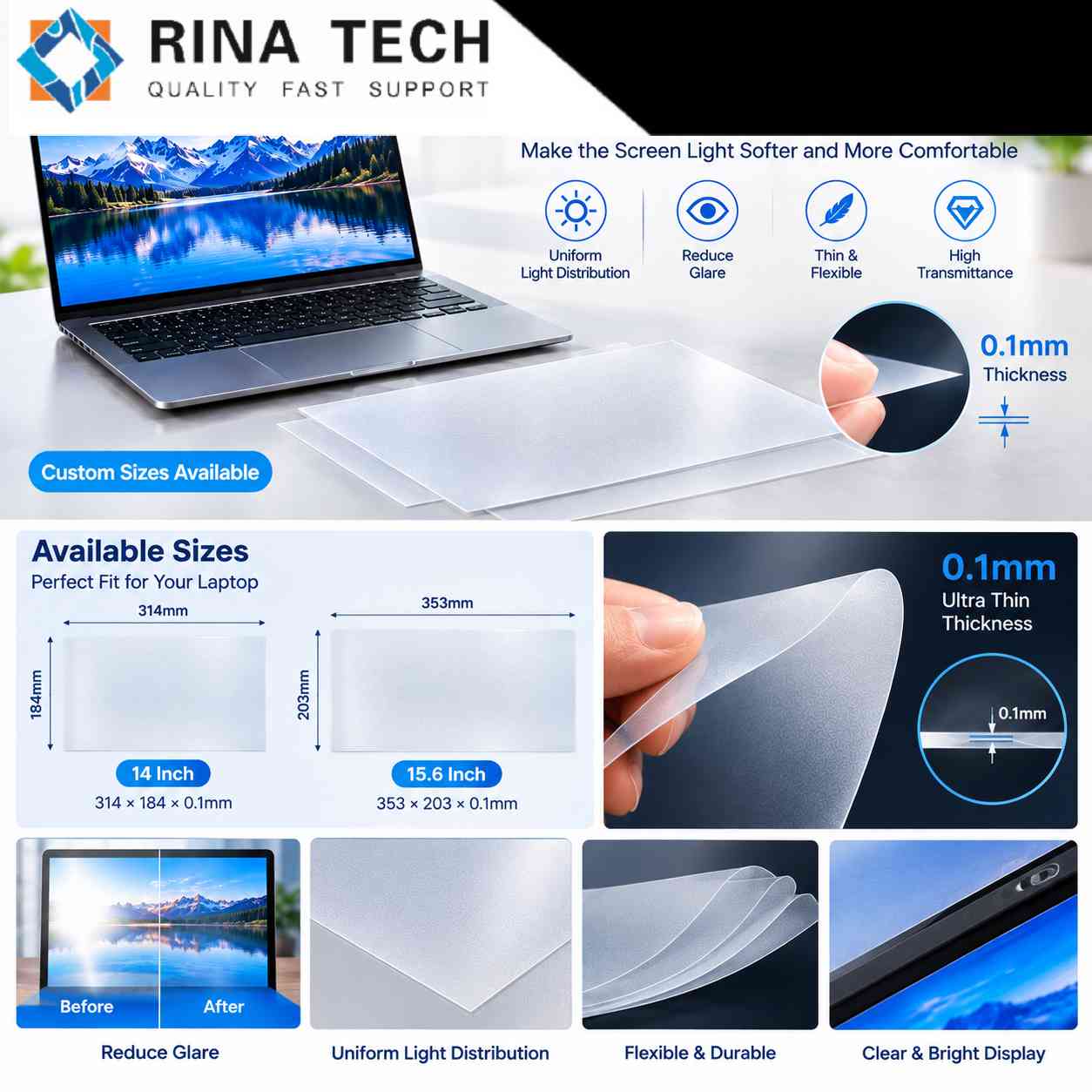
Can an optically efficient diffusion film extend laptop battery life?
Yes. By maximizing forward light transmission while maintaining high haze, engineered diffusion films increase total photon throughput. Display assemblies achieve target screen brightness levels (e.g., 400 to 500 nits) using lower LED drive currents. Lowering backlight energy consumption directly reduces system power draw, helping extend portable battery runtimes for mobile users.
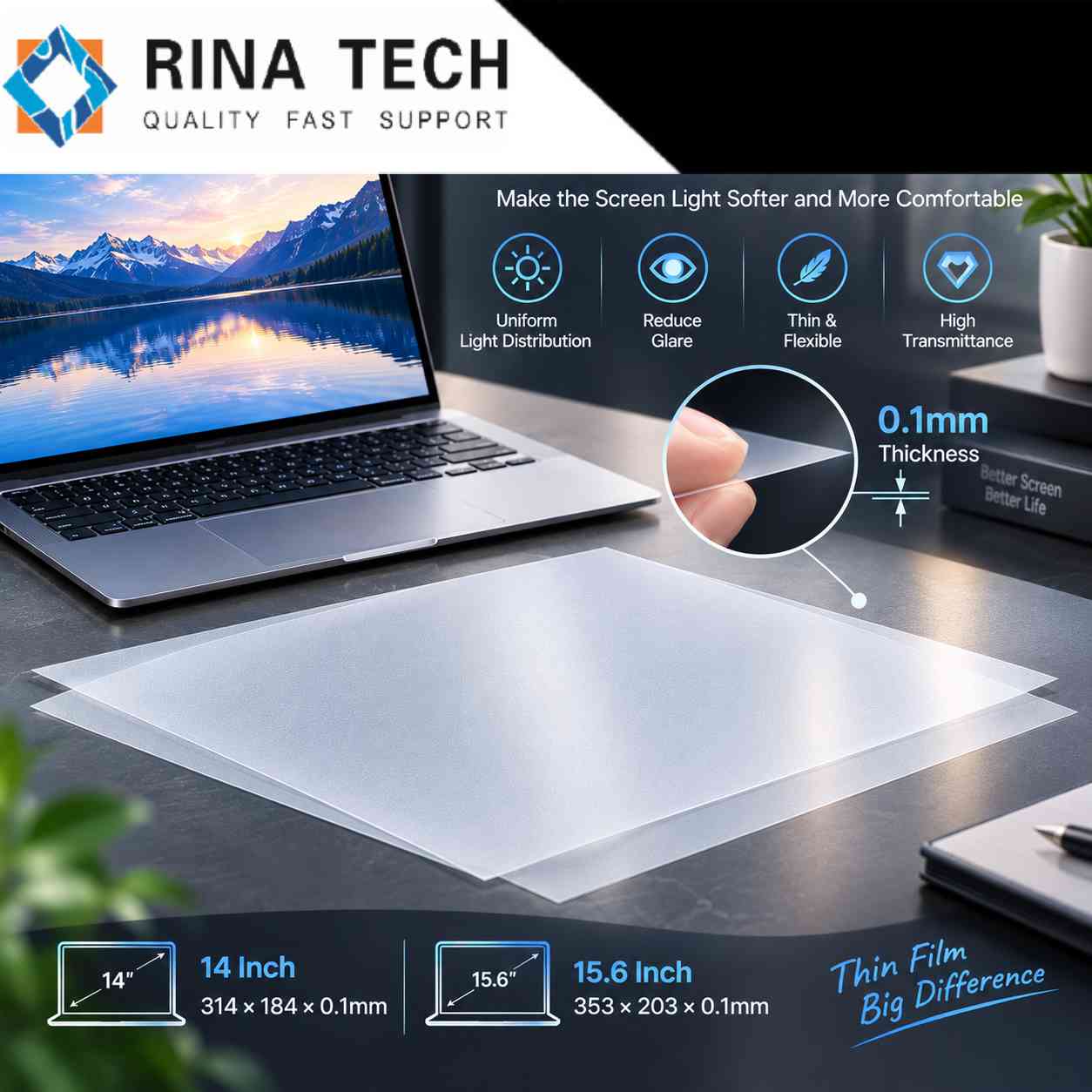
How do advanced diffusion layers eliminate visual moiré artifacts?
In modern high-resolution laptop displays (2.5K, 4K, and beyond), the periodic pixel grid of the LCD panel can interact with the linear prism patterns of Brightness Enhancement Films (BEF). This spatial overlap creates wavy visual artifacts known as moiré patterns. An upper diffusion film acts as an optical filter, scattering light exiting the prism sheet just enough to break up geometric alignment with the LCD matrix, eliminating moiré while keeping details sharp.
How do heat-stabilized substrates protect display flatnesses?
Laptops generate internal operational heat from high-performance CPUs and GPUs directly beneath the display hinge. Low-grade optical films warp, curl, or develop surface wrinkles when exposed to operational temperatures above 60°C. Premium laptop diffusion films utilize biaxially oriented PET base films with low thermal shrinkage coefficients and cross-linked hard-coat resins, ensuring the optical stack remains flat under severe thermal stress.
What Quality and Manufacturing Audits Must Engineers Perform for Mass Production?
What optical haze and light transmission metrics should be specified?
Sourcing diffusion films for high-volume laptop manufacturing requires auditing optical parameters under standardized test methods (such as ASTM D1003). For lower diffusion sheets, a haze specification between 85% and 95% paired with a total light transmittance (TLT) above 80% is recommended for hiding LGP dots. For upper diffusion sheets, haze values between 45% and 70% with a TLT exceeding 90% maximize screen brightness while smoothing prism output.
Why is sub-micron thickness tolerance critical for ultrabook assemblies?
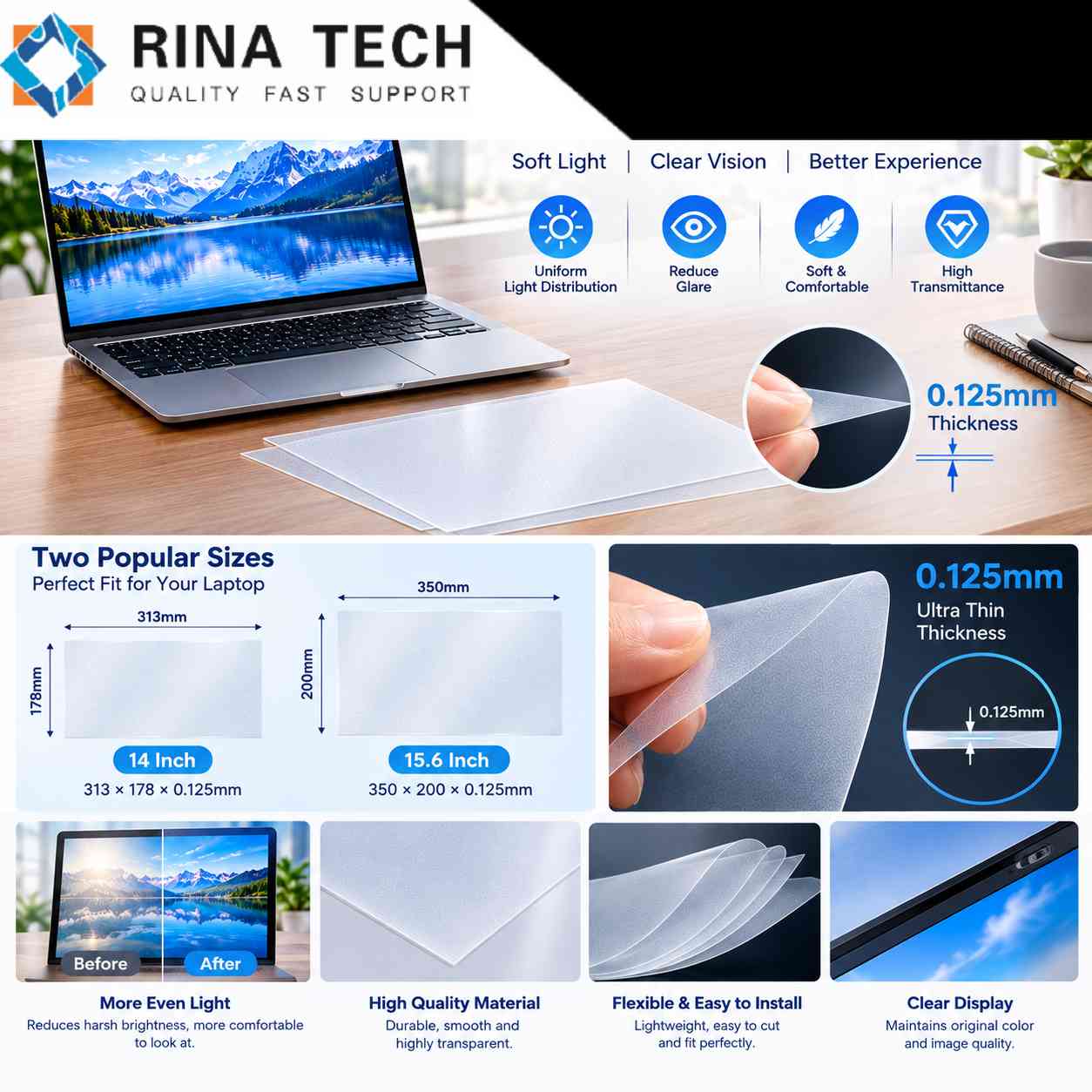
Modern ultrabook display lids offer minimal clearance for optical components. Laptop diffusion films typically range in thickness from 35 microns to 125 microns. Variations in sheet thickness cause uneven pressure distribution inside the display bezel, leading to localized display pinching, light leakage, or structural buckling. Sourcing films with strict dimensional thickness tolerances (within ±3 to ±5 microns) ensures consistent automated lamination and seamless chassis integration.
How does Automated Optical Inspection (AOI) screen out micro-defects?
Microscopic air bubbles, surface scratches, or uneven bead distribution on a diffusion film create permanent visual dark spots or bright specks once laminated inside an LCD module. To guarantee high yield rates in mass manufacturing, diffusion film rolls undergo 100% inline Automated Optical Inspection (AOI) inside Class 100 or Class 1000 cleanroom production facilities. High-resolution machine vision cameras scan the film in real time, filtering out micro-defects down to the micron level before sheets are cut for module assembly.


