

Is There A Better Way To Balance Haze And Brightness With LCD Diffusion Film For Laptops?
Oct 23, 2026
Why Is the Trade-Off Between Haze and Brightness Such a Persistent Engineering Challenge?
What is the fundamental physical conflict between optical haze and light transmission?
Optical haze measures the percentage of transmitted light that deviates by more than 2.5 degrees from the direct incident beam as it passes through a material. To eliminate harsh point-source LED "hot spots" and hide the micro-dot extraction patterns of a light guide plate (LGP), traditional diffusion films rely on high particle concentrations. However, increasing wide-angle scattering naturally causes backscattering, where photons bounce backward into the backlight unit.
How do legacy high-haze films drain laptop battery reserves?
When a notebook backlight module relies on traditional, heavily pigmented diffusion sheets to achieve high visual uniformity, total optical transmittance can drop significantly. To compensate for these transmission losses and reach target screen brightness levels (such as 400 to 500 nits), display designers must run the perimeter LED lightbar at higher current draw. This increased electrical load generates excess heat within the thin laptop lid and drains battery reserves, reducing overall device runtime.
Why do low-haze films create severe visual defects on modern screens?
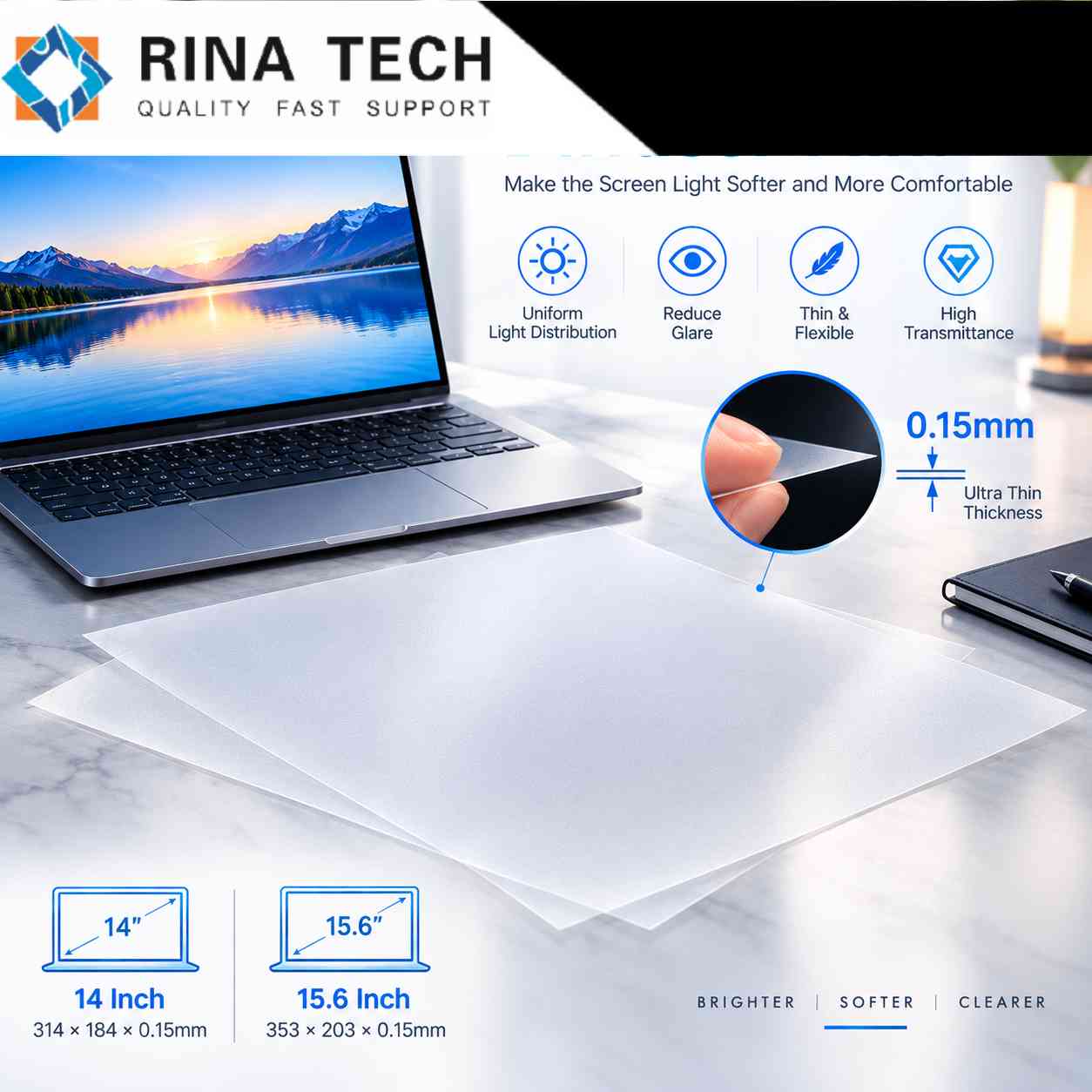
Conversely, selecting a low-haze, high-transmittance diffusion film to maximize battery efficiency exposes severe display flaws. Without sufficient light scattering, the raw, concentrated light exiting the LGP penetrates directly to the liquid crystal panel. Users observe visible "hot spots" along the bottom border, bright "flashlighting" in screen corners, and visible texture artifacts from the LGP extraction dots. These visual non-uniformities ruin color accuracy and degrade the viewing experience.
What Advanced Materials and Micro-Optics Solve the Haze-Brightness Paradox?
How do refractive-index-matched micro-spherical beads optimize light throughput?
Next-generation diffusion films replace crude, opaque whitening pigments with precision-engineered organic micro-spheres-typically cross-linked acrylic or silicone beads. Optical engineers tightly control the refractive index difference between these embedded micro-beads and the surrounding polymer resin matrix. By tuning this refractive gap, light rays undergo high-angle forward refraction rather than backward reflection. This micro-refractive strategy achieves high haze (>90%) while keeping total light transmittance above 88% to 92%.
How do surface-relief micro-lens arrays replace bulk internal scattering?
Rather than relying solely on internal particle scattering, advanced optical films incorporate precision micro-lens arrays (MLAs) embossed directly onto the PET substrate surface. These microscopic geometric structures act as refractive optical elements, redirecting propagating light rays at calculated forward angles. Surface micro-optics achieve homogeneous spatial light distribution without trapping photons inside the film, breaking the traditional link between high diffusion and heavy transmission loss.
What role do dual-mode co-extruded composite films play?
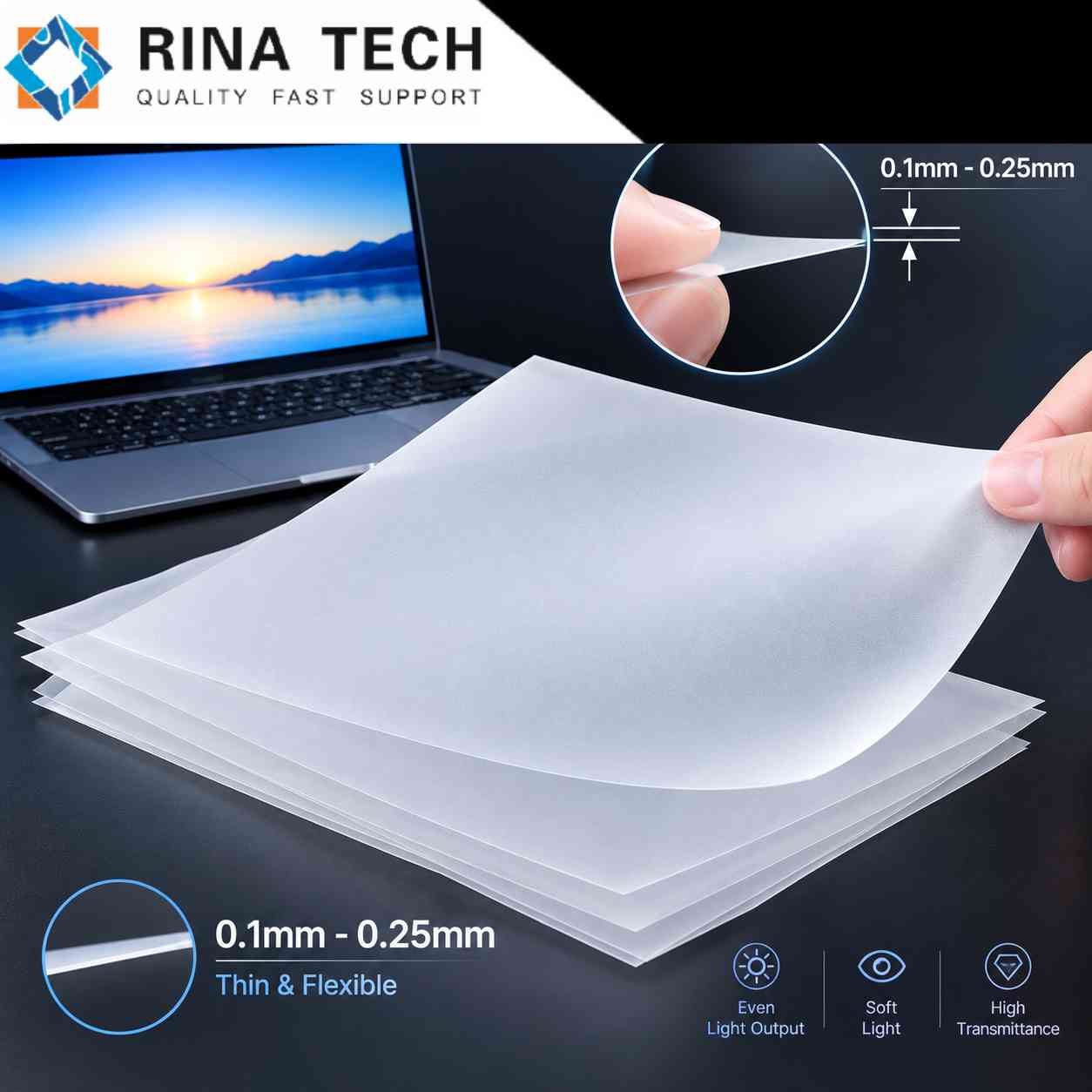
Leading optical film manufacturers employ multi-layer co-extrusion technology to build composite diffusion sheets. These multi-layer stacks combine a high-transmittance structural core layer with ultra-thin, highly functional outer scattering skins. Isolating the light-scattering micro-particles within specialized top and bottom micro-layers allows photons to pass through the clear central substrate with minimal attenuation, maximizing light throughput while delivering uniform surface diffusion.
How Does Optimizing the Diffusion Film Stack Enhance Laptop Display Performance?
How does balancing haze and transmittance improve display contrast and sharpness?
When an optical diffusion film achieves high forward light scattering with minimal backscatter, it provides a stable, uniform backlight foundation. Eliminating localized brightness spikes prevents light from blooming through dark pixels on the LCD panel. This controlled light distribution preserves deep black levels, elevates static contrast ratios, and sharpens fine typography and graphical details across the screen.
Can optimized diffusion films contribute to longer laptop battery life?
Yes. By increasing forward optical transmission while maintaining high haze, engineered diffusion films deliver higher screen brightness per watt of LED input power. Display modules can hit target nit levels using lower LED drive currents. This increase in optical efficiency directly reduces power consumption across the backlight unit, helping extend battery runtimes in portable notebooks.
How do upper and lower diffusion films work together in a display stack?
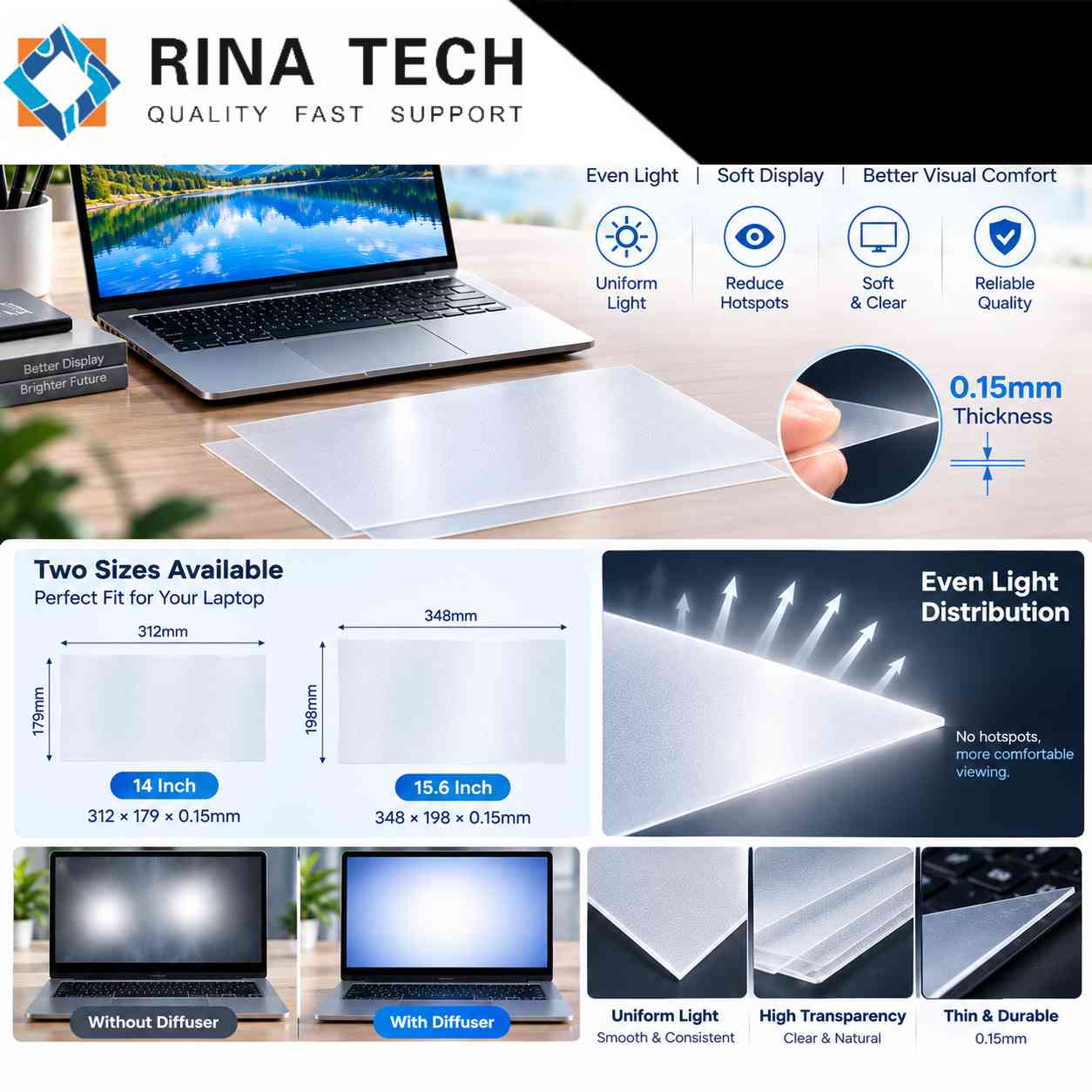
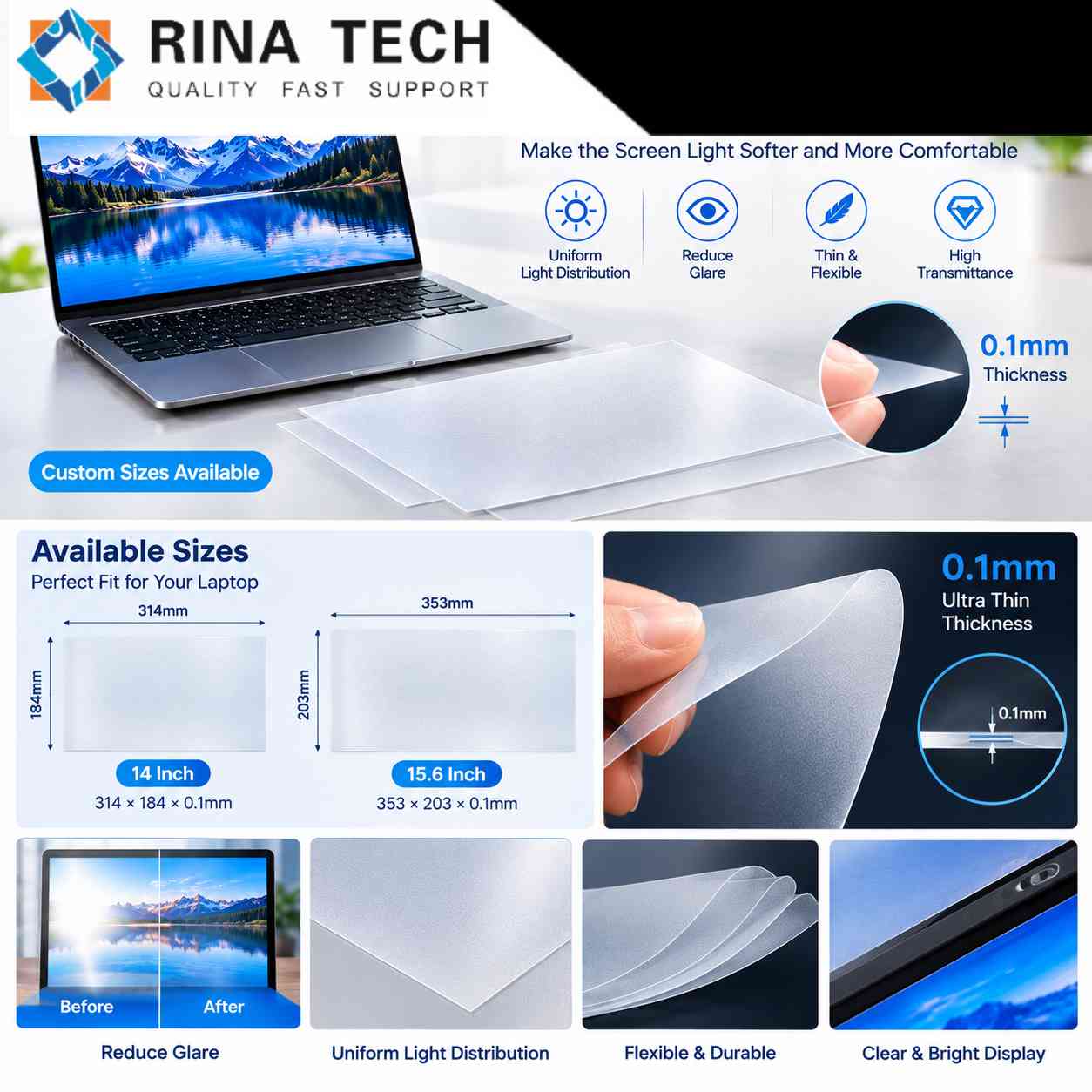
Modern notebook LCD backlights utilize two distinct diffusion layers that work in tandem. Positioned directly above the light guide plate, the lower diffusion film features higher haze and dense bead distribution to hide LGP extraction dots and convert directional light into a uniform surface source. Placed above the brightness enhancement prism sheets, the upper diffusion film features higher transmittance and lighter haze. Its role is to widen viewing angles smoothly, protect delicate prism structures, and suppress moiré patterns.
How do heat-stabilized diffusion substrates prevent long-term display warping?
High-performance laptops generate substantial internal operational heat. Low-grade optical films can warp, curl, or develop surface wrinkles under thermal stress, creating flashlighting defects and corner shadows. Premium diffusion films utilize biaxially oriented PET base films with low thermal shrinkage coefficients and cross-linked resins. These heat-stabilized materials resist thermal expansion, ensuring the screen maintains flat, uniform backlight performance throughout years of daily use.
What Key Testing Standards and Factory Audits Ensure High-Yield Mass Production?
How are haze and luminous transmittance measured under international standards?
To verify the optical performance of diffusion films, manufacturers rely on standardized optical testing equipment. Standards such as ASTM D1003 and ISO 14782 define exact protocols for measuring total luminous transmittance ($T_t$) and haze ($H$) using integrating sphere haze meters. Auditing production rolls under these standardized test methods ensures that every batch meets strict optical specifications.
01
Why is dimensional thickness tolerance critical for automated module assembly?
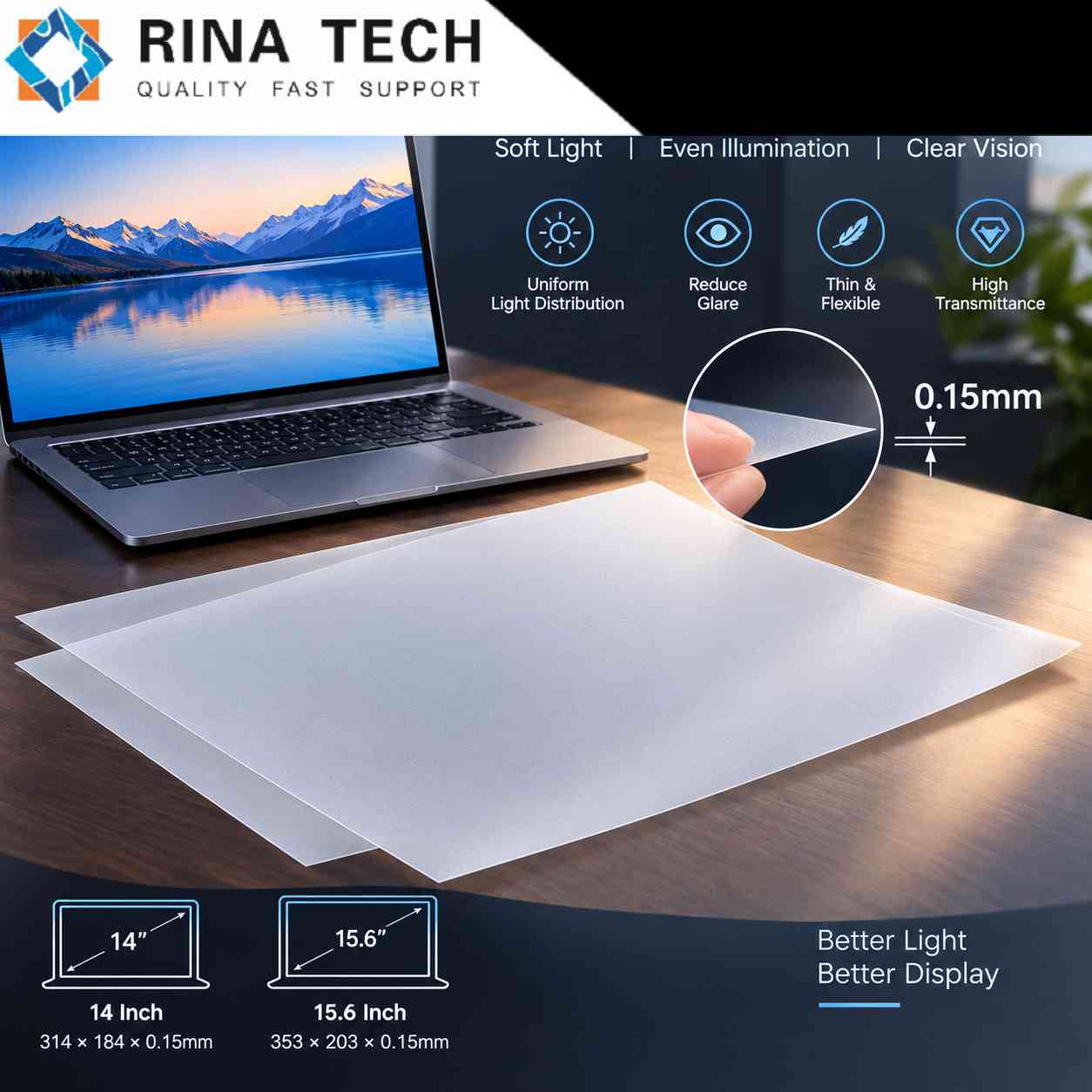
In ultra-thin laptop displays, optical films are manufactured to tight sub-millimeter thickness tolerances (typically 35 to 125 microns). In high-volume manufacturing, variations in sheet thickness can cause uneven pressure distribution inside the display bezel, leading to localized display pinching or structural buckling. Sourcing films with strict thickness tolerances ensures consistent automated robotic lamination and seamless chassis integration.
02
How does Automated Optical Inspection (AOI) eliminate microscopic field defects?
Microscopic air bubbles, surface scratches, or uneven bead distribution on a diffusion film can create permanent visual dark spots or bright specks once laminated inside an LCD module. To guarantee zero-defect yield rates in mass manufacturing, diffusion film rolls undergo 100% inline Automated Optical Inspection (AOI) within certified cleanroom facilities. High-resolution machine vision cameras scan the film in real time, filtering out micro-defects down to the micron level before sheets are cut for assembly.
03
What environmental chamber qualifications confirm long-term reliability?
Before approving a new diffusion film for commercial laptop production lines, sample batches undergo severe environmental stress qualifications. Standard benchmarks require samples to endure high-temperature baking , damp-heat humidity testing , and rapid thermal shock cycling ranging from -40℃ to +85℃. Passing these tests confirms the optical scattering coatings won't yellow, delaminate, or warp in real-world mobile environments.
04