

How Can Laptop Diffusion Film Improve Backlight Uniformity in Notebook Displays?
Oct 23, 2026
Why Do Modern Notebook Backlight Units Suffer From Visual Non-Uniformity?
What causes severe hot spots in edge-lit LED notebook displays?
Modern laptop screens prioritize ultra-slim profiles, forcing display designers to utilize edge-lit LED backlight unit (BLU) architectures. In an edge-lit configuration, high-intensity surface-mount light-emitting diodes are arrayed along the lower or side perimeter of the display chassis. Because individual LED chips act as intense point sources of light, injecting raw lumen output into the screen's light guide plate (LGP) naturally creates localized visual bright cones. Without intervening optical diffusion, these concentrated light beams penetrate directly to the liquid crystal panel, resulting in visible brightness spikes along the bottom border of the notebook screen.
How does excessive optical haze reduce total lumen output?
As light enters the edge of an optical light guide plate, photons bounce between the top and bottom surfaces via total internal reflection before escaping toward the display faceplate. Because photon density naturally decays as the distance from the perimeter lightbar increases, the center and top areas of the screen receive significantly fewer direct light rays than the bottom edges. This natural optical attenuation creates dark corners, gradient shadows, and noticeable brightness drop-offs.
Why do micro-defects in light guide plates become visible to end users?
To force propagating light rays out of an optical acrylic light guide plate toward the user's eyes, manufacturers etch millions of microscopic extraction dots or V-groove patterns onto the plate's surface. However, under high-brightness backlight conditions, these micro-structures, laser-etched grids, and minor substrate scratches can become visible to the naked eye as grainy textures or screen door artifacts. The raw light extracted from an LGP lacks spatial blending, meaning every underlying structural imperfection gets projected directly onto the back of the LCD matrix, compromising overall visual clarity and display smoothness.
How does light leakage at extreme viewing angles degrade user experience?
When light exits an unrefined backlight stack, light rays diverge at erratic and uncontrolled angles. Unfiltered directional light causes severe side-angle glare, color shifts, and brightness inversion when the notebook lid is tilted or viewed off-axis. Furthermore, stray lateral light escapes around the thin border bezels of modern laptop lids, creating unwanted perimeter light bleed. This off-axis light scatter drains optical efficiency, wastes battery reserves, and degrades contrast ratios, forcing users to continuously adjust their screen angle to find a usable viewing sweet spot.
What Optical Mechanisms Allow Laptop Diffusion Films to Homogenize Light?
How do microscopic light-scattering beads blend point-source light?
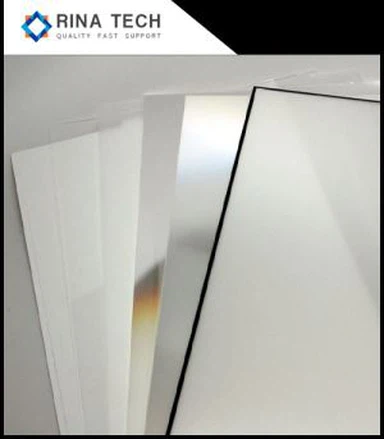
High-performance laptop diffusion films consist of a transparent PET (polyethylene terephthalate) base substrate coated with an engineered resin matrix containing millions of micro-spherical organic or inorganic light-scattering beads. These microscopic beads-typically composed of cross-linked acrylic, silicone, or titanium dioxide compounds-possess a refractive index carefully calibrated against the surrounding polymer binder.
01
What is the functional difference between lower and upper diffusion films?
A standard notebook LCD backlight module incorporates two distinct diffusion layers within its optical stack: a lower diffusion film and an upper diffusion film. Positioned directly above the light guide plate, the lower diffusion film features a higher haze value and higher concentration of scattering beads. Its primary function is to hide the physical micro-dot pattern of the LGP and convert harsh directional light into an evenly distributed surface source.
02
How do diffusion films achieve high haze without sacrificing light transmission?
Achieving flawless backlight uniformity historically meant adding heavy optical pigments that blocked light, severely reducing total screen brightness. Modern laptop diffusion films overcome this compromise through forward-scattering particle engineering. By optimizing the particle size distribution (typically between 2 and 10 microns) and matching the refractive indices of the scattering beads and base resin, the film achieves a haze rating over 90% while maintaining total light transmittance levels above 85% to 92%.
03
How does surface micro-texturing prevent optical wet-out and Newton's rings?
When two smooth plastic optical sheets-such as a diffusion film and a prismatic brightness enhancement film-come into direct physical contact under pressure, optical "wet-out" occurs. This creates unsightly, oil-slick-like interference patterns known as Newton's rings. To prevent this defect, advanced laptop diffusion films integrate micro-structured anti-blocking coatings or matte surface textures on their back surfaces.
04
How Does Upgrading Diffusion Film Quality Impact Real-World Notebook Display Metrics?
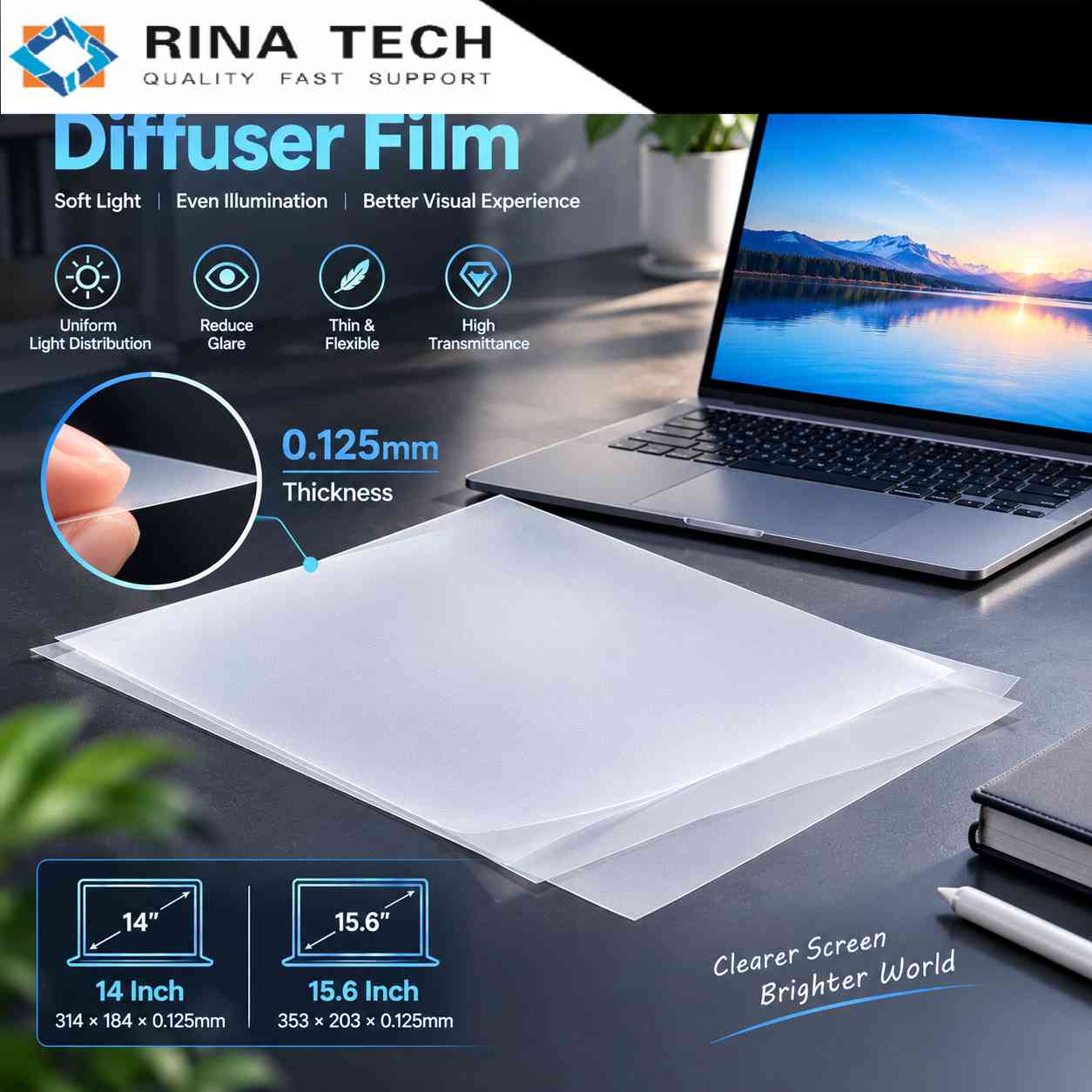
How does enhanced backlight uniformity improve color rendering accuracy?
In a liquid crystal display, RGB color filters rely on a consistent, stable white light backlight to render accurate color space gamuts (such as 100% sRGB or DCI-P3). When backlight intensity fluctuates across different regions of the panel, color saturation and color temperature shift dynamically across the screen faceplate. High-uniformity diffusion films eliminate localized luminance spikes, providing a flat light foundation that ensures color values remain uniform from the center of the display to the outermost screen edges-a critical feature for graphic designers, video editors, and photographers.
Can optimized light diffusion contribute to extended laptop battery life?
Yes. When a notebook display suffers from poor native light distribution, engineers are forced to drive perimeter LED lightbars at higher current levels to ensure dark center zones meet minimum readable brightness standards. High-efficiency diffusion films redistribute available lumens with superior spatial optical efficiency. By eliminating dark patches and maximizing forward photon throughput, display modules can hit target screen luminance (e.g., 400 to 500 nits) using lower LED drive currents, directly reducing system power consumption and extending portable battery runtimes.
How do advanced diffusion layers eliminate visual moiré patterns?
In modern high-resolution laptop displays (2.5K, 4K, and beyond), the periodic pixel grid of the LCD panel can visually interact with the geometric prism lines of Brightness Enhancement Films (BEF). This spatial wave overlap creates distracting, wavy visual artifacts known as moiré patterns. A high-precision upper diffusion film acts as an optical low-pass filter, gently scattering light exiting the prism sheet just enough to break up geometric alignment with the LCD pixel matrix. This eliminates moiré interference while keeping fine text and image details razor-sharp.
What Key Selection Standards Should Engineers Audit for Mass Production Diffusion Films?
What haze and total light transmittance values should be specified?
When sourcing diffusion films for high-volume laptop manufacturing, display engineers must carefully evaluate the optical balance between haze (the percentage of transmitted light that deviates from the direct path by more than 2.5 degrees) and total light transmittance (TLT). For lower diffusion sheets, a haze specification between 85% and 95% paired with a TLT above 80% is ideal for hiding light guide plate dots. For upper diffusion sheets, haze values are typically specified between 45% and 70% with a TLT exceeding 90% to maximize screen luminance while smoothing prism output.
Why is dimensional thickness tolerance critical for ultra-thin laptop lids?
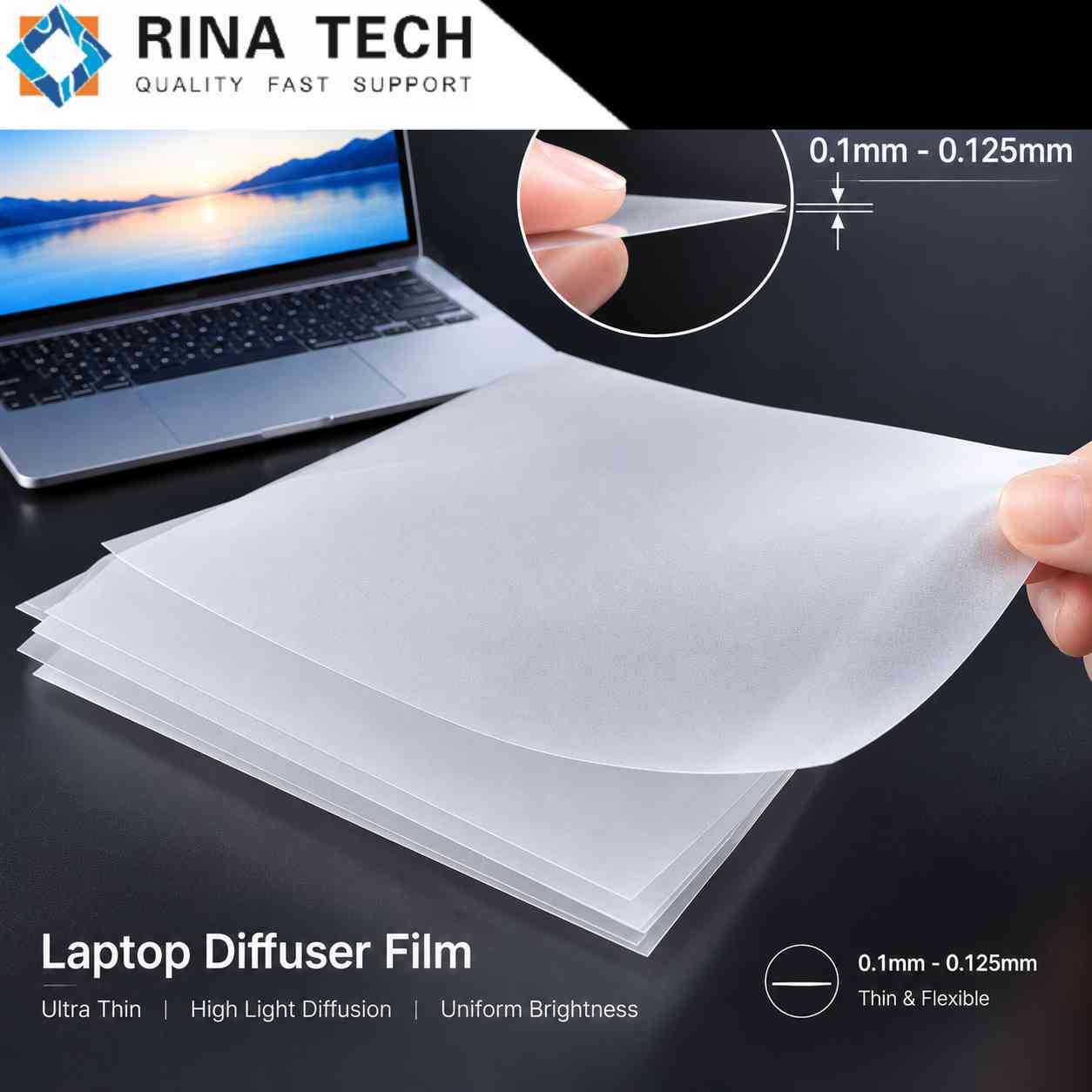
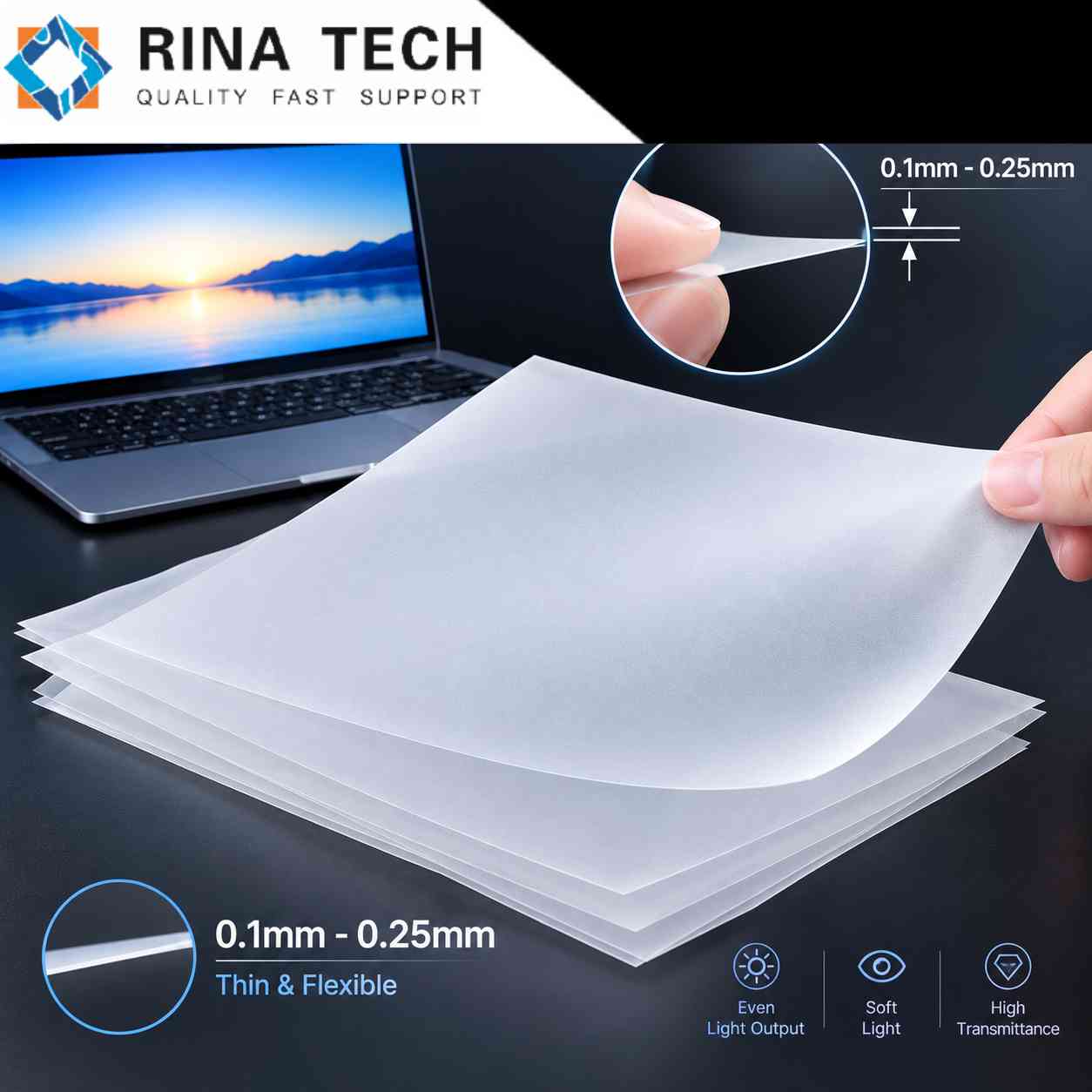
Modern ultrabook display assemblies offer sub-millimeter clearance for the entire optical backlight stack. Standard laptop diffusion films range in thickness from 35 microns to 125 microns. In mass production, variations in sheet thickness can cause uneven pressure distribution inside the display bezel, leading to localized display pinching, light bleed, or structural buckling. Sourcing films with strict dimensional thickness tolerances (within ±3 to ±5 microns) ensures consistent automated lamination and seamless chassis integration.
How does Automated Optical Inspection (AOI) prevent field defect rates?
Microscopic air bubbles, surface scratches, or uneven bead distribution on a diffusion film can create permanent visual dark spots or bright specks once laminated inside an LCD module. To guarantee zero-defect yield rates in mass manufacturing, diffusion film rolls must undergo 100% inline Automated Optical Inspection (AOI) within Class 100 or Class 1000 cleanroom production facilities. High-resolution machine vision cameras scan every square millimeter of film, flagging micro-defects down to the single-micron level before cutting sheets for module assembly.