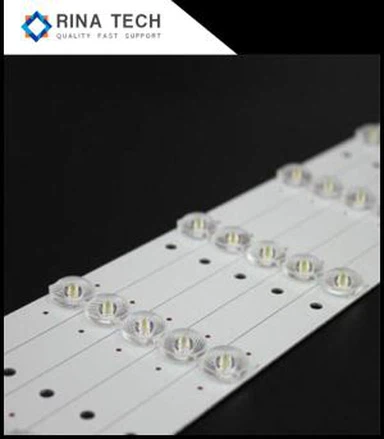


Light Guide Plate Manufacturing Process
Nov 01, 2018
Since the 1990s, science and technology have continued to develop, and the method of making light guide plates has been slowly improved. Different and early print productions have been derived. Relatively speaking, we call it “non-printing”.

Injection Molding
It fills the molten forming material into the closed mold in a high pressure manner, which requires the light guide plate and the microstructure to be completed simultaneously in the injection molding, and the mold must be made quite strong, so the mold price is also quite expensive, so it is necessary Mass production to offset the high cost of the mold. The single-sided microstructure array light guide plate generally adopts an injection molding process, and the bottom texture structure thereof may be a micro lens shape, a micro-spherical shape or a tetrahedral pyramid prism shape.
Lithography
The lithography technique is to apply a layer of corrosion-resistant photoresist on a flat silicon wafer, and then pass the glare through the lithographic plate to selectively expose the lithographic plate according to the graphic information of the specific layer produced; The developed photoresist is then removed, leaving a film with a micro-patterned structure on the upper surface of the wafer. The surface roughness of the light guide plate fabricated by photolithography is poor, and the loss of light energy is relatively large.
Doping
When the light guide plate is injection molded, a transparent particle material with a scattering function is directly injected into the light guide plate, and the concentration of the transparent particles is appropriately adjusted to achieve effective control of the light output, and finally the high uniformity of the light output is achieved. Since the doping process is not easy to accurately control, it is suitable for making small and medium-sized light guide plates by injection molding, and uneven light emission problems may occur for large-sized light guide plates.
Laser engraving
The laser engraving method is to strictly control the energy of the laser head and the position of the laser head according to the program requirements, and to vaporize the microstructure array with a certain size on the back side of the light guide plate. This method can be very precise. Control the depth of the scattering structure, but the efficiency is very low, which is not convenient for mass production.
Sandblasting
The mold with rough distribution surface is made by sand blasting method, and the rough distribution on the mold is transferred to the light guide plate during injection molding. The more the rough surface, the stronger the scattering ability, and the rough distribution of the surface is adjusted by reasonable adjustment. The light reaching the illuminating surface is evenly distributed.
Single point diamond machining
Single-point diamond machining, also known as nanofabrication, can achieve nanometer-scale surface roughness. It fixes the workpiece on a precision lathe and uses a natural single crystal diamond tool for fixed-point turning. Firstly, the light guide plate core is fixed on the rotary shaft for rotation, and then the rapid piezoelectric feed of the diamond fast knife is used to complete the production. The lenticular lens of the light guide plate is processed by the fast knife feed system and then equipped with an ultra-precision single-point diamond device.