


Is Our New Laptop LGP The Right Fit For Your Next Backlight Design?
Sep 24, 2026
What Engineering Challenges Are Driving the Evolution of Modern Laptop Backlight Units?

Why are laptop displays requiring thinner optical stacks?
Modern notebook designs demand ultra-thin chassis profiles to meet consumer preferences for lightweight, highly portable devices. Display engineers are pushed to reduce the total thickness of the backlight unit (BLU) down to sub-millimeter scales. Achieving a thin form factor requires replacing bulky conventional optical plates with precision-engineered Light Guide Plates (LGPs) that maximize light extraction while occupying minimal vertical space.
How does uneven backlight distribution impair display quality?
A common defect in low-grade backlight assemblies is non-uniform light distribution, which manifests as dark spots, edge glare, or "hot spotting" near perimeter LEDs. Poor light extraction forces display panels to show inconsistent brightness across the screen, diminishing color accuracy and visual clarity. Resolving this issue demands an LGP with highly precise micro-optical extraction patterns capable of distributing light evenly across the entire active display area.
Why do conventional light guide plates waste excessive battery power?
Standard light guide plates often suffer from low light extraction efficiency, absorbing or trapping a significant portion of the light emitted by perimeter LEDs. To compensate for this loss and achieve target luminance levels, laptops must run their LED backlights at higher currents. This excess power consumption generates unwanted heat and drains laptop battery reserves, reducing overall device efficiency.
What Key Innovations Make Our New Laptop LGP Stand Out for Next-Generation Displays?
How does our optical-grade PMMA substrate ensure high light transmission?
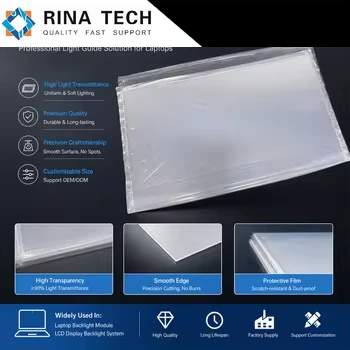
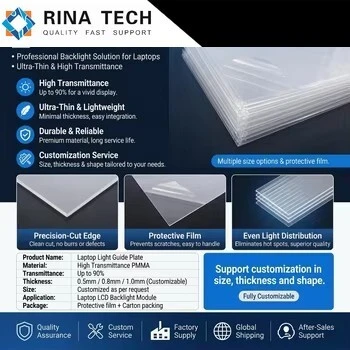
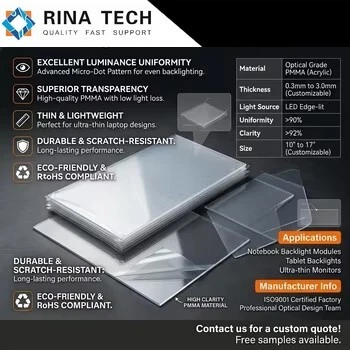
Our new laptop Light Guide Plate is manufactured using 100% virgin, high-purity optical PMMA (polymethyl methacrylate). This advanced polymer boasts an exceptional light transmission rate exceeding 93%, ensuring that light injected from the perimeter LEDs passes through the plate with minimal internal attenuation. The substrate maintains crystal-clear optical clarity and resists thermal yellowing, guaranteeing stable long-term visual performance.
How does precision 3D laser micro-dotting maximize light extraction efficiency?
Rather than relying on traditional screen-printed ink dots that deteriorate over time, our LGP features proprietary 3D laser micro-dotting technology. Precision lasers etch millions of microscopic, variable-density optical extraction dots directly into the PMMA substrate. These micro-structures capture propagating light rays and redirect them perpendicularly toward the display panel, achieving surface illumination uniformity exceeding 90%.
How does our ultra-thin optical profile fit slim ultrabook chassis designs?
Designed specifically for high-density display integration, our new LGP is available in ultra-thin gauges ranging from 0.3 mm to 0.8 mm. Despite its slim profile, the plate maintains high structural stiffness and low thermal warping characteristics. This thin profile enables display designers to shrink the overall thickness of the LCD backlight unit without sacrificing optical output or surface rigidity.
How Does Installing Our Advanced LGP Upgrade Overall Display Performance?
How does high backlight uniformity sharpen fine text and high-res imagery?
Uniform backlight distribution provides a stable background luminance across every pixel on the LCD panel. By eliminating gradient shadows and bright spots, our LGP enhances edge contrast, making fine text sharper and graphic renderings more vibrant. This visual consistency is critical for creative professionals, software developers, and users working with high-density displays.
Can our high-extraction LGP significantly extend laptop battery life?
Yes. By increasing light extraction efficiency and optimizing optical throughput, our LGP delivers high surface luminance at lower LED drive currents. Laptops equipped with our advanced LGP achieve target brightness levels while consuming up to 20% less backlight power. This reduction directly translates to cooler device operation and extended battery runtimes for mobile users.

How does thermal stability protect display color accuracy under heavy workloads?
High-performance laptops generate considerable heat during gaming, video editing, or heavy computational tasks. Our LGP features a thermal-stabilized formulation that resists heat distortion up to 95℃. The plate maintains its dimensions and optical properties under high internal temperatures, preventing shift in light extraction patterns and keeping color rendering consistent across the entire panel.
How does our LGP design reduce display backlight bleed?
Backlight bleed typically occurs when light leaks around the perimeter edges of a display panel due to improper light channeling within the LGP. Our LGP incorporates micro-grooved perimeter light dams and optimized extraction boundaries that channel light inward toward the display area. This containment eliminates edge glow, yielding deeper blacks and cleaner panel borders.
How Does Our LGP Integration Simplify Manufacturing and Lower Total System Costs?
How does automated precision cutting improve assembly yield rates?
Our light guide plates are cut using automated high-speed laser and CNC routing equipment with strict dimensional tolerances within 0.05mm. This precision ensures fit into display frames and optical housing brackets during high-volume assembly lines. Consistent sizing minimizes alignment errors, reduces scrap rates, and accelerates factory throughput during laptop manufacturing.
Can our LGP be customized to match non-standard aspect ratios?
Yes. As laptop screen form factors diversify into 16:10, 3:2, and dual-screen configurations, display backlight units require custom optical profiling. We offer fully customizable micro-dot mapping tailored specifically to unique aspect ratios, curved displays, or non-rectangular panel shapes, ensuring uniform light coverage regardless of screen geometry.
How does superior light extraction lower the overall bill of materials?
Because our LGP extracts light efficiently across the active area, display designers can achieve target nit brightness using fewer LED diodes along the perimeter lightbar. Reducing the required LED count lowers power consumption, simplifies thermal heat-sink requirements, and reduces overall component costs across the entire display backlight assembly.


