


Need A Thinner Light Guide Plate For Laptop Backlights Without Sacrificing Brightness?
Sep 24, 2026
What Core Mechanical Bottlenecks Limit Slimming Down Laptop Backlight Units?
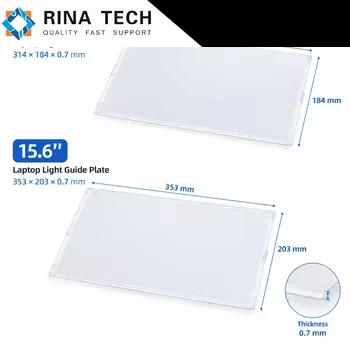
Why do standard light guide plates become fragile when thinned down?
Conventional Light Guide Plates (LGPs) rely on rigid acrylic or glass substrates designed to maintain mechanical stability across a wide surface area. When manufacturers attempt to reduce plate thickness from standard 1.0mm dimensions down to sub-millimeter scales (0.3 mm to 0.5 mm), the structural flexural modulus drops exponentially. Thinner optical plates lose torsional rigidity, making them prone to sagging, warping, or cracking under normal chassis flexing and routine laptop lid opening.
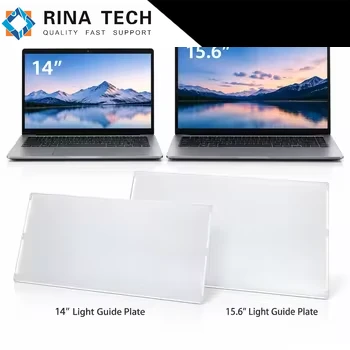
How does reducing LGP thickness restrict LED light injection?
Light coupling efficiency depends heavily on matching the edge height of the optical plate with the light-emitting surface of perimeter LEDs. Standard side-emitting LEDs measure between 0.6 mm and 0.8 mm in height. When an LGP is thinned below the LED emitter profile, a significant fraction of injected light spills over or reflects off the coupling boundary. This optical mismatch causes severe injection loss before light even enters the propagation matrix.
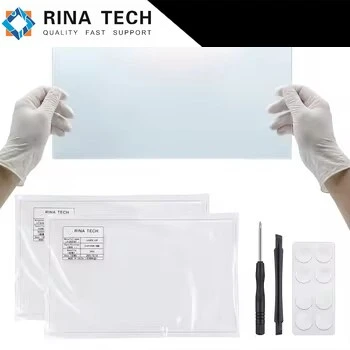
Why do ultra-thin optical plates suffer from extreme edge hot-spotting?
Thinner light guide plates restrict the spatial volume available for initial light mixing near perimeter entry edges. As light enters a thin PMMA sheet, the light rays have less vertical headroom to scatter and homogenize before reaching active display zones. This spatial constraint creates visible bright cones, dark gaps, or "tooth-like" light patterns directly adjacent to perimeter LED locations, degrading visual uniformity along the lower display border.
What Advanced Optical Innovations Prevent Brightness Losses in Sub-Millimeter LGPs?
How does high-transmittance virgin PMMA preserve photon throughput?
Next-generation sub-millimeter LGPs utilize ultra-pure, optical-grade virgin polymethyl methacrylate (PMMA) resins engineered with ultra-low optical damping. Boasting an intrinsic total light transmission rate exceeding 92.5%, this specialized resin eliminates internal material absorption losses. High material purity ensures that even with double the internal reflections per millimeter, photons propagate across the full width of the screen without premature attenuation.
How does high-density 3D laser micro-dotting maximize light extraction?
To compensate for reduced light-carrying volume, advanced LGPs replace traditional surface-printed inks with precision 3D laser micro-dotting. High-resolution lasers etch millions of microscopic, variable-depth optical extraction centers directly into the internal PMMA substrate. These micro-structures redirect propagating light rays perpendicularly out toward the display panel with high extraction efficiency, recovering bright, punchy surface nits.
How do micro-prism injection couplers optimize light coupling from micro-LEDs?
To overcome physical size mismatches between ultra-thin plates and perimeter light sources, engineers pair sub-millimeter LGPs with micro-LED edge arrays and integrated prism edge couplers. Micro-prism arrays etched directly into the LGP entry edge refract incoming wide-angle light into tight internal propagation angles. This optical alignment eliminates light spillover, capturing up to 95% of emitted LED lumens inside thin 0.4mm plates.
How Does Upgrading to Ultra-Thin High-Efficiency LGPs Transform Laptop Performance?
How much vertical space can display engineers reclaim in ultrabook lids?
Shifting from a conventional 1.0 mm LGP assembly down to a 0.3 mm or 0.4 mm high-extraction optical plate saves up to 600 microns of vertical space within the LCD stack. This profile reduction allows laptop OEMs to shrink overall display lid thickness, reduce total device weight, or reallocate critical interior clearance for structural aluminum reinforcement and anti-shock foam layers.
Can a high-efficiency ultra-thin LGP lower system battery consumption?
Yes. By maximizing photon extraction and eliminating coupling light loss, an advanced ultra-thin LGP achieves target screen luminance (400 to 500 nits) using lower LED drive currents. Reducing the energy required by display backlights-which typically consume up to 30% of total laptop power-directly lowers overall power draw, helping extend portable battery runtime by up to 15%.
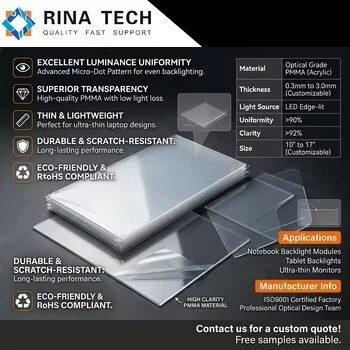
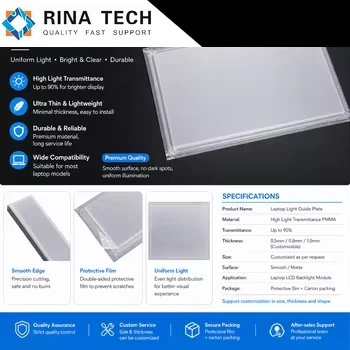
How do advanced thin LGPs improve display thermal management?
Because high-extraction sub-millimeter LGPs achieve bright surface illumination at lower LED drive power, perimeter lightbars generate significantly less operational heat. Furthermore, thinner optical plates dissipate thermal energy more rapidly across their surface area. Lower operating temperatures prevent localized thermal stress, protecting sensitive liquid crystal cells and polarizers from heat-induced yellowing.
How does high surface uniformity enhance modern high-resolution screens?
High-density 3D laser dot mapping achieves surface light distribution uniformity exceeding 90% across the active display area. Eliminating edge glare, dark corners, and gradient shadows provides an ultra-stable backlight foundation. This optical consistency enhances pixel-level contrast, crisp text rendering, and true-to-life color reproduction on 2.5K and 4K notebook displays.
What Key Manufacturing Quality Audits Ensure Reliable Sub-Millimeter LGP Production?
Why is certified Class 100 cleanroom production mandatory for thin LGPs?
In sub-millimeter optical plates, tiny dust particles or airborne static debris trapped on the surface create amplified light-scattering artifacts. High-volume manufacturing of thin LGPs must take place inside certified Class 100 cleanroom environments equipped with ionized air wash systems. Maintaining pristine cleanroom standards guarantees that every optical panel leaves the factory free of visual point defects.
01
How does Automated Optical Inspection (AOI) verify dot pattern accuracy?
Because laser micro-dot patterns on ultra-thin LGPs feature micron-scale density gradients, manual quality control is insufficient. Automated Optical Inspection (AOI) systems use high-resolution cameras and machine vision algorithms to inspect 100% of manufactured sheets in real time. AOI verifies dot depth, spatial pitch, and edge clarity, instantly filtering out panels that exhibit subtle pattern drift.
02
What environmental chamber tests confirm thermal stability in thin plates?
Before approving sub-millimeter LGPs for commercial production, sample batches undergo severe environmental stress testing. Standard qualifications subject plates to high-temperature baking (85℃ for 1,000 hours), damp-heat humidity chambers (60℃ / 90% RH), and rapid thermal shock cycling. Passing these tests confirms the thin polymer stack won't warp, yellow, or delaminate in real-world mobile use.
03
Why is precision laser edge-cutting critical for automated module lamination?
Sub-millimeter optical plates require clean, burr-free perimeter edges to ensure accurate alignment during automated robotic display lamination. High-speed CNC laser cutting produces mirror-smooth perimeter cuts with tight dimensional tolerances within 0.02 mm. Precise mechanical dimensions prevent assembly pinching, reduce light leakage around screen bezels, and boost factory throughput on high-volume notebook production lines.
04


