

What Should You Check Before Choosing A Laptop Light Guide Plate For Mass Production?
Sep 24, 2026
How Do Raw Material Standards Impact High-Volume LGP Manufacturing?
Why is 100% virgin PMMA essential for optical clarity?
Using 100% virgin optical-grade polymethyl methacrylate (PMMA) guarantees a light transmission rate exceeding 92% to 93%. Recycled or mixed acrylic resins contain microscopic impurities and molecular inconsistencies that absorb light and create haze. In high-volume manufacturing, specifying virgin PMMA ensures every panel achieves uniform brightness without unexpected optical absorption losses.
How do thermal expansion coefficients affect tight assembly tolerances?
PMMA naturally expands and contracts in response to temperature fluctuations generated by internal laptop components and environmental shifts. If the raw material's coefficient of thermal expansion is not precisely controlled, mass-produced LGPs may warp, buckle, or shift within the backlight housing. Engineers must verify material thermal stability to prevent mechanical pinching and light leakage during continuous device operation.

Why does yellowing resistance dictate long-term display lifespans?
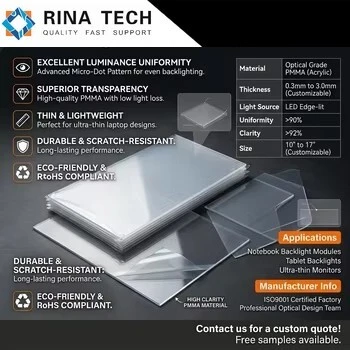
Inferior optical polymers degrade when exposed to continuous heat from perimeter LEDs and environmental UV radiation, turning yellow over time. This chemical yellowing severely shifts display color temperature, causing crisp white backlights to look dull and warm. Verifying UV-stabilized and heat-resistant resin formulations ensures that mass-produced displays maintain color accuracy throughout their operational lifespan.
How does raw sheet thickness consistency prevent yield loss?
Sub-millimeter variation in raw acrylic sheet thickness disrupts light coupling from perimeter LED lightbars. If an LGP sheet varies in thickness across a production batch, the light entry edge will misalign with the LED emitters, leading to light loss and edge hot-spotting. Strict sheet thickness tolerances are essential before launching high-volume production.
What Micro-Optical Dotting Techniques Ensure Uniformity Across Thousands of Panels?
Why is 3D laser micro-dotting preferred over screen printing for volume runs?
Traditional screen-printed ink dots degrade, peel, or yellow over time, and solvent-based inks introduce batch-to-batch density variations. 3D laser micro-dotting permanently vaporizes optical scattering structures directly into the PMMA substrate. Laser dotting offers unmatched repeatable precision across large production runs, ensuring zero dot degradation over years of daily use.
01
How does variable dot density optimization eliminate dark spots?
Light propagating from perimeter LEDs naturally attenuates as it travels across the optical plate. To maintain uniform surface luminance, the micro-dot pattern must feature a gradient density-smaller, sparser dots near the light entry edge and larger, denser dots farther away. Optical simulation software must optimize this gradient pattern for the specific panel aspect ratio before cutting master production dies.
02
What role does optical simulation modeling play prior to mass tooling?
Before committing to full-scale manufacturing, engineers must perform rigorous Monte Carlo ray-tracing simulations to model light behavior within the custom LGP. Ray-tracing analysis predicts surface luminance uniformity, light extraction efficiency, and potential edge light leakage. Validating designs digitally eliminates costly trial-and-error tooling modifications during physical factory bring-up.
03
How do non-contact etching methods prevent surface contamination during dotting?
Non-contact laser or electron-beam dotting processes eliminate physical tool wear and mechanical debris during the patterning stage. Contact-based mechanical engraving can leave microscopic burrs and dust particles that trap light or create visible dark spots under high-magnification inspection. Clean, non-contact etching ensures pristine surface quality across every manufactured unit.
04
What Dimensional Tolerances and Mechanical Standards Must Be Audited?

Why is ultra-precise edge diamond polishing critical for light injection?
The light entry edge of an LGP acts as the optical gateway for perimeter LED lightbars. Rough or micro-fractured edges cause unwanted reflection and refraction, reflecting light away from the optical guide. Specifying mirror-finish diamond polishing or high-precision laser edge-cutting minimizes injection loss, maximizing lumen transfer from the LEDs into the light guide plate.
How do tight CNC cutting tolerances prevent perimeter light leakage?
Laptops feature extremely narrow screen bezels, leaving minimal clearance around display components. High-precision CNC routing or automated laser cutting ensures perimeter dimensions remain within tight tolerances ($\pm 0.05\text{ mm}$). Precise outer dimensions prevent light leakage around panel borders and ensure seamless automated robotic drop-in during display module assembly.
What corner alignment features simplify automated robotic assembly?
High-speed display assembly lines rely on automated vision systems and pick-and-place robotics. Incorporating pre-registered mechanical notch features, chamfered keying corners, or alignment tab slots into the LGP design prevents upside-down or reversed installation during manufacturing. Built-in mechanical keying lowers assembly defect rates and accelerates factory throughput.
What Quality Assurance Protocols and Factory Audits Prevent Mass Field Failures?
Why are Class 100/1000 cleanroom manufacturing environments mandatory?
Microscopic dust particles, airborne fibers, or oil droplets trapped inside an optical stack act as light-scattering obstructions, causing permanent bright or dark spots on the screen. Mass production of optical LGPs must take place within certified Class 100 or Class 1000 cleanrooms equipped with HEPA filtration and anti-static air ionization bars to guarantee spot-free visual surfaces.
How does Automated Optical Inspection (AOI) screen out micro-defects?
Human visual inspection cannot reliably detect micro-scratches, pinholes, or minor dot density variations across thousands of production units per day. Automated Optical Inspection (AOI) systems utilize high-resolution camera arrays and machine vision algorithms to scan 100% of manufactured LGPs in real time, instantly flagging and rejecting any unit that deviates from strict optical thresholds.
How does vendor supply chain stability protect long-term production runs?
Sourcing LGPs for mass production requires evaluating a supplier's raw material sourcing, master roll inventory, and secondary manufacturing capacity. A sudden change in acrylic resin suppliers or laser machine calibration mid-production can cause noticeable batch-to-batch color shifts and brightness variations. Securing fixed material specifications and multi-factory sourcing agreements ensures a uninterrupted supply of matching display components.