

Is Automotive Interior Ambient Lighting The Next Essential Feature in Modern Vehicles?
Jul 03, 2026
What Exactly Is Automotive Interior Ambient Lighting?

Automotive interior ambient lighting refers to the decorative and functional lighting systems installed within a vehicle's cabin to enhance aesthetics, create atmosphere, and support user interaction. Unlike functional lighting such as dome lights or reading lamps, ambient lighting provides soft, indirect illumination that highlights interior contours, materials, and surfaces. Modern systems go far beyond simple illumination: they incorporate multi-zone, addressable light-emitting units combined with optical light guides and electronic control systems to enable color variation, dynamic lighting animations, and event-linked visual feedback.
The technology has evolved from a purely decorative accessory into an integral component of the intelligent cockpit. Ambient lighting is now embedded in doors, dashboards, footwells, center consoles, roof headliners, cupholders, and storage areas, and is increasingly synchronized with infotainment systems and advanced driver-assistance systems (ADAS) alerts. In essence, it has transitioned from a nice-to-have embellishment to a strategic enabler of user experience, vehicle personalization, and perceived quality.
What Specific Materials and Core Technologies are Employed in the Manufacturing of Automotive Ambient Lights?


Light-Guiding Polymers
The backbone of linear ambient lighting is the optical light guide, typically manufactured from premium-grade Polymethyl Methacrylate (PMMA) or Polycarbonate (PC). PMMA is highly favored for its unparalleled optical clarity, high light transmission efficiency, and resistance to yellowing under UV stress. For areas prone to high mechanical impacts or elevated thermal loads, impact-modified Polycarbonate is utilized due to its superior structural resilience and higher melting point.
01
Optical Diffusion Agents
Raw light guides would naturally allow light to escape primarily at the ends or create harsh, localized "hot spots" directly above the LED source. To counteract this, manufacturers embed micro-spherical scattering particles or chemically etch micro-structures onto the surface of the polymer. This ensures that light is leaked evenly along the entire longitudinal axis of the tube, creating a continuous, uninterrupted neon-like glow.
02
Flexible Printed Circuit Boards
To navigate the complex, tight, and highly contoured spaces behind leather upholstery, wood veneers, and metallic trim panels, ultra-thin Flexible Printed Circuit Boards are employed. These substrates utilize polyimide films bonded with conductive copper traces, allowing the entire electrical assembly to bend and twist without risking electrical shorts or fracturing the solder joints of the surface-mounted LEDs.
03
Semiconductor Light Sources
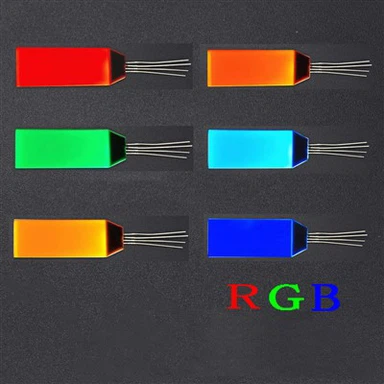
Modern systems rely on high-density RGB (Red, Green, Blue) or RGBW (Red, Green, Blue, White) surface-mount device (SMD) LEDs. The inclusion of a dedicated white diode allows for the rendering of crisp, high-purity pastel colors and neutral tones that standard RGB mixing struggles to achieve cleanly.
04
Where and How are These Ambient Lighting Systems Applied Throughout the Vehicle Cabin Architecture?
The spatial distribution of ambient lighting within a modern vehicle is a highly calculated exercise in structural balance, ergonomics, and spatial design. Designers use light to alter the perceived volume of the cabin, drawing the eye toward premium materials while masking structural seams and mechanical fasteners. The application zones have expanded from simple floor illumination into an all-encompassing, multi-layered architectural grid.
The standard layout of a contemporary interior lighting matrix includes the following primary application zones:
The Primary Horizon Line (Dashboard & Instrument Panel): A continuous, sweeping light guide is typically embedded within the crevice separating the upper dashboard soft-touch materials from the lower decorative trim. This serves as the visual anchor of the entire system, emphasizing the width of the vehicle and establishing a panoramic cockpit feel.
Door Panel Contours and Recesses: Ambient lighting is heavily deployed across door architectures. This includes accentuating the upper door trim, illuminating the structural armrests, and embedding soft, indirect lighting within the door handle recesses and lower door map pockets. These locations serve a dual purpose, guiding the occupant's hands at night while creating a layered, three-dimensional depth when viewed from the center seats.
The Central Console Flanks: Light strips are frequently integrated along the lateral edges of the transmission tunnel or floating center console. This defines the boundaries between the driver and passenger zones, emphasizing the architectural layout of the cockpit control center.
Footwell and Under-Seat Cavities: Flooding the driver and passenger footwells with low-intensity illumination helps lower the psychological sensation of confinement in dark environments, making entry and egress significantly safer and more welcoming.

What Distinct Advantages and Functional Benefits Do Interior Ambient Lights Provide to Vehicle Occupants?
While critics once dismissed ambient lighting as a superficial, gimmicky marketing ploy, extensive empirical research in automotive ergonomics, cognitive psychology, and traffic safety has proven that intelligently executed interior lighting delivers profound functional benefits. It serves as a vital tool for enhancing passenger well-being, optimizing driver performance, and elevating the overarching safety framework of the vehicle.
The primary advantages can be systematically categorized into psychological, ergonomic, and safety-oriented vectors:

01
Psychological Well-Being and Mood Regulation
Color deeply influences human emotion and physiological arousal. By leveraging the principles of chromotherapy, modern ambient lighting can actively alter the mood inside the cabin. For instance, soft blue and green wavelengths have been shown to lower heart rates and reduce salivary cortisol levels, acting as a powerful calming agent during high-stress urban traffic congestion. Conversely, vibrant amber or soft orange tones can stimulate cognitive alertness and inject a sense of energy during monotonous, long-distance highway cruising.
02
Ergonomic Comfort and Fatigue Mitigation
Driving through pitch-black rural roads for extended periods creates severe visual fatigue. The stark contrast between the intense, high-luminance glow of large modern central infotainment screens and the absolute darkness of the outside world forces the human pupil to continuously dilate and constrict. By introducing a soft baseline of ambient light throughout the peripheral vision of the driver, the contrast ratio is drastically smoothed out. This significantly minimizes eye strain, prevents ocular muscle fatigue, and helps the driver remain focused for longer durations.
03
Active ADAS Integration and Safety Alerting
The most significant evolutionary leap of ambient lighting is its transition into an active safety component. Because ambient light fills the driver's peripheral vision, it can convey critical information faster than a traditional dashboard icon or acoustic chime. Modern vehicles configure the lighting system to serve as an instantaneous warning layer. If the lane-departure system detects an unintended drift, the corresponding side of the dashboard can flash a violent amber. During blind-spot monitoring, if a driver activates a turn signal while a vehicle is hidden adjacent to them, the entire door panel light can strobe in brilliant red.
04
Perceived Luxury and Brand Differentiation
From a commercial standpoint, ambient lighting vastly inflates the perceived material quality and financial value of a vehicle. A cabin featuring standard plastics and synthetic leathers can be transformed into a premium, lounge-like environment simply through the masterful application of indirect, high-purity lighting. For automotive manufacturers, custom-calibrated startup lighting animations and unique color harmonies serve as a crucial tool for establishing a distinct, unforgettable brand identity in an incredibly crowded marketplace.