

Need A Laptop Brightness Enhancement Film That Boosts Display Brightness Without Extra Power?
Oct 30, 2026
Why Do Standard Laptop Backlights Lose over Half Their Generated Light Energy?
What causes severe light attenuation inside conventional LCD backlight units?
Liquid crystal display (LCD) panels are inherently transmissive, meaning they do not generate their own illumination. Instead, they rely on a perimeter LED backlight module to inject raw light across the screen matrix. However, as light travels from the light guide plate through standard diffusers, liquid crystal cells, color filters, and polarizing layers, over 80% to 90% of the total generated photons are absorbed or scattered away before ever reaching the user's eyes. This extreme optical loss limits on-axis screen brightness.
How does wide-angle light scattering waste battery power?
Perimeter LED bars emit photons in a wide hemispherical pattern across all directions. When light exits an unrefined light guide plate, a significant portion escapes at steep lateral angles. Light rays projecting toward the extreme far left or right of the display chassis contribute nothing to the user seated directly in front of the laptop. Running LEDs at full current to compensate for off-axis light waste drains battery reserves and generates unnecessary thermal heat inside thin laptop lids.
Why do standard polarizers absorb half of the available backlight lumens?
To control liquid crystal orientation, an LCD panel requires linearly polarized light. Standard rear polarizers operate as absorptive filters: they allow light aligned with one specific polarization axis to pass through while absorbing all perpendicular light waves. This fundamental physical boundary instantly eliminates roughly 50% of incoming backlight energy as useless heat before the light even reaches the liquid crystal cell, creating a massive efficiency bottleneck.
What happens when laptop users work in bright outdoor or ambient environments?
When laptops are used outdoors, near office windows, or under high-overhead lighting, ambient light reflects off the top display surface. If on-axis screen brightness is insufficient, ambient glare overpowers the display's emitted output, causing graphics to appear washed out and dark. Without an optical brightness enhancement film (BEF), users are forced to crank up backlight current, depleting laptop battery life in less than a few hours.
How Does Micro-Prism Technology Direct Light to Boost On-Axis Luminance?
How do microscopic triangular prisms manage light propagation angles?
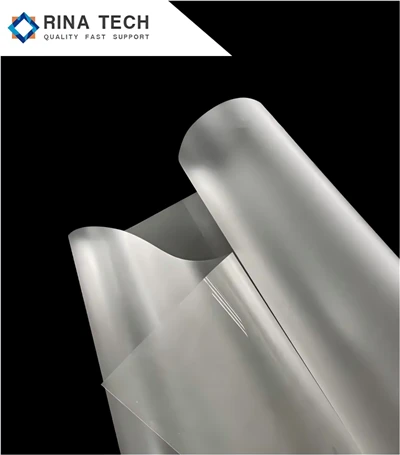
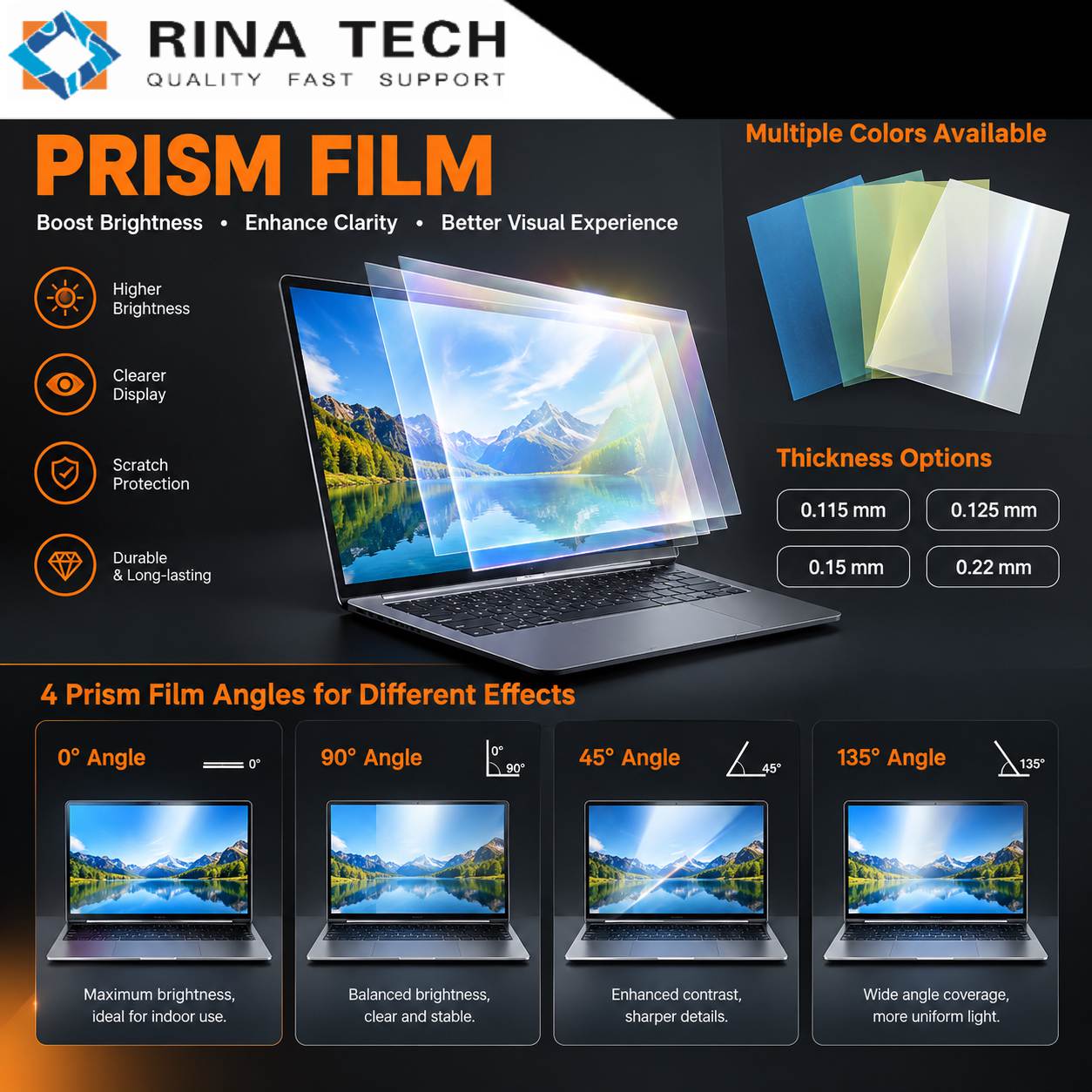
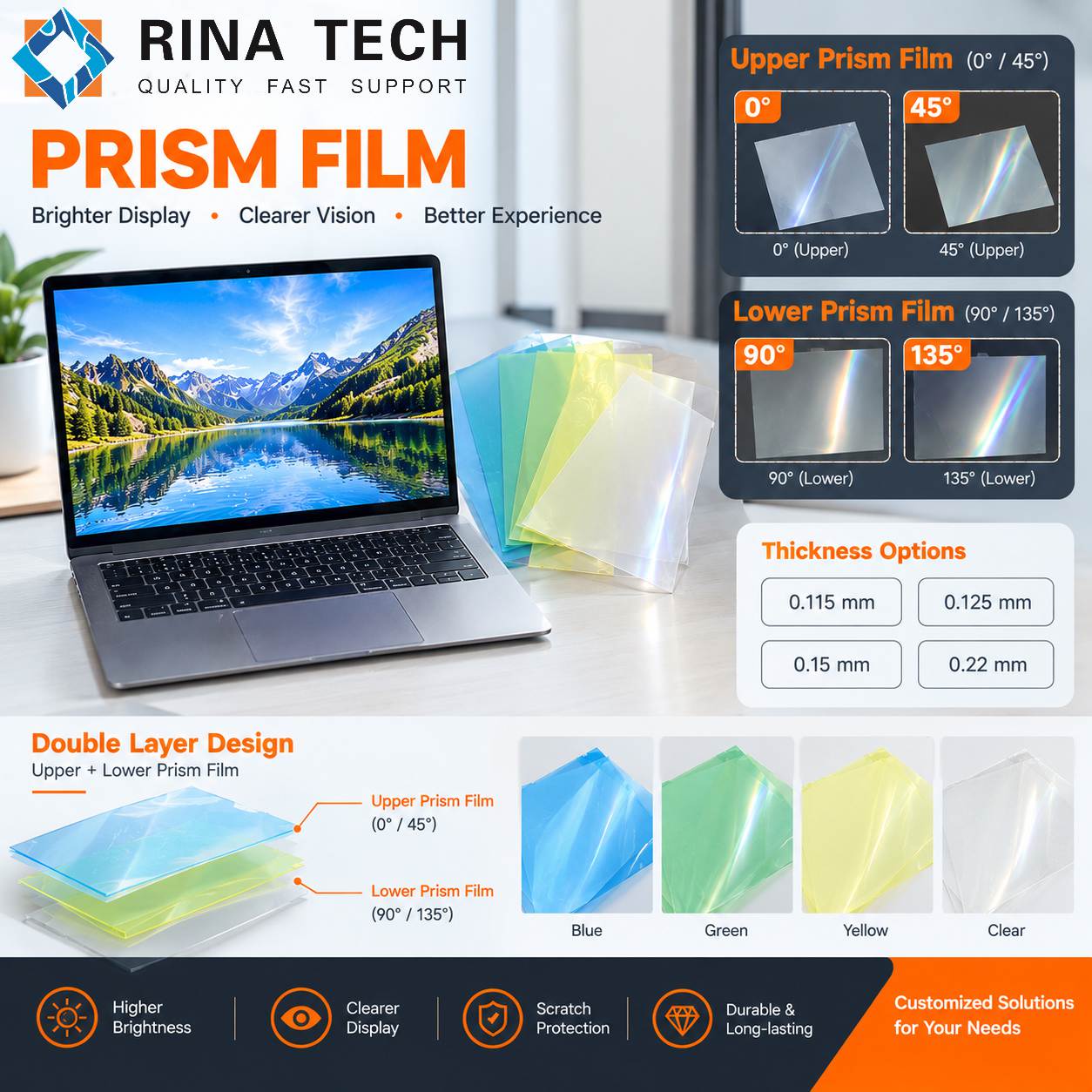
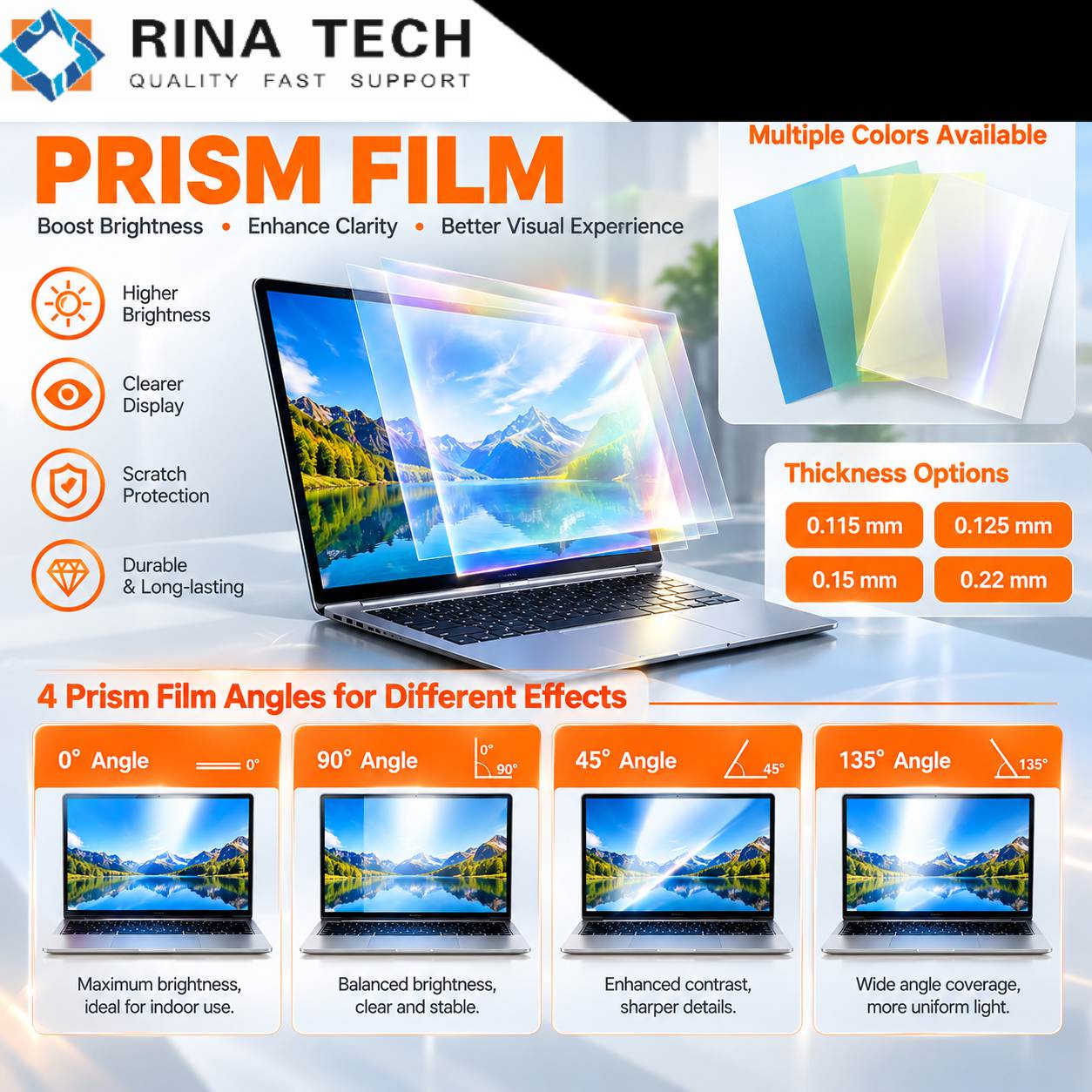
A Brightness Enhancement Film (BEF) features an engineered micro-structure layer comprising millions of parallel triangular prisms embossed onto an optical-grade PET substrate. Using the fundamental principles of refraction and total internal reflection (TIR), these microscopic prisms capture wide-angle, scattered light rays exiting the diffuser sheet.
01
What is the optical recycling mechanism behind total internal reflection?
Light rays that strike the BEF's micro-prisms at extreme, shallow angles cannot exit forward through refraction. Instead, these steep rays undergo total internal reflection inside the prism structures, reflecting backward down into the backlight cavity. Once inside the cavity, the reflected rays bounce off the bottom reflective sheet, depolarize, and travel back up to the BEF at new angles.
02
How much on-axis brightness gain can a single BEF sheet achieve?
Integrating a single precision-engineered prism sheet into a laptop backlight stack increases on-axis surface luminance by approximately 50% to 60% without adding a single milliwatt of additional electrical power. By focusing scattered ambient light into a useful forward viewing cone, the film allows a 300-nit panel to reach over 450 nits using the exact same LED drive current.
03
Why are dual crossed BEF configurations used in premium laptop displays?
A single BEF sheet redirects light along only one axis (either horizontally or vertically). To compress light along both axes simultaneously, display engineers stack two BEF sheets orthogonally at a 90-degree angle to one another. This crossed-prism configuration concentrates scattered photons from all directions into a tight central viewing cone, delivering total brightness gains of 110% to 120% without increasing power draw.
04
What Role Do Reflective Polarizer Films Play in Complete Backlight Efficiency?
How do reflective polarizers differ from standard absorptive polarizers?
While standard polarizers absorb light waves aligned perpendicularly to their transmission axis, advanced Dual Brightness Enhancement Films (DBEF) act as reflective polarizers. Built from hundreds of alternating multi-layer polymer films with matching and mismatched refractive indices, a DBEF transmits the desired linearly polarized light wave while reflecting the unwanted wave component back into the backlight cavity for conversion.
How does polarization conversion recycle previously lost light?
When the reflected polarization component travels back down into the backlight module, it strikes diffusely reflective bottom sheets and optical diffusers. These scattering bounces randomize the polarization state of the light rays. When the recycled light returns to the DBEF, roughly half of the newly randomized waves are now oriented correctly to pass through the film, while the remainder is reflected back to repeat the cycle. This process recycles up to 60% of otherwise wasted light.
How do combined BEF and DBEF film stacks maximize display performance?
Combining a micro-prismatic BEF stack with a reflective polarizing film (DBEF) delivers the ultimate backlight efficiency upgrade. The BEF sheets compress wide-angle light into a tight forward cone, while the DBEF recycles mismatched polarizations. Together, this integrated optical film stack can more than double on-axis display luminance, making 600-nit outdoor-readable laptop screens achievable within slim, power-conscious battery budgets.
How Does Upgrading to Precision BEFs Lower System Costs and Extend Device Reliability?
How does higher optical efficiency directly extend laptop battery runtimes?
Because an advanced BEF stack doubles on-axis brightness through light recycling, display engineers can choose between two major benefits: significantly increasing display brightness at current power levels, or maintaining target brightness levels while cutting LED drive current by up to 30% to 40%. Reducing backlight energy draw extends notebook battery life during mobile work.
How does reducing LED power consumption improve display thermal management?
Perimeter LED lightbars are a primary source of internal heat build-up inside laptop lids. Running LEDs at high drive currents generates thermal stress that radiates directly into sensitive liquid crystal cells and polarizers. By achieving target nit levels at lower drive currents through BEF recycling, the display assembly operates significantly cooler, protecting optical adhesives from thermal degradation and preventing screen yellowing over time.
Can integrating BEF sheets lower the total bill of materials (BOM) cost?
Yes. Achieving high display brightness without optical film recycling requires installing dense, high-count LED lightbars and larger copper thermal heat sinks. Integrating high-gain BEF sheets allows display manufacturers to hit target brightness metrics using fewer LED diodes and smaller, less expensive power driver circuits. The cost savings from reduced LED counts and simplified cooling hardware offset the cost of the optical film stack.