

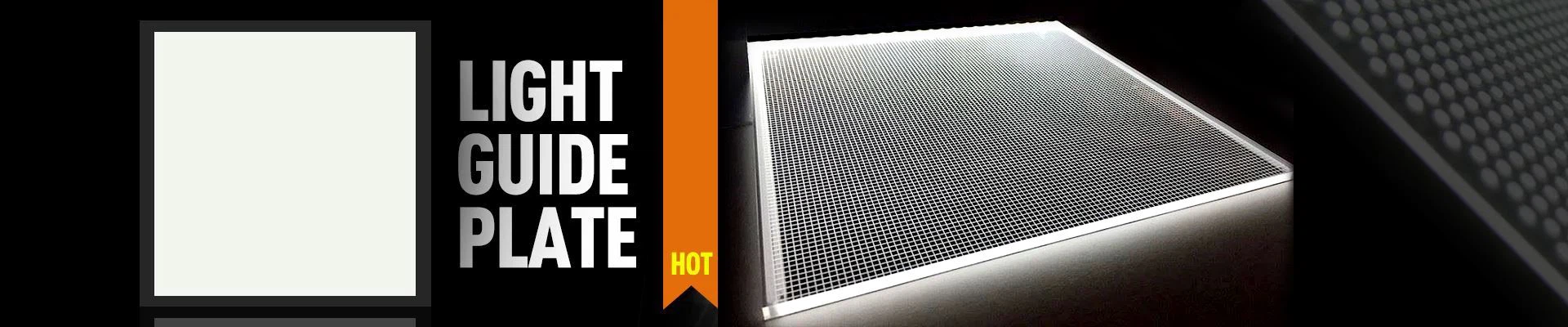


Perforated Light Guide Plate
Product Name: Perforated Light Guide Plate
Thickness: 0.7mm, 0.8mm, 1mm, 1.5mm, 2mm, 2.5mm, 2.8mm, 3mm, 4mm, 6mm, 8mm, 10mm
Size: Customizable
Material: PMMA, PC, PS
Light Emitting Process: Laser dotting, screen printing, screen-free printing, nano-plate
Advantages: Reduced assembly difficulty;
Uniform panel light emission;
Customizable hole size
- Fast Delievery
- Quality Assurance
- 24/7 Customer Service
Product Introduction
Rina Technology Co., Ltd. is one of the leading manufacturers and suppliers of perforated light guide plate in China. Welcome to wholesale durable products in stock here and get quotation from our factory. All customized products are with high quality and low price.
Product Introduction of Perforated Light Guide Plate

A perforated light guide plate is a functional optical component that achieves efficient light transmission and uniform diffusion by precisely perforating the surface or interior of a transparent substrate, combined with optical principles. Its core substrate is typically made of high-transmittance materials such as acrylic (PMMA), PC, or PS
Through CNC laser drilling or precision mechanical drilling processes, an array or customized distribution of micropores is formed in specific areas of the plate. The pore diameter is usually between 0.1mm and 2mm, and the spacing and size of the pores can be flexibly adjusted according to optical requirements.


When light emitted from a light source enters from the side of the perforated light guide plate, most of the light is transmitted within the substrate due to total internal reflection. When it encounters the micropores on the surface, the light undergoes refraction, scattering, and reflection,
Meanwhile, the back of the board is usually fitted with a reflective film to enhance light utilization, and the front can be combined with a diffusion film to further optimize the uniformity of light output, ultimately achieving a highly efficient optical conversion effect of "side light in, front light out"

Advantages of Perforated Light Guide Plates:


1. Excellent Light Uniformity and Stable Optical Performance
Perforated light guide plates achieve directional scattering and uniform diffusion of light through precise control of aperture diameter, depth, and aperture array distribution, effectively avoiding problems such as "bright edges" and "dark areas" common in traditional light guide plates. Their light uniformity typically reaches over 85%, and the light is soft and non-glaring.
2. High Light Utilization and Significant Energy Saving
The micro-perforated structure efficiently breaks total internal reflection. Combined with the auxiliary effect of a reflective film, the conversion rate of side-incident light is significantly improved, with light utilization reaching over 90%. This means that for the same light output brightness requirements, devices using perforated light guide plates can be equipped with lower-power light sources (such as LEDs)
3. High Design Flexibility and Wide Adaptability
The drilling process can be customized to meet diverse needs. Whether it's the hole size, hole arrangement (e.g., matrix, honeycomb), or the shape and size of the board, everything can be flexibly adjusted to suit specific optical designs. Furthermore, a wide range of substrates are available: acrylic is lightweight and easy to process, PC is highly impact-resistant, and glass is heat-resistant, meeting the performance requirements of various scenarios.
4. Controllable Processing Costs and Good Mass Production Capability
With the maturity of CNC laser drilling technology, the processing efficiency of perforated light guide plates has significantly improved, with high process stability and a low scrap rate. Compared to light guide plates using complex processes such as screen printing and photolithography, its production process is simpler, especially in the processing of medium to large-sized products, where the cost advantage is more pronounced, meeting the needs of mass production.
Application of Perforated Light Guide Plate

- Consumer Electronics

- Automotive Industry

- Home and Commercial Lighting

- Advertising, Media, and Display

RINA TECHNOLOGY
is a high-tech enterprise specializing in research, development, production ,sales of Optical LED products and provide the one step optical lighting solution for customers.Established in 2011, Hong Kong, after years of rapid development, Rina Tech has settled office and factory in Shenzhen,and has professional senior technicians and qualified managers,has a talented team for product research and designing.
Nowadays, we have laser cutting machines, printers, film cutting machines, injection molding equipments,high-standard assembly workshops, BM-7 clean machines and other advanced equipments.
Our factory daily output is more than 80000pcs. to cater for the market at home and abroad.With years of unremitting effort,RINA TECH has passed get the Registration Certificate ofCustoms Declaration Unit of the People's Republic of China , National Credit Cultivation Certificate and Get our own Brand already.
We has made many breakthroughs in researching and manufacturing and has
obtained lots of good reputation from oversea customers.
Now we has cooperated with and become strategic partner of some famous enterprises such as LG, Samsung, Lenovo etc."Living on Sincerity, following with Market, Advancing by Specialty" is our eternal philosophy,and the company motto is "Good at Production, Good for Society".
We look forward to cooperating with you to make the world better and future brighter!
FAQ
Q1: How should I choose the appropriate substrate for a Perforated Light Guide Plate based on the application scenario?
A1: The substrate characteristics should be matched to the core requirements of the scenario: ① For general indoor scenarios (such as ordinary monitors and office flat panel lights), acrylic substrates are preferred, with a light transmittance of over 92%, moderate cost, and easy processing; ② For outdoor or high-impact scenarios (such as outdoor light boxes and automotive displays), PC substrates are preferred, with impact resistance 6-8 times that of acrylic, and resistance to high and low temperatures (-40℃ to 120℃); ③ For high-temperature and high-cleanliness scenarios (such as medical equipment and industrial testing instruments), glass substrates are preferred, as they are resistant to high temperatures (up to over 300℃), chemical corrosion, and their surface is less prone to dust accumulation, making cleaning and maintenance simpler.
Q2: Can the light emission uniformity of the Perforated Light Guide Plate be adjusted? How?
A2: Light emission uniformity can be flexibly adjusted according to requirements, achieved through two main dimensions: ① Optimized aperture structure parameters: Aperture diameter near the light source can be set to 0.1-0.3mm, with an aperture spacing of 5-8mm; on the side farther from the light source, the aperture diameter increases to 0.5-0.8mm, and the aperture spacing decreases to 3-5mm, balancing light distribution through "smaller apertures sparsely spaced near the light source and larger apertures densely spaced far from the light source"; ② Auxiliary optical film combination: For ultra-high uniformity (such as in medical imaging displays), a double-layer diffusion film (80% and 90% haze respectively) can be superimposed on the front of the light guide plate, and a high-reflectivity (≥95%) silver film can be used on the back to further eliminate light differences, increasing uniformity to over 90%.
Q3: What special treatments are required when the Perforated Light Guide Plate is used outdoors?
A3: For outdoor use, the key issues to address are UV resistance, waterproofing, and anti-aging. Specific solutions include: ① UV resistance treatment: Apply a 5-10μm UV-resistant coating (such as an acrylic coating containing nano-TiO₂) to the substrate surface, or directly use a special substrate with added UV-resistant agents. This can block more than 99% of ultraviolet rays, preventing the board from yellowing and becoming brittle; ② Waterproof sealing: Seal the edges of the light guide plate (using weather-resistant silicone sealant). When used with the backlight module, add a waterproof gasket to prevent rainwater from seeping into the holes and affecting optical performance; ③ Structural protection: Secure with an aluminum alloy frame with pre-drainage holes. Also, add a heat insulation layer to the back of the light guide plate to reduce the impact of high temperatures on the light source and light guide plate, extending its outdoor lifespan.
Q4: What might be causing the "light spot" problem with the Perforated Light Guide Plate? How can it be resolved?
A4: "Light spots" are mostly caused by uneven light distribution or structural mismatch issues. Corresponding solutions: ① Light source issues: If the LED bead spacing is too large (>10mm), reduce the bead spacing to 5-8mm, or replace with LED beads with a larger beam angle (≥120°) to achieve more uniform light coverage; ② Hole structure issues: If light spots appear on the light source side, the hole diameter may be too large, requiring a reduction of 0.1-0.2mm in that area; if appearing in the middle area, increase the density of the hole arrangement; ③ Film material issues: If a diffusion film is not used or the diffusion film haze is too low, replace it with a high-haze diffusion film (haze ≥85%), or increase the number of diffusion film layers; ④ Installation issues: If the distance between the light guide plate and the light source...
Q5: Is the surface of the Perforated Light Guide Plate easily scratched? How to maintain it?
A5: The surface hardness of the Perforated Light Guide Plate is related to the substrate. Acrylic substrates have lower surface hardness (Mohs hardness 2-3), making them easily scratched by sharp objects; PC substrates have slightly higher hardness (Mohs hardness 3-4), offering slightly better scratch resistance. During routine maintenance, avoid wiping the surface with hard cloths or sharp tools. When cleaning, it is recommended to use a soft, lint-free cloth dampened with a small amount of water or neutral detergent to gently wipe the surface. If high surface scratch resistance is required, a perforated light guide plate with a hardened surface can be selected. After hardening, the surface hardness can reach Mohs hardness level 5 or above, significantly improving scratch resistance.
Hot Tags: perforated light guide plate suppliers, factory, customized, price, in stock, LED guide plate


