

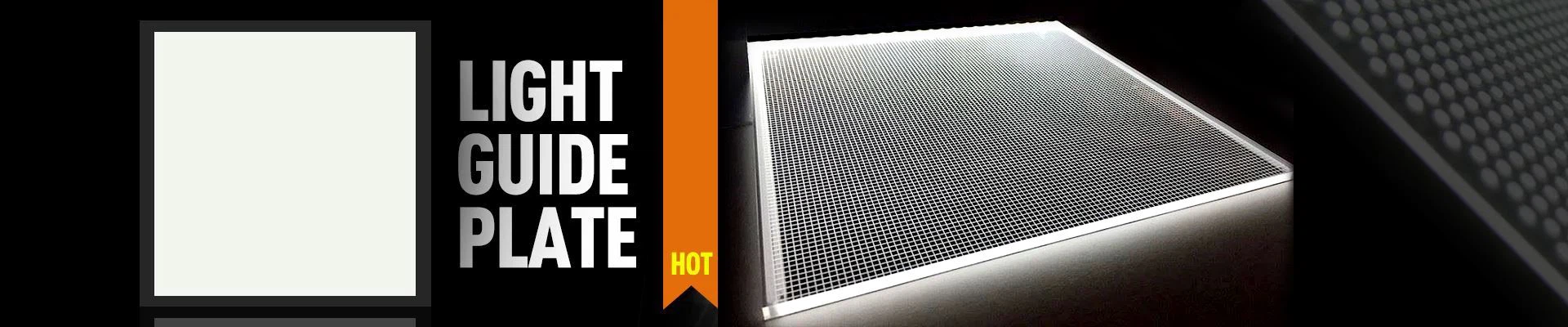


Irregularly Shaped Light Guide Plate
Product Name: Irregularly Shaped Light Guide Plate
Thickness: 0.7mm, 0.8mm, 1mm, 1.5mm, 2mm, 2.5mm, 2.8mm, 3mm, 4mm, 6mm, 8mm, 10mm
Size: Customizable
Material: PMMA, PC, PS
Light Emitting Process: Laser Dotting, Screen Printing, Screen-Free Printing, Nano Plate
Advantages: Grade A Quality, High Uniformity
- Fast Delievery
- Quality Assurance
- 24/7 Customer Service
Product Introduction
Rina Technology Co., Ltd. is one of the leading manufacturers and suppliers of irregularly shaped light guide plate in China. Welcome to wholesale durable products in stock here and get quotation from our factory. All customized products are with high quality and low price.
Irregularly Shaped Light Guide Plate Product Introduction
An Irregularly Shaped Light Guide Plate is an optical light guide element that breaks away from the traditional rectangular shape limitations, designed with a special structure based on actual application needs. Its core function is the same as a conventional light guide plate: through the optical microstructures within the plate (such as dots, V-grooves, etc.), it efficiently refracts, reflects, and homogenizes light emitted from side-lit or direct-lit light sources, ultimately achieving uniform output of the surface light source. Compared to standard light guide plates, the significant advantage of irregularly shaped light guide plates lies in their "shape adaptability," precisely matching various non-standard installation spaces and product shape requirements. Common irregularly shaped types mainly include the following:


- Triangular Irregularly Shaped Light Guide Plate: The overall shape is triangular, with precisely polished edges and corners. It can adapt to triangular lamps, decorative panels, and other scenarios. The light output boundary perfectly matches the triangular outline,
- Perforated Irregularly Shaped Light Guide Plate: Perforations are drilled at specific intervals and with varying diameters on the light guide plate itself. The position and size of the holes can be customized according to installation needs (such as avoiding structural components) or optical effects
- Long Strip Irregularly Shaped Light Guide Plate: With an aspect ratio far exceeding that of conventional light guide plates, it is typically used in linear lighting scenarios, such as cabinet lights, corridor light strips, and instrument indicator lights. It can achieve uniform light output over long distances
- Circular Irregularly Shaped Light Guide Plate: Featuring a circular or elliptical structural design, the light output surface is annular or fully circular, suitable for round ceiling lights, dashboards, decorative round light sources, etc., creating a softer, more symmetrical optical effect.
- Polygonal Irregularly Shaped LGP: Covering pentagonal, hexagonal, octagonal and other irregular polygonal structures, mainly used for personalized decorative lighting, backlighting of irregularly shaped displays, customized instrument panels and other scenario
The Significant Role of Irregularly Shaped Light Guide Plates
1. Breaking Form Limitations and Empowering Innovative Product Design
Traditional rectangular light guide plates often restrict the appearance of products, forcing designs to compromise by "fitting the light guide plate." Irregularly shaped light guide plates, however, can be customized to perfectly match the product's design requirements. Whether it's a complex polygonal structure or a special perforation design, they can be precisely matched, providing greater design freedom for lighting fixtures, electronic products, and decorative components, helping companies launch more differentiated and competitive products. For example, in smart wearable devices, the application of circular irregularly shaped light guide plates allows the dial backlight to better fit the dial shape, enhancing the product's sophistication.
2. Optimizing Light Utilization and Enhancing Illumination and Display Effects
Irregularly shaped light guide plates are not simply "shape deformations"; their internal optical microstructures are specifically designed according to the characteristics of their shape. For example, elongated irregularly shaped light guide plates address brightness attenuation issues in long-distance light guiding by optimizing dot density distribution; triangular light guide plates feature special treatment of the microstructure in the corner areas to prevent dark areas. This combination of form and optical design ensures that while breaking with traditional forms, it still achieves high uniformity and high transmittance light output, improving the comfort of lighting products and the clarity of display products.
3. Reduced Installation Costs and Improved Space Adaptability
In many non-standard installation scenarios, using traditional light guide plates often requires secondary cutting and splicing, resulting in material waste and potential issues such as light leakage and uneven brightness due to insufficient cutting precision. Irregularly Shaped Light Guide Plates utilize a "customized production" model, directly producing products that meet installation size and shape requirements without secondary processing. This reduces material waste and labor costs while perfectly adapting to small, special installation spaces, such as elevator cars, irregularly shaped display cases, and instrument interiors, improving overall assembly efficiency.
4. Expanding Application Boundaries and Driving Technological Upgrades Across Multiple Fields
With the maturation of irregularly shaped light guide plate technology, its applications have expanded from traditional lighting to multiple high-end fields such as display backlighting, medical equipment, and automotive electronics. In the automotive industry, perforated irregularly shaped light guide plates can be used in interior ambient lighting, achieving personalized light layouts by avoiding structural components of the vehicle body through perforations. In medical equipment, polygonal irregularly shaped light guide plates can provide uniform illumination sources for diagnostic instruments, improving detection accuracy. Its diverse forms and stable optical performance provide crucial support for technological upgrades in various fields.
Application of Irregularly Shaped Light Guide Plate


RINA TECHNOLOGY
is a high-tech enterprise specializing in research, development, production ,sales of Optical LED products and provide the one step optical lighting solution for customers.Established in 2011, Hong Kong, after years of rapid development, Rina Tech has settled office and factory in Shenzhen,and has professional senior technicians and qualified managers,has a talented team for product research and designing.
Nowadays, we have laser cutting machines, printers, film cutting machines, injection molding equipments,high-standard assembly workshops, BM-7 clean machines and other advanced equipments.
Our factory daily output is more than 80000pcs. to cater for the market at home and abroad.With years of unremitting effort,RINA TECH has passed get the Registration Certificate ofCustoms Declaration Unit of the People's Republic of China , National Credit Cultivation Certificate and Get our own Brand already.
We has made many breakthroughs in researching and manufacturing and has
obtained lots of good reputation from oversea customers.
Now we has cooperated with and become strategic partner of some famous enterprises such as LG, Samsung, Lenovo etc."Living on Sincerity, following with Market, Advancing by Specialty" is our eternal philosophy,and the company motto is "Good at Production, Good for Society".
We look forward to cooperating with you to make the world better and future brighter!
FAQ
Q1: Is there a difference in light transmittance between an Irregularly Shaped Light Guide Plate and a regular light guide plate?
A1: Under the premise of using the same substrate (such as acrylic, PC) and similar optical microstructure design, the light transmittance of an Irregularly Shaped Light Guide Plate is basically the same as that of a regular rectangular light guide plate, usually reaching over 85%. Its light transmittance performance mainly depends on the material quality and microstructure processing precision, rather than the shape itself. For some complex irregular shapes (such as multi-corner, densely perforated products), if the design is reasonable, the light transmittance can also be avoided by optimizing the microstructure.
Q2: Is the customization cycle for an Irregularly Shaped Light Guide Plate long?
A2: The customization cycle needs to be determined comprehensively based on the complexity of the product shape, size, and order quantity. For standard irregular shapes (such as simple triangles, circles, and rectangles), if mature molds or processing solutions already exist, the customization cycle is typically 3-7 days. For complex polygons, densely perforated shapes, or large-sized irregular products, specialized design and mold development are required, potentially extending the cycle to 10-15 days. Providing detailed shape drawings and optical requirements in advance can effectively shorten the customization cycle.
Q3: Is the Irregularly Shaped Light Guide Plate suitable for outdoor use?
A3: Whether it is suitable for outdoor use depends mainly on the selected substrate and surface treatment process. If a PC substrate (with better weather resistance than acrylic) is used and an anti-UV coating is applied, the Irregularly Shaped Light Guide Plate can withstand high and low temperatures, rain, and UV radiation outdoors, making it suitable for outdoor landscape lighting, traffic signs, and other scenarios. If a regular acrylic substrate is used, it is more suitable for indoor environments, as outdoor use is prone to aging and yellowing.
Q4: How to solve the problem of uneven brightness in some areas of the Irregularly Shaped Light Guide Plate?
A4: Uneven brightness in some areas is usually related to the optical microstructure design or installation method. First, check if the installation is in place, ensuring proper fit between the light source and the light guide plate (for side-lit light sources, ensure the distance between the LEDs and the side of the light guide plate is uniform). If the issue is with the product itself, contact the supplier to optimize the microstructure distribution, such as increasing the dot density or adjusting the dot size in dark areas.
Q5: What is the typical lifespan of an Irregularly Shaped Light Guide Plate?
A5: Under normal usage conditions (avoiding high temperatures, direct sunlight, and physical impacts), irregularly shaped light guide plates made with high-quality acrylic substrates can last 5-8 years, while PC substrate products can last 8-12 years. Their lifespan is mainly affected by the rate of material aging; regular cleaning of the surface (avoiding the use of corrosive cleaning agents) can effectively extend their lifespan.
Hot Tags: irregularly shaped light guide plate suppliers, factory, customized, price, in stock, LED guide plate


