

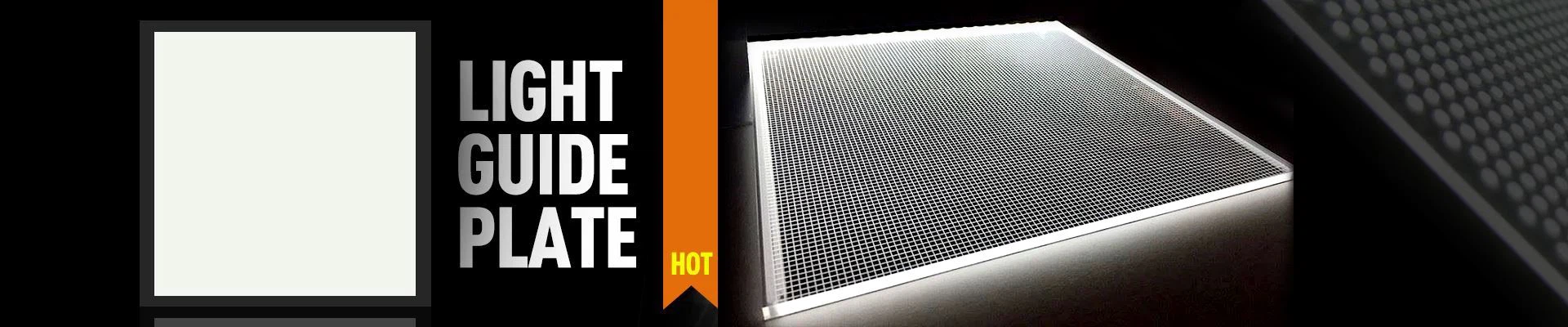


Custom-Shaped Light Guide Plate
Product Name: Custom-Shaped Light Guide Plate
Thickness: 0.7mm, 0.8mm, 1mm, 1.5mm, 2mm, 2.5mm, 2.8mm, 3mm, 4mm, 6mm, 8mm, 10mm
Size: Customizable
Material: PMMA, PC, PS
Light Emitting Process: Laser Dotting, Screen Printing, Screen-Free Printing, Nano Plate
Advantages: Customizable irregular shapes;
High panel uniformity;
Suitable for both indoor a
nd outdoor use.
- Fast Delievery
- Quality Assurance
- 24/7 Customer Service
Product Introduction
Rina Technology Co., Ltd. is one of the leading manufacturers and suppliers of custom-shaped light guide plate in China. Welcome to wholesale durable products in stock here and get quotation from our factory. All customized products are with high quality and low price.
Custom-Shaped Light Guide Plate Product Introduction:
Breaking Form Limitations, Unleashing the Charm of Light and Shadow


The Custom-Shaped Light Guide Plate is a new type of optical component that completely breaks free from the constraints of traditional rectangular light guide plates through special optical design and processing techniques. Its core function remains the same: utilizing the principles of light refraction, reflection, and scattering to transform the line light emitted by side-lit LED light sources into a uniform and soft surface light source. However, thanks to its core advantage of "customized shape," it can perfectly adapt to various non-standard installation spaces and personalized design needs, providing great freedom for the appearance innovation and structural optimization of end products while retaining excellent optical performance.
Compared to traditional standardized light guide plates, the biggest advantage of Custom-Shaped Light Guide Plates lies in their versatility in form. Below are some common custom shapes and their application characteristics:
Custom-Shaped Light Guide Plate Manufacturing Process:
Precision Control for High-Quality Optical Performance
1. Requirements Analysis and Optical Design:
First, based on the customer's specific requirements, optical engineers use professional software to perform optical simulation and design. Core design content includes determining the substrate thickness and refractive index requirements of the light guide plate, and designing the distribution density and size of optical dots according to the contour characteristics of the customized shape. In complex edge areas or areas where light is difficult to reach, the dot density needs to be increased to ensure uniform light emission.
2. Substrate Selection and Pre-treatment:
Commonly used light guide plate substrates are PMMA and PC , materials with high light transmittance, good weather resistance, and processability. Based on the size and complexity of the customized shape, a suitable substrate sheet is selected, followed by pre-treatment, including surface cleaning and static electricity elimination, ensuring the substrate surface is free of impurities to avoid affecting subsequent processing accuracy and optical effects.


3. Precision Mold Making (for Injection Molding):
If mass production of Custom-Shaped Light Guide Plates is using injection molding, a precision mold must be made according to the design drawings. The mold cavity must be precisely machined according to the customized shape. Simultaneously, the designed optical dot pattern is transferred to the mold surface via laser engraving or chemical etching. The precision of the mold directly determines the shape accuracy and dot clarity of the light guide plate; therefore, multiple trial moldings and corrections are necessary during mold making to ensure compliance with requirements.
4. Molding Processing:
Injection molding is suitable for mass production. Pre-treated substrate particles are heated and melted, then injected into a precision mold. After cooling and solidification, the blank is removed, yielding a preliminary Custom-Shaped Light Guide Plate blank. For small batches or highly irregularly shaped products, CNC precision cutting is used. CNC equipment cuts the substrate sheet according to the design path, precisely shaping the customized form.
5. Optical Dot Machining:
If injection molding is not used, optical dot machining is required on the surface of the molded light guide plate blank. Common methods include laser engraving (using a high-energy laser to etch a dot pattern onto the substrate surface, offering high precision and strong pattern controllability), screen printing (printing ink containing a dot pattern onto the light guide plate surface, a lower-cost method suitable for simple dot designs), and nanoimprinting . During processing, the depth and uniformity of the dots must be strictly controlled to avoid incomplete or uneven dot distribution.
6. Edge Treatment and Surface Strengthening:
Custom-shaped light guide plates may have cutting marks or burrs on their edges. These need to be treated with grinding and polishing processes to make the edges smooth and flat, while improving edge reflectivity. Subsequently, the surface of the light guide plate undergoes strengthening treatment, such as spraying an anti-scratch coating (to increase surface hardness and prevent scratches), an anti-glare coating (to reduce light reflection and improve visual comfort), and in some applications, an anti-fingerprint coating.
7. Quality Inspection and Packaging:
After processing, a rigorous quality inspection process is implemented, including: shape accuracy inspection (using a coordinate measuring machine to check the deviation between the actual shape and the design drawings), optical performance inspection (using professional equipment to check indicators such as luminous uniformity, transmittance, and color temperature consistency), and surface quality inspection. Custom-Shaped Light Guide Plates that pass inspection are packaged with anti-static materials to prevent damage or dust contamination during transportation.
Custom-Shaped Light Guide Plate Applications:
Penetrating Multiple Fields, Empowering Product Innovation

- Consumer Electronics

- Automotive Industry

- Home and Commercial Lighting

- Advertising, Media, and Display

RINA TECHNOLOGY
is a high-tech enterprise specializing in research, development, production ,sales of Optical LED products and provide the one step optical lighting solution for customers.Established in 2011, Hong Kong, after years of rapid development, Rina Tech has settled office and factory in Shenzhen,and has professional senior technicians and qualified managers,has a talented team for product research and designing.
Nowadays, we have laser cutting machines, printers, film cutting machines, injection molding equipments,high-standard assembly workshops, BM-7 clean machines and other advanced equipments.
Our factory daily output is more than 80000pcs. to cater for the market at home and abroad.With years of unremitting effort,RINA TECH has passed get the Registration Certificate ofCustoms Declaration Unit of the People's Republic of China , National Credit Cultivation Certificate and Get our own Brand already.
We has made many breakthroughs in researching and manufacturing and has
obtained lots of good reputation from oversea customers.
Now we has cooperated with and become strategic partner of some famous enterprises such as LG, Samsung, Lenovo etc."Living on Sincerity, following with Market, Advancing by Specialty" is our eternal philosophy,and the company motto is "Good at Production, Good for Society".
We look forward to cooperating with you to make the world better and future brighter!
FAQ
Q1: Is there a difference in light transmittance between an Irregularly Shaped Light Guide Plate and a regular light guide plate?
1. Q: How long does it typically take to customize a Custom-Shaped Light Guide Plate?
A: The customization time for a Custom-Shaped Light Guide Plate is affected by various factors. For small batches of simple shapes (such as circles or triangles), if CNC cutting and halftone printing are used, the timeframe is usually 3-7 working days. For large-scale production of complex, irregularly shaped products requiring injection molds, the mold-making timeframe is approximately 15-30 working days. Subsequent mass production timeframes depend on the order quantity, typically 5-10 working days. Specific timeframes can be adjusted based on customer needs and production schedules.
2. Q: What are the maximum size and minimum thickness supported for a Custom-Shaped Light Guide Plate?
A: The maximum size mainly depends on the substrate specifications and processing equipment capabilities. Large light guide plates several meters in size can be achieved using splicing technology. The maximum size of a single light guide plate is typically 2440mm × 1220mm. The minimum thickness is related to material properties and shape complexity. PMMA material can have a minimum thickness of 0.5mm, while PC material, due to its better toughness, can have a minimum thickness as low as 0.7mm. However, excessively thin light guide plates are prone to deformation during complex shape processing, requiring design based on actual needs.
3. Q: How should the substrate of the Custom-Shaped Light Guide Plate be selected for different application scenarios?
A: PMMA (acrylic) substrate has high light transmittance (≥93%) and low cost, suitable for indoor lighting, advertising light boxes, consumer electronics, and other scenarios without special weather resistance requirements. PC substrate has excellent impact resistance, high temperature resistance (withstanding a temperature range of -40℃ to 120℃), and weather resistance, suitable for automotive interiors, outdoor advertising screens, industrial equipment, and other scenarios with high environmental adaptability requirements. If both light transmittance and flexibility are required, PET material can be selected, suitable for flexible curved surface scenarios such as smart wearable devices.
4. Q: What might be the cause of uneven light emission during the use of the Custom-Shaped Light Guide Plate?
A: Common causes include: 1. Inadequate optical dot design, such as insufficient dot density at the edges of complex shapes; 2. Insufficient dot processing precision during manufacturing, resulting in missing or unevenly sized dots; 3. Misalignment of the light source installation position, failing to precisely align with the light-incident surface of the light guide plate; 4. Dust or oil contamination on the surface of the light guide plate, affecting light propagation. These issues can be resolved by optimizing the dot design, checking the light source installation position, and cleaning the surface of the light guide plate.
5. Q: How to perform daily maintenance and upkeep of the Custom-Shaped Light Guide Plate?
A: Daily maintenance precautions include: avoiding scratching the surface with sharp objects to prevent damage to the scratch-resistant coating; when cleaning, use a soft, lint-free cloth or cotton swab dipped in clean water or a special cleaning agent to gently wipe the surface, avoiding the use of corrosive solvents such as alcohol and acetone; when not in use for extended periods, store it in a dry, well-ventilated environment, avoiding direct sunlight and high temperature and humidity environments to prevent substrate aging or deformation; avoid applying excessive pressure during installation to prevent cracks in the light guide plate.
Hot Tags: custom-shaped light guide plate suppliers, factory, customized, price, in stock, LED guide plate


