


Why is the LCD screen we see black?
Mar 24, 2022
The figure below is the basic schematic diagram of the LCD screen. I will briefly explain the process and then explain.
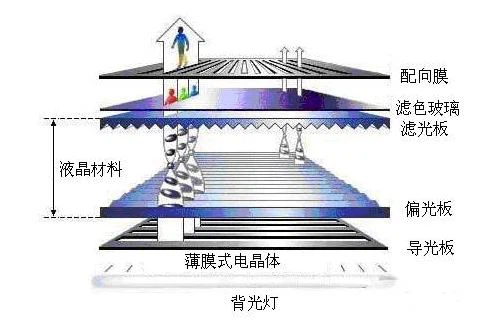
Look from the bottom up. The backlight is a point light source that emits a kind of light that is directed to "all directions" through the light guide plate, and the backlight becomes uniform. The light from "all directions" passes through the polarizer and is filtered. those that cannot pass through. The liquid crystal material is optically active, and can rotate the "horizontal" light slowly when it is rotated to 90°, 270°, etc., and can be completely changed to "vertical", and then pass through the filter plate (this TN type liquid crystal matching method filter plate and When the polarizing plate is 90°), its brightness is 100%; when it is rotated to 180°, 360°, etc., it will completely fail to pass through the filter, and its brightness is 0%; the rest of the angle grayscale is between 0-100%.

At this time, there are only brightness colors between black and white, so each group of 3 liquid crystals passes through the red, green and blue color filter glass respectively to form a group of 3 liquid crystals of three primary colors, 3 colors (the proportion of which is determined by the angle of the liquid crystal rotation). decision) superimposed into a desired color, such a group of liquid crystals, become a pixel.
If you see this and understand it, the following conclusions will be easy to understand. So, why are most of the black and white LCD screens we see coming out black?
Mainly for reasons of cost, necessity and longevity. There is no need to use color, and the cost of color filter glass can be saved. There is no need to combine three primary colors into one. For the same panel, the pixels are tripled. Only black and white can be used, not black-white uniform grayscale. It can reduce the cost of the control circuit (only 0 and 1 are needed = =) The voltage control can also be very arbitrary, it does not need to be very black or very white, it is almost enough, the accuracy of the circuit design is reduced a lot, many circuits and components are used more Less, the higher the life and stability, and the lower the cost. For products that do not have a backlight and use ambient light as the light source, the backlight is also omitted, and the power and energy consumption of the backlight is also omitted. Why not use the background black For the question of displaying white, the answer is that commonly used display panels such as glass and plastic are transparent, and the cost of dyeing glass and plastic black will increase. The display method used by the LCD is based on the principle described above. When the power is off, the liquid crystal does not rotate, the backlight is not turned on, the upper and lower polarizers are perpendicular to each other, and all the light is blocked, so it is black.