

What is an acrylic light guide plate? What is the design principle of the light guide plate and where can it be used?
Oct 25, 2021
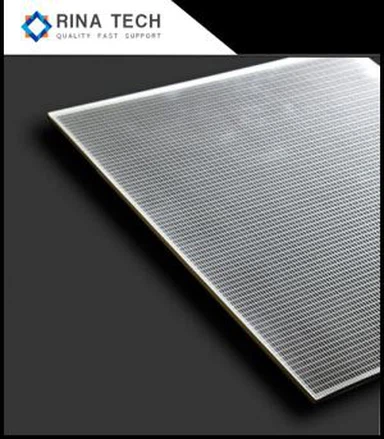
The light guide plate is actually acrylic, also called plexiglass. The difference is that optical grade acrylic is used as the material. The backlight mold line technology is used to pass the high light conductivity of the light guide point. The computer calculates the light guide point to make the light guide plate light. It is refracted into the uniform light state of the surface light source to be manufactured and molded. It's a bit advanced, but it's almost the same as LCD technology. We have mentioned the light guide principle of the ultra-thin light box, and we will introduce it here.
Design principle of light guide plate
The design principle of the widely used light guide plate is derived from the laptop LCD screens we see every day. It uses the principle of spectrum analysis combined with laser engraving or digital printing technology, and is made under constant temperature, constant humidity, and dust-free environmental conditions. It has the distinctive features of ultra-thin and ultra-bright, uniform light guide, energy saving and environmental protection, no dark areas, simple and fast installation and maintenance. At present, the maximum width of the light guide plate can reach 1500mm, the maximum length can reach 3000mm, and the thinnest thickness is 2mm. The larger the size, in order to ensure the brightness, the thickness should be correspondingly increased, and the light guide effect is correspondingly poor, and the thickest light guide plate does not exceed 20mm.
Astigmatism principle of light guide plate
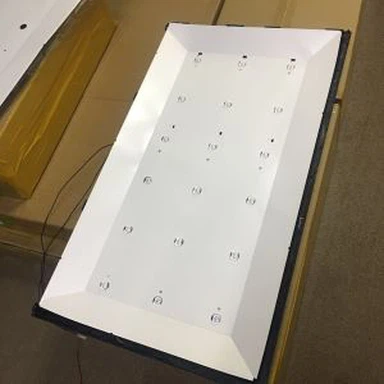
The light guide plate is made by using the injection molding method to press propylene into a plate with a smooth surface, and then use a high-reflectivity and non-light-absorbing material on the acrylic plate, and print a round or square diffusion point on the bottom of the plate by screen printing. , In order to diffuse the light. When the light hits the diffusion point, the light will be reflected in all directions, and then it will be emitted from the front of the light guide plate, destroying the reflection conditions. In order to make uniform light emission, it is necessary to use a variety of sparse and dense, different sizes of diffusion points (sparse and dense, different sizes can ensure that the probability of light reflecting in all directions is roughly the same). The purpose of the reflective plate in the light guide plate is to reflect the light exposed on the bottom surface back into the light guide plate, so as to increase the utilization rate of light and increase the brightness. Although the current manufacturing processes of various light guide plates are different, they all use the principles of light reflection and light scattering.
The production characteristics of the light guide plate
Refractive index: The ratio of the refractive index of the two media is called the relative refractive index. In engineering optics, the refractive index of air is often regarded as 1, and the refractive index of other media is the relative refractive index of air;
Optical waveguide: The phenomenon of total reflection of light electromagnetic waves confines the light waves to propagate in the waveguide and the limited area around it;
Incident angle: when light hits the interface of two media, the angle between the incident light and the normal of the interface;
Reflection angle: the angle between the reflected light and the normal of the interface when the light hits the interface and is reflected;
Dispersion: The phenomenon that the refractive index of a colorless transparent object increases with the decrease of the wavelength of light is called dispersion;
Ultraviolet light: The function of blocking ultraviolet light through the flat transparent body due to the change of the refractive index of the ultraviolet light.
Manufacturing method of light guide plate
1. Professional CNC engraving, as mentioned above, engrave many concave or convex spherical surfaces to reflect light and refract light. The quality of this production method is the best! But the cost is higher!
2. Mold making. The light guide plate made by this method has a general effect, but it is suitable for mass production!
3. Screen printing, using a special ink to print various patterns on transparent plates (such as PMMA material), similar to dots.
After the above-mentioned scientific processing, the transparent acrylic board, as long as the light-emitting body is installed on the side (depending on the area of the light guide plate, you can choose ordinary fluorescent tubes, CCFL cold cathode tubes, light-emitting diodes and other light sources. Generally installed on both sides of the length, the width is comparable It can only be installed on one side for hours), the entire surface of the acrylic plate will emit a bright, uniform and soft light after power on, which is called a light guide plate.
The production of ultra-thin light boxes all use PMMA as the basic material, but because there are too many levels of PMMA, they can generally be understood and controlled. There are two types of PMMA most commonly used in the market: one is for making glasses, the other is for ordinary acrylic sheets for advertising decoration, and the glasses are made of optical-grade PMMA resin. It has the function of anti-ultraviolet rays, and the ordinary acrylic board used in advertising decoration will begin to age in 60 to 120 days under strong light. Nowadays, the yellowish ordinary light boxes are a good example.
Optical-grade PMMA sheets are divided into single-film and multi-film. Generally, optical-grade PMMA sheets are only single-film. If it is to be made into a backlight, a lot of reflection or diffusion films must be added to prevent light from outside. The multi-film optical grade PMMA sheet means that the refractive index of both sides is greater than the refractive index of the middle layer, so that light can not break out of the surface layer, and can transmit light like an optical fiber. The light travels as a geometric waveguide in the multimode optical PMMA board. To change the light transmission mode, a transparent PMMA micron material with high refractive index must be added to effectively control the uniformity of the light.
In the design of ultra-thin light box, Yichen makes full use of the light source to make the light box achieve the best advertising effect. Because we have light guide plates with very special principles, the design of each of our ultra-thin light boxes is very energy-saving.
The production characteristics of the light guide plate
Refractive index: The ratio of the refractive index of the two media is called the relative refractive index. In engineering optics, the refractive index of air is often regarded as 1, and the refractive index of other media is the relative refractive index of air;
Optical waveguide: The phenomenon of total reflection of light electromagnetic waves confines the light waves to propagate in the waveguide and the limited area around it;
Incident angle: when light hits the interface of two media, the angle between the incident light and the normal of the interface;
Reflection angle: the angle between the reflected light and the normal of the interface when the light hits the interface and is reflected;
Dispersion: The phenomenon that the refractive index of a colorless transparent object increases with the decrease of the wavelength of light is called dispersion;
Ultraviolet light: The function of blocking ultraviolet light through the flat transparent body due to the change of the refractive index of the ultraviolet light.
Manufacturing method of light guide plate
1. Professional CNC engraving, as mentioned above, engrave many concave or convex spherical surfaces to reflect light and refract light. The quality of this production method is the best! But the cost is higher!
2. Mold making. The light guide plate made by this method has a general effect, but it is suitable for mass production!
3. Screen printing, using a special ink to print various patterns on transparent plates (such as PMMA material), similar to dots.
After the above-mentioned scientific processing, the transparent acrylic board, as long as the light-emitting body is installed on the side (depending on the area of the light guide plate, you can choose ordinary fluorescent tubes, CCFL cold cathode tubes, light-emitting diodes and other light sources. Generally installed on both sides of the length, the width is comparable It can only be installed on one side for hours), the entire surface of the acrylic plate will emit a bright, uniform and soft light after power on, which is called a light guide plate