

Light Guide Plates vs. Diffuser Plates: Which is Right for Your Project?
Oct 12, 2022
When it comes to lighting, there are a lot of different factors to consider. One of the most important decisions you'll make is deciding between light guide plates and diffuser plates. Both have their benefits, but which one is right for your project? In this blog post, we will discuss the difference between light guide plates and diffuser plates, and help you decide which one is right for you!
Generally, we distinguish the light guide plate and diffuser plate from four aspects.
Material
The base material of a diffuser plate is typically polycarbonate (PC), while the base material of a light guide plate is typically polymethyl methacrylate (PMMA). While both materials have their advantages, PC is generally more durable and heat-resistant, while PMMA offers better clarity and transparency. In terms of performance, diffusion boards provide more evenly diffused lighting, while light guide boards allow for more control over the direction of light.PMMA material is much more expensive than PC material because of its good optical properties and better light transmittance than PC material. PC material diffusion plate mainly makes light dispersion and makes uniform distribution on the panel. Of course, PC material also has the advantage that PC material is more resistant to moisture than PMMA material, PMMA material is easily deformed by water absorption. As a result, each type of board has its own advantages and disadvantages, and the best choice for a given project will depend on the specific requirements.
Function
The main role of the diffuser plate
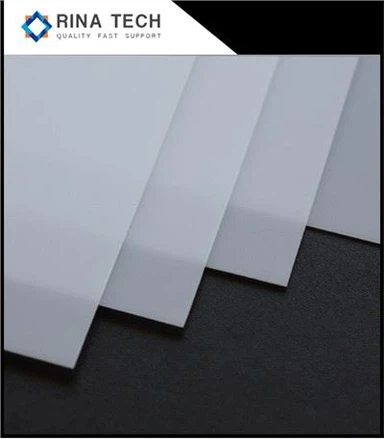
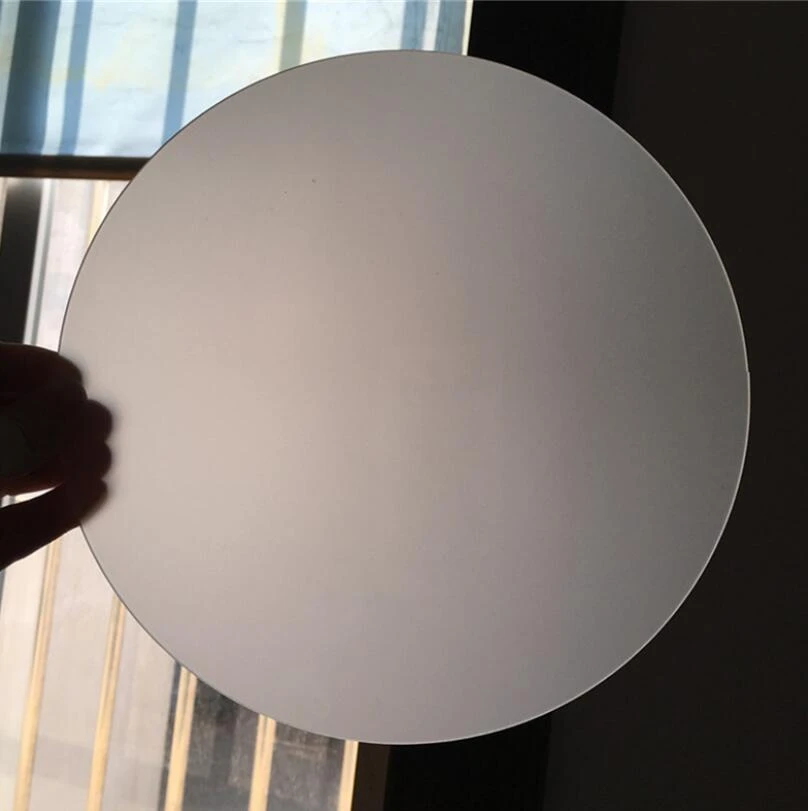
A diffuser plate is an essential component of a backlight system, and its primary purpose is to distribute light evenly. A diffuser plate consists of a clear glass or plastic sheet with a frosted or textured surface. This surface helps to scatter the light, creating a more even distribution of light. In addition to creating a more uniform light source, a diffusion plate also protects the optical materials below from damage. By scattering the light and evenly distributing it across the surface of the plate, a diffusion plate helps to create a more uniform illumination, making it an essential component of any backlighting system.
The main role of the light guide plate
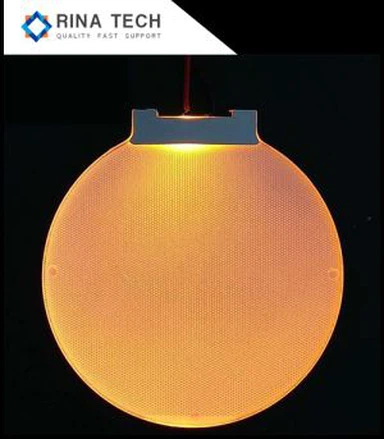
The light guide plate is an important part of the LED lamp. It has the functions of guiding light and distributing light. The main role of the light guide plate also has two, one is to guide the LED light point source of luminous flux uniformly distributed throughout the face, that is, for the guidance of light distribution. The second is to use the reflection mechanism for greater efficiency in the use of luminous flux and control of light distribution. The material used for the light guide plate is generally a plastic material with good transparency and high hardness. It has good wear resistance and can be used for a long time. In addition, it has high safety and can be used with confidence.

Working Principle
A diffuser plate is a layer of material that helps to scatter light in a uniform pattern. It is often used in display lighting components, where it is important to have an evenly lit surface. The diffuser plate works by refracting and reflecting light off of diffusion particles within the medium, which causes the light to be scattered in multiple directions. This results in a more even distribution of light, which makes it easier to see the display. Diffuser plates are made from materials like PC/PMMA/PS, which have a high refractive index and are good at scattering light. By using a diffuser plate, display manufacturers can provide a better viewing experience for their customers.
The principle of the light guide plate is the use of an optical grade acrylic sheet to absorb the light from the lamp to stay on the surface of the optical grade acrylic sheet, when the light is shot to each guide point, the reflected light will spread to all angles, and then destroy the reflection conditions by the front of the light guide plate shot. A variety of sparse, different sizes of light guide points, can make the light guide plate uniform light. The use of this principle can make the display screen have a good uniformity of color and brightness while reducing the viewing angle dependency of liquid crystal displays.
Appearance
The side light is the most important feature of the light guide panel light. The side light is the light from the side of the lamp. It enters the light guide and is refracted from the front of the light. Therefore, the light guide is also the core device of the panel light. If there is no side light, the panel light is unable to emit the front light. In addition, the panel light has good uniformity, high brightness, and low power consumption. It is an energy-saving and environmentally friendly product. It is widely used in offices, homes, and other indoor lighting.
The light guide plate does not have very regular light from the light guide, and from the surface of the panel light without a diffuser plate kind of dense network, dense phobia of friends must be very unbearable, this time it is necessary to diffuse the light guide plate will be uniform, the effect of diffusion and material haze, at the same time, high fog will also affect the light rate, which is a contradiction. The main purpose of the diffuser plate is to scatter the light source so that the surface of the object has a more uniform brightness, thus increasing the three-dimensional impression. When selecting a diffuser plate, its color (light color), thickness, and optical properties should be considered first. Only when these three indicators meet our requirements can we better serve our purpose. Secondly, in the actual use process still need to pay attention to two points: one is to try to avoid using off-the-shelf PMMA material made of white plastic products; the second is when fixing should pay attention to1390 hot melt adhesive layer or material do not damage diffusion. In addition, although there are many advantages to using a diffuse board, we also need to be aware of some of its shortcomings. For example, when used for backlighting purposes, because it scatters light in all directions, about 30% of light is lost; and in terms of internal stress caused by uneven heating during processing Diffuse plate may cause curvature and poor flatness. Therefore, we need to carefully consider all factors before deciding whether or not to use a diffuse plate. In short, whether we need to use a diffuse plate depends on the specific situation. If we choose to use it, we should also pay attention to its selection and use.
In addition to its role in diffusing light, the diffusion plate also helps to protect the light guide. The light guide is extremely easy to scratch and is also susceptible to sticky dust. As a result, the diffusion plate must be placed over the light guide in order to protect it. While the diffusion plate does not completely eliminate the risk of damage, it does significantly reduce it. In addition, the diffusion plate also helps to ensure that the light emitted by the light guide is evenly distributed. Without the diffusion plate, the light would be concentrated in a small area, which would eventually lead to damage. As a result, the diffusion plate plays an essential role in protecting the light guide and ensuring that it emits evenly distributed light.