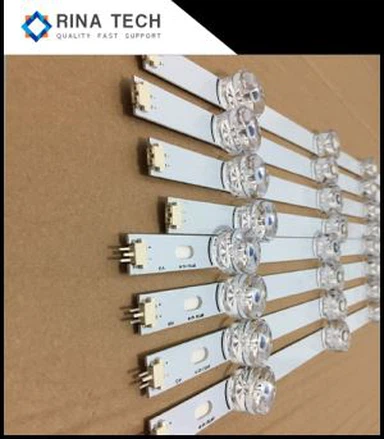


Isn’t the backlight the same concept as the backlight module?
Sep 17, 2021
Back Light Unit (Back Light Unit) is the provider of liquid crystal display (LCD) light source. LCD itself does not emit light. The performance of the light source of the backlight module determines the visual perception of the display. Liquid crystal displays are light and light due to their thin thickness. Moreover, it is easy to carry, and the demand has increased rapidly in recent years, and it has been able to occupy a place in the CRT market.
The structure of the backlight module, incident light source (lamp, LED or EL etc.) Light Guide Plate (Light Guide Plate) Reflector (Reflector) Prism sheet (prism sheet). Lamp reflector (lamp reflector) Outer frame.
What is a backlight module? What is it used for?
The Back Light Modul is one of the key components of the LCD Panel. Since the liquid crystal itself does not have luminous characteristics, a light source must be added to the bottom of the LCD panel to achieve full color display. As a result, the function of the backlight module is to supply sufficient brightness and uniformly distributed planar light sources, so that the LCD can display images normally.
At present, the main product categories of backlight modules include: light-emitting diodes (LED), tungsten halogen lamps, electroluminescence (ELD), cold cathode fluorescent lamps (CCFL), cathode emitting lamps (CLL), and metal halide lamps.
Among them, the technology is mature and the performance is stable. The backlight source commonly used on color liquid crystal displays (TFT-LCD) is cold cathode fluorescent lamp (CCFL); the LED backlight source is commonly used on LCDs with a small area, especially for uniform light emission. High-efficiency side backlights are the main ones, and LED backlights are mainly used in LCD display panels such as mobile phones, PDAs, game consoles, household appliances, meters, instruments, digital products, automotive application parts and other products.
What is the backlight module?
LCD liquid crystal display is the abbreviation of Liquid Crystal Display. The structure of LCD is to place liquid crystals in two parallel pieces of glass. There are many small vertical and horizontal wires between the two pieces of glass. The rod-shaped crystal molecules are controlled by whether or not electricity is applied. Change the direction and refract the light to produce the picture.
The LCM liquid crystal display module is a component that assembles liquid crystal display devices, connectors, integrated circuits, PCB circuit boards, backlight sources, and structural parts. The English name is "LCD Module", abbreviated as "LCM", and it is generally called in Chinese "LCD Module".
In fact, it is a kind of commercialized component. According to the relevant national standards of our country, only the inseparable integrated components are called "modules", and the detachable ones are called "components".
Therefore, the standard name should be called "liquid crystal display assembly".
But because people have been accustomed to call it "module" for a long time.
That is to say, the difference between lcd and lcm can be drawn, so what is the difference between lcd and lcm: lcd is a display screen, lcm is a collection of various devices including lcd and controlling lcd display mode and content, such as chips and circuit boards.
It can be said that lcd is the front desk for displaying content, and lcm is the entire operating system including the front desk.
What is the backlight module?
The main components of liquid crystal displays are liquid crystal modules, and the main components of liquid crystal modules include open cell (glass and PCB) and backlight modules.
Because the liquid crystal is not a self-luminous material, it is necessary to provide a light source separately.
If the light source is placed behind the open cell, it is called a backlight module.
It is called a module because the backlight is composed of many parts.
Generally, it mainly includes light source (such as CCFL, LED), LGP (converting line or point light source into surface light source), optical film (generally including lower diffuser, prism film, upper diffuser), plastic frame, back plate (from Support and fixation).