

Analysis of the structure and main performance of polarizers for LCD
Sep 11, 2018
Polarizers, which are one of the main raw materials for liquid crystal displays (LCDs), account for about 20% to 30% of their manufacturing costs. However, since the manufacturing technology of polarizers has been monopolized by countries such as Japan and Korea, the introduction of polarizers Very little information. This paper takes the polarizer of TN type LCD as an example to introduce some problems that many LCD polarizer users are more concerned about.
Structure of polarizer
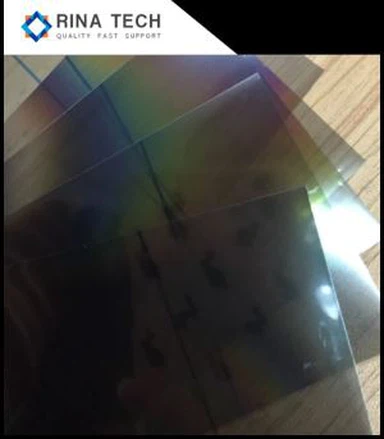
The polarizer is an optical film which is composed of a plurality of polymer materials and has a function of generating polarized light. According to the position of the liquid crystal screen, it can be roughly divided into a patch (also referred to as a transmissive sheet) and a negative film. Two kinds (also called reflection sheets), the following figure is a schematic diagram of the cross-section structure of the face and the film of a typical TN type polarizer:
Material and main functions of each layer
Polarizing layer: It is made by dyeing and stretching PVA (polyvinyl alcohol) film, which is the main part of polarizer, also called polarizing film. The polarizing layer determines the polarizing performance and transmittance of the polarizer, and is also a major part of the color tone and optical durability of the polarizer. The basic processing technology of the polarizing layer can be divided into two series of dyeing and iodine according to the dyeing method. According to the stretching process, it can be divided into two series: dry stretching and wet stretching. The materials and processing techniques can be changed. Adjustment of polarization, transmittance, hue and optical durability. TAC layer: The polarizing layer made of PVA film is easy to absorb water, fade and lose polarizing properties. Therefore, it is necessary to use a layer of TAC (cellulose triacetate) film with good optical uniformity and transparency on both sides to isolate moisture and Air, protect the polarizing layer. An anti-ultraviolet polarizer and an anti-glare polarizer can be produced by using a TAC film having a UV CUT and an Anti-Glare function.
Adhesive: It can be divided into a reflective film side adhesive and a release film side adhesive. The function of the reflective film side adhesive is to firmly bond the reflective film to the TAC film, and the process requirements do not allow re-peelability. The release film side adhesive is a laminated sensitive adhesive, which determines the adhesive performance and the processing performance of the polarizer, and its performance is one of the most concerned problems for LCD polarizer users. Separate film: PET (ethylene terephthalate) film coated with silicon coating on one side, mainly plays a role in protecting the pressure-sensitive adhesive layer, and the peeling force is on the LCD patch. The workability at the time has a certain influence.
Protective film: A PE (polyethylene) film coated with an EVA layer (ethylene vinyl acetate copolymer) on one side, which has a low viscosity and functions to protect the surface of the TAC film.
Reflective film: A PET film that is a single-sided evaporated aluminum. Currently, a non-directional reflective aluminum film is often used. If the reflective film is replaced with a transflective film, a transflective polarizer can be fabricated. In addition, various gold plating, silver plating film, and laser film can be used as the reflective film to obtain various background colors and mirrors. Reflection and other effects.
Main performance indicators of polarizers
Table 1 is a typical polarizer performance table. The following is a description of each project indicator:
1. The direction of the absorption axis The size of the polarizer for the TN type LCD which is usually commercially available is mainly the following two types:
The direction of the absorption axis is as shown in the figure. If the polarizer is supplied to the LCD manufacturer in a special size, the absorption axis should be marked or described.
2, Transmittance (Transmittance) 透过 polarizer transmittance index can be divided into single (single), parallel (Parallel), straight (Crossed) three items. It is usually measured in accordance with JIS-Z-8701 using an integrating sphere spectrophotometer. The monomer transmittance refers to the transmittance of the single polarizer, and the parallel transmittance (H0) refers to the transmittance of the two polarizers parallel to the absorption axis, and the orthogonal transmittance (H). 90) refers to the transmittance of two polarizers with orthogonal absorption axes. In these three indicators, H0 and H90 affect the brightness (H0) and contrast of the LCD screen (H0). /H90) is very important for LCD manufacturers. In order to obtain a high-brightness and high-contrast display, H0 is as high as possible and H90 is as small as possible.
3. The Hue hue is represented by the values of a and b, and is usually measured using an integrating sphere spectrophotometer. a, b value is the color coordinate value in the CIE (International Commission on Illumination) Lab color system, and the approximate color corresponding to a set of a and b values can be found from the color coordinate map.
4. Polarizing Co-Efficiency Polariton (ν) is a calculated value used to represent the overall efficiency of polarized light produced by a polarizer. This formula can be converted to H0/H90=(1). +ν2)/(1-ν2), it can be seen that the closer the ν value is to 100%, the higher the contrast (H0/H90).
5. Peeling force The peeling force of the polarizer is further divided into protective film peeling force, peeling film peeling force, and peeling force on the glass substrate. The measurement of the three peeling forces was carried out by using a tensile tester in accordance with the JIS-C-2107 standard, in which the peeling force of the protective film and the peeling force of the peeling film were measured in the direction of 180°, and the direction of the glass substrate was in the direction of 90°. Stripped. For LCD manufacturers, polarizers are important for the release properties of glass substrates. If the peeling is difficult within a short time (4 to 6 hours) after sticking or there is residual glue on the glass plate after peeling, the polarizer has poor reworkability, and the poor placement of the film may cause the entire LCD screen to be scrapped. However, if the peeling force is small, the pressure-sensitive adhesive has poor durability and moisture resistance after the polarizer is attached to the glass substrate, and the surface of the peeling film is depressed, which affects the performance of the polarizer.
6. Durability The durability test of the polarizer is to peel off the release film and the protective film and then attach it to the glass substrate. After degassing by pressure, it is placed in a constant temperature and humidity chamber to observe the changes before and after the experiment. . Among them, the foaming and peeling index is mainly to evaluate the durability of the adhesive, and the optical change index is to evaluate the durability of the PVA layer. The durability requirements of polarizers should be based on the design requirements (use environment) of different types of LCD products