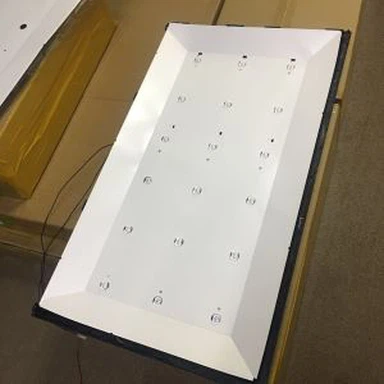


Definition And Structure Of Backlight Module
May 21, 2021
The backlight module is a component that provides suitable (required specifications) light to the Panel.
Backlight is the optics that provides a back light source in LCD display products As a result, the quality of the backlight determines the brightness, uniformity of the emitted light, and color gradation of the LCD screen and other important parameters, and to a large extent determines the luminous effect of the LCD screen. 1.2 The position of the backlight module in the LCD display. Side-lit backlight module 1. Definition and structure of backlight module Direct-type backlight module 1. Definition and structure of backlight module 2.1 Backlight source and classification ★ Cool by light source type Cathode Tube Fluorescent Lamp (CCFL) Light Emitting Diode (LED) Electroluminescence (EL) ★ According to the distribution of the light source, direct-lit backlight (bottom backlight), side-light backlight 2. Brief introduction of module components 2.1.1 CCFL and light-emitting principle CCFL (Cold Cathode Fluorescent Lamp) is abbreviated as CCFL, which is translated as cold cathode fluorescent lamp in Chinese. It has the advantages of high power, high brightness, and low energy consumption. It is widely used in display, lighting and other fields. Because the CCFL tube has small tube size, simple structure, low tube surface temperature, high surface brightness, and easy processing into various shapes (straight tube shape, L shape, U shape, ring shape, etc.); long service life, display It has the advantages of good color, uniform light emission, etc.; therefore, it is also an ideal light source for TFT-LCD at present, and it is also widely used in advertising light boxes, scanners and backlights. Module composition material introduction CCFL structure Electronic electrode (Ni, W) Glass Visible light fluorescent agent Mercury ultraviolet Noble gas The principle of CCFL plus high-voltage high-frequency electric field (emission of electrons) The electron and inert gas collide with the second electron and mercury vapor collide and release Ultraviolet rays collide with fluorescent agents to emit visible light. Cold Cathode Fluorescent Lamp module composition material introduction 2.1.2 LED and light-emitting principle LED (Lighting Emitting Diode), or light-emitting diode, is a semiconductor solid light-emitting device. It uses a solid semiconductor chip as a luminescent material. The excess energy is emitted by the recombination of carriers in the semiconductor to cause photon emission, which directly emits red, yellow, blue, green, cyan, orange, purple, and white light. The core part of the light-emitting diode is a wafer composed of a P-type semiconductor and an N-type semiconductor. There is a transition layer between the p-type semiconductor and the n-type semiconductor, which is called a PN junction. In the PN junction of certain semiconductor materials, when the injected minority carriers and the majority carriers recombine, the excess energy is released in the form of light, thereby directly converting electrical energy into light energy. With reverse voltage applied to the PN junction, it is difficult to inject minority carriers, so it does not emit light. Brief introduction of module composition materials Visible light LED (450~680nm) Invisible light LED (850~1550nm) According to the emission wavelength class ternary compound LED (such as AlxGa1-xAs, AlxGa1-xP) Quaternary compound LED (such as AlInGaP, InAlGaAs, AlxGa1- xAsyP1-y) Binary compound LEDs (such as GaAs, GaSb, GaN) Classification of LEDs according to their constituent elements Classification of LEDs LED classification a. The pin-type package is the commonly used A3-5mm package structure. Generally used in LED packages with low current (20-30mA) and low power (less than 0.1W). It is mainly used for instrument display or indication, and can also be used as a display screen during large-scale integration. The disadvantage is that the package has a large thermal resistance (generally higher than 100K/W) and a short life. b. Surface Mount Technology (SMT) is a packaging technology that can directly paste and solder the packaged device to a designated position on the PCB surface. c. COB is the English abbreviation of Chip On Board (Chip On Board Direct Mounting). It is a kind of LED chip that is directly pasted to the PCB board through adhesive or solder, and then the electrical interaction between the chip and the PCB board is realized through wire bonding. Even the packaging technology. d. SiP (System in Package) is a new type of package integration method developed on the basis of System on Chip (SOC) in order to meet the requirements of portable development and miniaturization of the whole machine in recent years. LED lamps are classified according to package structure. Blue LED yellow phosphor. Advantages: simple structure, high luminous efficiency. Disadvantages: less red light component, poor reducibility of about 65%. 1 2 RGB phosphor near ultraviolet LED advantages: good color reproducibility Disadvantages: ultraviolet light Accelerate the aging of encapsulation resin and phosphors. Blue LED+yellow phosphors emit pseudo-white UV, near-ultraviolet LED+RGB phosphors and form a white LED light mixing structure Advantages: no external light mixing, compact B/L structure Disadvantages : It is greatly affected by current and heat dissipation, and there are problems with good performance chip packaging. R-LED G- LED B- LED R-LED G- LED B- LED 3 RGB three-color LED integrated package white LED 4 single RGB three-color LED White light produced by color mixing Advantages: separate heat dissipation device