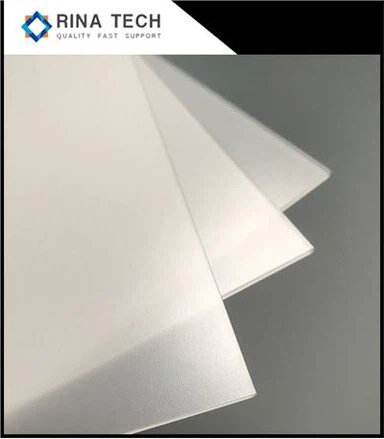


The concept, working principle of reflective sheet
Nov 25, 2021
The reflective film is a part of the constituent materials of the LCD backlight module. It is located at the bottom of the backlight module
and under the light guide plate. Its function is to reflect the light that leaks through the light guide plate below and then return to the panel side.
So as to achieve the effect of reducing light loss and increasing brightness.

The types of LCD reflective sheet are mainly divided into two categories: white reflective film and silver-plated mirror reflective film.
White reflective film can be divided into white polyester reflective film and white polypropylene reflective film according to the material, of which white polyester reflective film accounts for more than 99.8%.
According to the structure, the white reflective film can be divided into a reflective film coated with a high-reflectivity coating and a reflective film without a coating.
The white reflective film can be used for backlight modules of all sizes, while the silver-plated mirror reflective film is mainly used for small and medium-sized backlight modules such as mobile phones and notebook computers.
The reflectivity of the reflector film is generally required to be above 96%, and after coating a high-reflectivity coating or after the mirror surface is plated with silver,
the reflectivity will increase to above 97%, and the highest will reach 100%.
The reflective film was originally a low-density white polyester film introduced by Toray, Japan, and was first applied to flat panel displays.
◤ The working principle of reflective film
When light is projected onto the surface of the reflective film, since the opacity of the reflective film is more than 99%, most of the light is reflected on the surface.
There is a one-to-one correspondence between the incident light and the reflected light of the silver-plated mirror reflection film. Specular reflection occurs. The higher the surface gloss of the reflection film, the higher the reflectivity.
The fine uneven structure on the surface of the white reflective film causes light to be reflected in multiple directions, that is, diffuse reflection, which is the main reflection method of the white reflective film.
For white reflective film, in addition to surface scattering, part of the light is refracted into the film medium. Due to the large amount of fillers and/or microbubbles inside the film, the light will be reflected, refracted and re-reflected when encountering these foreign objects. Especially the refractive index of the medium in the microbubble is 1.0, the light will be reflected on the inner surface of the microbubble, and will be refracted at a larger angle.
All these complicated internal structures prevent the light from being able to pass through the film medium smoothly, and then change the light path to reflect back to the surface of the film.
Therefore, the white film not only requires high opacity, but also requires less than 40% of the surface gloss at a 60° angle.
If a white coating or a mirror coating is applied to the back of the film, the reflectivity will also be improved.