

LCD screen LCD module work
Oct 08, 2018
LCD screen LCD module works
The physical characteristics of the liquid crystal are: when the power is turned on, the arrangement becomes orderly, so that the light is easily passed; when the power is not supplied, the arrangement is disordered, and the light is prevented from passing. Let the LCD block like a gate or let light penetrate. Technically speaking, the LCD panel contains two fairly fine sodium-free glass materials called Substrates with a layer of liquid crystal in between. When the light beam passes through the liquid crystal layer, the liquid crystal itself will stand or twist in an irregular shape, thereby blocking or allowing the light beam to pass smoothly. Most liquid crystals are organic complexes composed of long rod-shaped molecules. In the natural state, the long axes of these rod-shaped molecules are substantially parallel. The liquid crystal is poured into a well-machined slotted plane, and the liquid crystal molecules are arranged along the groove, so if the grooves are very parallel, the molecules are also completely parallel.
Liquid crystal is an organic compound that exhibits fluidity of both liquid and optical anisotropy of crystal under normal temperature conditions, and is therefore called "liquid crystal". In external conditions such as electric field, magnetic field, temperature, stress, etc. Under the influence, the molecules are easily rearranged, and the various optical properties of the liquid crystal change accordingly. The anisotropy of the liquid crystal and its molecular arrangement are easily controlled by the applied electric field and magnetic field. It is the physical basis of using this liquid crystal. , that is, the "electric-optical effect" of the liquid crystal, the light is modulated by the electrical signal, thereby forming a liquid crystal display device. Under the action of different current electric fields, the liquid crystal molecules are regularly rotated by 90 degrees to produce a difference in transmittance, so The difference between light and dark is generated under the power ON/OFF, and each pixel is controlled according to this principle to form a desired image.
Monochrome LCD principle
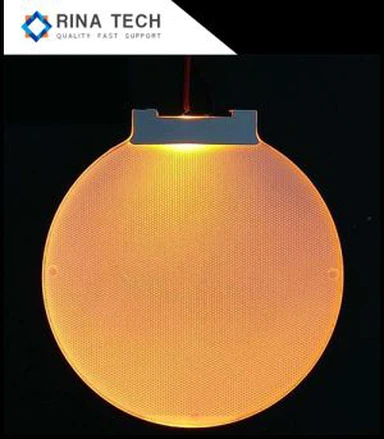
From the structure of the liquid crystal display, whether it is a notebook computer or a desktop system, the LCD display screen is a layered structure composed of different parts. The LCD consists of two glass plates with a thickness of 0.7mm, 0.63mm, and 0.5mm (which can also be made thinner by physical or chemical thinning), with a uniform thickness of 3~5μm including liquid crystal (LC) material. Separated by intervals. Because the liquid crystal material itself does not emit light, it is necessary to configure an additional light source for the display screen. On the back of the liquid crystal display screen, there is a light guide plate (or a uniform light plate) and a reflective film. The main function of the light guide plate is to convert the line light source or the point light source. A surface light source that is perpendicular to the display plane. Light from the backlight enters the liquid crystal layer after passing through the first layer of polarizing filter. The crystal droplets in the liquid crystal layer are all contained in a small cell structure, and one or more cells constitute one pixel on the screen. Between the glass plate and the liquid crystal material is a transparent electrode, the electrode is divided into rows and columns, at the intersection of the rows and columns, by changing the voltage to change the optical rotation state of the liquid crystal, the liquid crystal material acts like a small light valve. Around the liquid crystal material are a control circuit portion and a drive circuit portion. When the electrodes in the LCD generate an electric field, the liquid crystal molecules are distorted, and the light passing through them is regularly refracted, and then filtered through the second layer of the filter layer to be displayed on the screen.
LCD technology is to fill the liquid crystal between two planes with fine grooves. The grooves in the two planes are perpendicular to each other (intersecting at 90 degrees). That is to say, if the molecules on one plane are arranged in the north-south direction, the molecules on the other plane are arranged in the east-west direction, and the molecules located between the two planes are forced into a state of 90-degree twist. Since the light propagates in the direction in which the molecules are arranged, the light is also twisted by 90 degrees as it passes through the liquid crystal. When a voltage is applied to the liquid crystal, the liquid crystal molecules will rotate to change the light transmittance, thereby achieving multi-gray display.
The LCD is dependent on the polarizing filter (slice) and the light itself. Natural light is randomly scattered in all directions. A polarizing filter is actually a series of increasingly thin parallel lines. These lines form a net that blocks all light that is not parallel to these lines. The line of the polarizing filter is exactly perpendicular to the first one, so it can completely block the light that has been polarized. Only when the lines of the two filters are completely parallel, or the light itself has been twisted to match the second polarizing filter, the light is penetrated.
The LCD is made up of two mutually perpendicular polarizing filters, so under normal circumstances all light that is trying to penetrate should be blocked. However, since the two filters are filled with twisted liquid crystals, after the light passes through the first filter, it is twisted by the liquid crystal molecules by 90 degrees, and finally passes through the second filter.