

Design scheme of light guide plate:
Feb 24, 2022
1. Design scheme of light guide plate:
The laser network solution has the following characteristics:
1. Combined with different acrylic materials and different ways of use, it is possible to use a uniform and unified laser dot layout, or to make a dot layout of different sizes according to different specifications and use ways. To achieve the perfect unity of commonality and exclusivity.
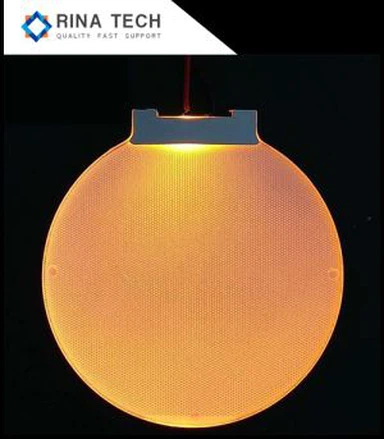
2. The light guide is more uniform, and the evenness can reach 90% or more.
3. Effective use of the dense reflection of the surrounding small points and the "skewing" function of the large point in the middle, there is no dark pattern and "black hole" at all. And can create special effects.
Second, the classification of the light guide plate:
1. By shape
Flat plate: The light guide plate is rectangular when viewed from the light source.
Wedge-shaped plate: also known as the inclined plate, from the point of view of the light, one side is thick and the other is thin into a wedge (triangle) shape.
2. By outlets
Printing: After the light guide plate is processed, the dots are printed on the reflective surface by printing, which is divided into IR and UV.
Non-printing type: The dots are directly formed on the reflective surface when the light guide plate is formed. It is further divided into chemical etching (Etching), precision mechanical characterization (V-cut), photolithography (Stamper), and internal diffusion.
3. Follow the incoming light
Side light type: place the illuminant (light tube or LED) on the side of the light guide plate.
Direct type: place the illuminant (light tube or LED) under the light guide plate.
4. Press to shape
Injection molding: use an injection molding machine to inject optical grade PMMA particles into the mold with high temperature and high pressure to cool and form.
Cutting and forming: The optical grade PMMA original board is cut to complete the finished product.