

Classification And Knowledge Points Of LCD Backlight Panels
Aug 31, 2021
Classification and knowledge points of LCD backlight panels
The backlight is an optical component that provides a back light source in LCD display products. Since the liquid crystal glass itself does not have light-emitting characteristics, a light-emitting source, that is, a backlight plate, is added behind the liquid crystal glass as needed. The scope of application covers medical treatment, beauty, instrumentation, vehicle equipment, industrial equipment, bank terminals, office automation, communications, electronic toys and consumer products.
The working principle of the backlight board:
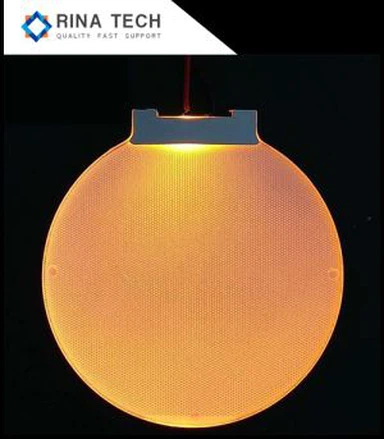
The working principle of the LED backlight panel is to turn a point light source (LED) into a surface light source (backlight panel, backlight source)
Backlight panel classification:
Backlight panels currently have three types of backlight panels according to light source types: EL, CCFL, and LED. Depending on the location of the light source, they are divided into side-light type and direct-light type (backlight type).
The following is a brief introduction of them:
◆Edge light type: the back light board made by setting the linear or point light source on the side of the specially designed light guide plate. According to the needs of actual use, it can be made into two-sided or even three-sided. Edge-lit backlights can generally be made very thin, but the light utilization rate of the light source is small, and the thinner the light source, the smaller the utilization rate, about 50%. The core of its technology is the design and production of light guide plates. Commonly used edge light types are LED backlight and CCFL backlight.
◆LED lamp backlight: LED lamp is also called light-emitting diode. Compared with other light sources, the power consumption of a single LED lamp is very small. From blue to red, LED lights come in many colors, such as "Table 1" and "Table 2"; there is also a special color that is white. "Table 3" gives the commonly used chromaticity range. In various colors, it can be roughly divided into two types: highlight and low brightness: Basically, "Table 1" belongs to low brightness (although amber, orange and red also have slightly brighter colors), "Table 1" Two" and "table three" are highlighted.
Since white is a mixed color, there is no identifiable wavelength value, so it is represented by its coordinate value on the chromaticity diagram. We customize it as "cool white" and "warm white". In various colors, there is a problem of color deviation. Among them, blue and white are more obvious, especially white. Now LED suppliers can't effectively control it.
◆CCFL backlight: The great advantage of this kind of backlight is high brightness, so the large area black and white negative phase, blue mode negative phase and color liquid crystal display devices basically use it. In theory, it can make a variety of colors based on the color matching principle of the three primary colors. The disadvantage is that it consumes a lot of power and requires inverter circuit drive, and the operating temperature is narrow, between 060 degrees, while other backlight boards such as LEDs can reach between -2070.
◆Backlight type: It is a flat surface light source with a certain structure, which can be a continuous and uniform surface light source, such as EL or flat fluorescent lamp; it can also be composed of more point light sources, such as dot matrix LED or incandescent lamp. Backlight board, etc. Commonly used are LED dot matrix and EL backlight.
◆ EL backlight: electroluminescence, a cold light source that relies on the intrinsic luminescence of phosphors excited by an alternating electric field. Its great advantage is that it is thin and can achieve a thickness of 0.20.6mm. The disadvantages are low brightness, short life span (usually 30005000 hours), inverter drive is required, and flicker, noise and other defects may occur due to circuit interference. There are two types of EL drivers: inverter and Driver IC.
Because the frequency and load output voltage of the current Driver IC cannot reach the typical conditions of EL (400Hz, AC100V), the brightness is lower than that of the inverter drive. Recently, white light (full-color) EL and LCD backlight panels have also come out. However, due to the low brightness, it is basically used for small size LCD displays below 4 inches. Such as: mobile phones, PDAs, game consoles, etc. Full-color (white light), large-size brightness backlight panels, and now the mainstream is still using CCFL as the light source.
◆LED bottom backlight: The advantages are good brightness and good uniformity. The disadvantage is that the thickness is large (greater than 4.0mm), the number of LEDs used is large, and the heating phenomenon is obvious. Generally use low-bright colors for design, while high-bright colors are basically not considered due to the high cost