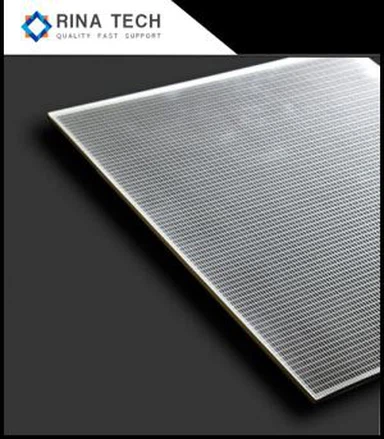

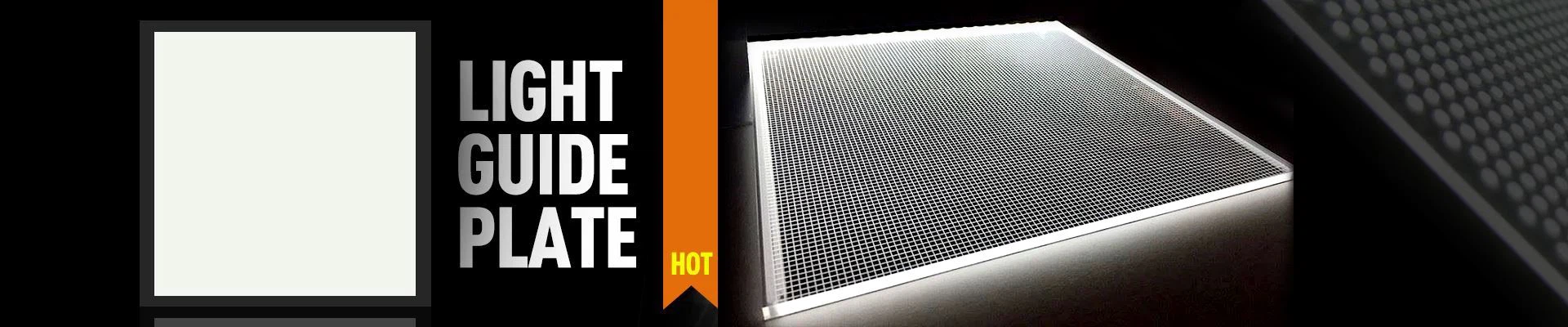




LGP For LED
Product Name: LGP For LED
Material: PMMA, PC, PS
Size: Customizable
Thickness: 0.4mm and above (customizable)
Advantages:
Lightweight and thin design with support function
Light source conversion function
Brightness and uniformity control function
- Fast Delievery
- Quality Assurance
- 24/7 Customer Service
Product Introduction
Rina Technology Co., Ltd. is one of the leading manufacturers and suppliers of lgp for led in China. Welcome to wholesale durable products in stock here and get quotation from our factory. All customized products are with high quality and low price.
Products Description
Introduction to LGP for LED LGP for LED

It is a high-precision optical component. Its core function is to efficiently convert LED point or line light sources into uniform and soft surface light sources. It is one of the core components in LED backlight systems and LED lighting equipment, and is widely used in various scenarios that rely on uniform surface light output.

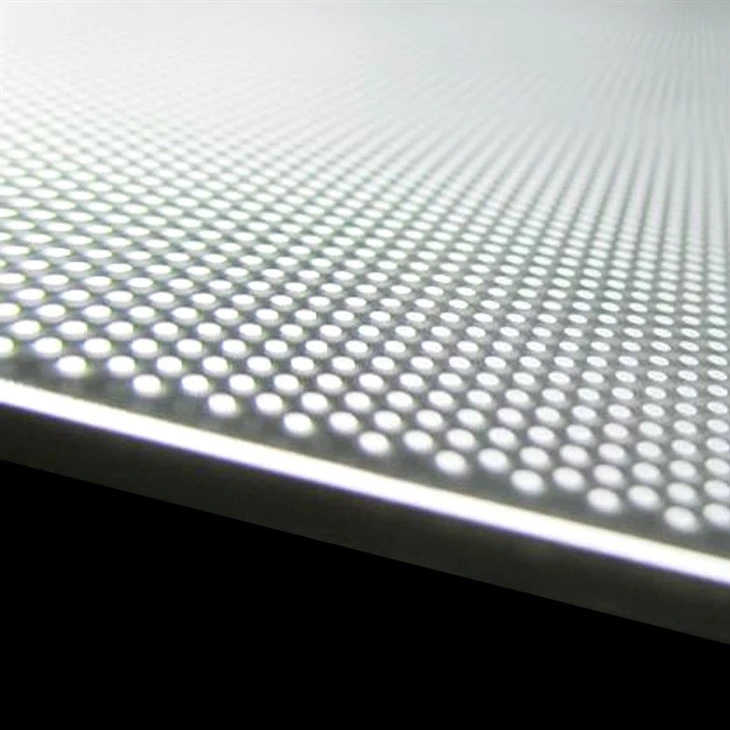
Its core principle is based on total internal reflection (TIR). By designing precise microstructures on or inside the plate (such as laser-engraved micro-dots, UV-printed halftone dots, etc.), it guides LED light to propagate within the plate and emit it uniformly.

LGP for LED primarily uses optical-grade PMMA (acrylic) and PC (polycarbonate), while some high-end applications utilize special materials such as MS resin and COC. It features high light transmittance, strong weather resistance, and is lightweight and easy to process.

The size, thickness, and microstructure patterns can be customized according to application requirements to meet the design needs of different LED products. It is a key support for achieving "lightweight, thin, uniform, and energy-saving" in modern LED display and lighting technology.
LGP For LED Functions
1. Slimming and Lightweight Support Function:
LGP For LED itself has ultra-thin characteristics (thickness can be as low as below 0.3mm). It can achieve uniform surface light output without the need for complex optical components, effectively reducing the overall thickness and volume of LED products. This supports the design of lightweight and miniaturized products such as ultra-thin LED displays, foldable screen devices, and ultra-thin panel lights. It also possesses good mechanical properties, is not easily deformed or yellowed, and ensures long-term stable operation of the product.
2. Brightness and Uniformity Adjustment Function:
The brightness, uniformity, and softness of the surface light source can be flexibly adjusted according to application scenario requirements by modifying the microstructure pattern (laser engraving, UV printing, etc.) and the board thickness. This adapts to the lighting needs of different scenarios-for example, high-end display scenarios require high uniformity (≥90%), while ordinary lighting scenarios can appropriately adjust the softness (haze adjustable from 3% to 60%), while avoiding issues such as bright spots and dark areas, ensuring the consistency of the overall lighting effect.
LGP for LED Production Process:
1. Raw Material Selection and Pre-treatment:
High-transmittance materials such as optical-grade PMMA and PC are preferred. For some high-end products, special materials such as MS resin and COC are used. Batch testing of raw materials ensures that their transmittance, color difference, and dimensional stability meet standards. They are then cleaned and dried to remove impurities and moisture, preventing them from affecting subsequent processing accuracy and optical performance.
2. Design and Simulation:
The dimensions and thickness of the LGP are determined using CAD design software. Microstructure patterns (dots, prisms, etc.) are designed using optical simulation software (such as 3D optical simulation), and a 48-hour optical analysis is performed to generate uniformity and brightness distribution maps, verifying the design's rationality. Prototype samples are then manufactured (completed in 5-7 days) for actual optical testing, optimizing the design until it meets standards.
3. Substrate Forming:
Select the appropriate forming process based on product requirements-Injection molding is suitable for mass production, complex shapes, or ultra-thin LGPs. Molten optical material is injected into a high-precision mold and cooled to form the final shape. Extrusion molding is suitable for large-volume production of flat LGPs with uniform thickness. The material is heated and softened before being extruded through a mold to form a continuous sheet. After forming, the substrate is cut to ensure dimensional accuracy (error ≤ ±0.01mm).
4. Microstructure Processing:
This is the core process, mainly divided into three methods: Laser engraving (highest precision, capable of achieving <10µm microstructures, suitable for high-end products), UV printing (high efficiency, moderate cost, suitable for mid-to-low-end products), and screen printing (low cost, suitable for large-size products). These processes create precise microstructures on or inside the substrate, achieving uniform light guidance. After processing, the surface is cleaned to remove residual impurities.
5. Auxiliary Layer Lamination:
Depending on application requirements, a reflective layer (silver reflective film or white PET substrate) is laminated to the back of the LGP to improve light recovery efficiency; a diffusion layer is laminated to the front to further optimize light softness and eliminate light spots caused by microstructures. Some products may include a brightness enhancement film to improve front brightness.
6. Inspection and Packaging:
100% comprehensive inspection of finished products is conducted, including light transmittance, brightness uniformity, dimensional accuracy, and appearance defects (scratches, bubbles, dot defects, etc.). AOI automated inspection equipment ensures product qualification. After passing inspection, products are packaged in a cleanroom to prevent damage during transportation and finally stored for delivery (mass production delivery cycle 10-15 days).
LGP for LED applications

- Commercial Lighting:

- Industrial and Office Lighting:

- Medical Lighting:

- Automotive Lighting:

RINA TECHNOLOGY
is a high-tech enterprise specializing in research, development, production ,sales of Optical LED products and provide the one step optical lighting solution for customers.Established in 2011, Hong Kong, after years of rapid development, Rina Tech has settled office and factory in Shenzhen,and has professional senior technicians and qualified managers,has a talented team for product research and designing.
Nowadays, we have laser cutting machines, printers, film cutting machines, injection molding equipments,high-standard assembly workshops, BM-7 clean machines and other advanced equipments.
Our factory daily output is more than 80000pcs. to cater for the market at home and abroad.With years of unremitting effort,RINA TECH has passed get the Registration Certificate ofCustoms Declaration Unit of the People's Republic of China , National Credit Cultivation Certificate and Get our own Brand already.
We has made many breakthroughs in researching and manufacturing and has
obtained lots of good reputation from oversea customers.
Now we has cooperated with and become strategic partner of some famous enterprises such as LG, Samsung, Lenovo etc."Living on Sincerity, following with Market, Advancing by Specialty" is our eternal philosophy,and the company motto is "Good at Production, Good for Society".
We look forward to cooperating with you to make the world better and future brighter!
FAQ
1. Q: What is the core function of LGP for LED?
A: The core function is to convert LED point or line light sources into uniform, soft surface light sources. Through total internal reflection and microstructure guidance, it reduces light loss and eliminates hotspots. It also supports the thinner and lighter design of LED products, improving display or lighting effects. It is a core component of LED backlighting and lighting systems.
2. Q: What materials are mainly used to make LGP for LED?
A: The mainstream materials are optical-grade PMMA (acrylic) and PC (polycarbonate). PMMA has high light transmittance and moderate cost, making it suitable for most scenarios; PC has strong impact resistance, making it suitable for complex environments such as outdoor and automotive applications; high-end applications may use special materials such as MS resin and COC to improve temperature resistance and optical performance.
3. Q: What is the approximate lifespan of an LGP for LED?
A: Under normal operating conditions (avoiding high temperatures, direct sunlight, and scratches from sharp objects), the lifespan can reach 5-8 years. LGPs made of high-quality materials (such as optical-grade PMMA) effectively prevent yellowing and aging, maintaining good light-guiding performance over a long period, essentially matching the lifespan of the LED light source, eliminating the need for frequent replacement.
4. Q: What could be the cause of uneven brightness in an LGP for LED?
5. Q: Can LGPForLED be customized in size and shape?
A: Yes, LGP For LED supports full customization. Size, thickness (0.3mm-10mm), shape (flat, curved, irregular), microstructure patterns, and brightness parameters can be customized according to customer needs. It adapts to the design requirements of different LED products (such as foldable screen phones, irregularly shaped light boxes, and automotive components). Prototype samples can be provided for bulk customization.
6. Q: What is the difference between LGPFor LED and ordinary light guide plates?
A: The core difference lies in adaptability and optical performance. LGP For LED is specifically designed for the characteristics of LED light sources, with a more precise microstructure and higher light utilization (≥90%). It can effectively match the luminous characteristics of LED point/line light sources and eliminate hot spots. Ordinary light guide plates are adapted to traditional light sources (such as CCFLs), with lower light guiding efficiency and uniformity, failing to meet the requirements of thinner and more energy-efficient LED products. Furthermore, the materials and processing technology are not as precise as LGPFor LED.
Hot Tags: lgp for led suppliers, factory, customized, price, in stock, LED guide plate