



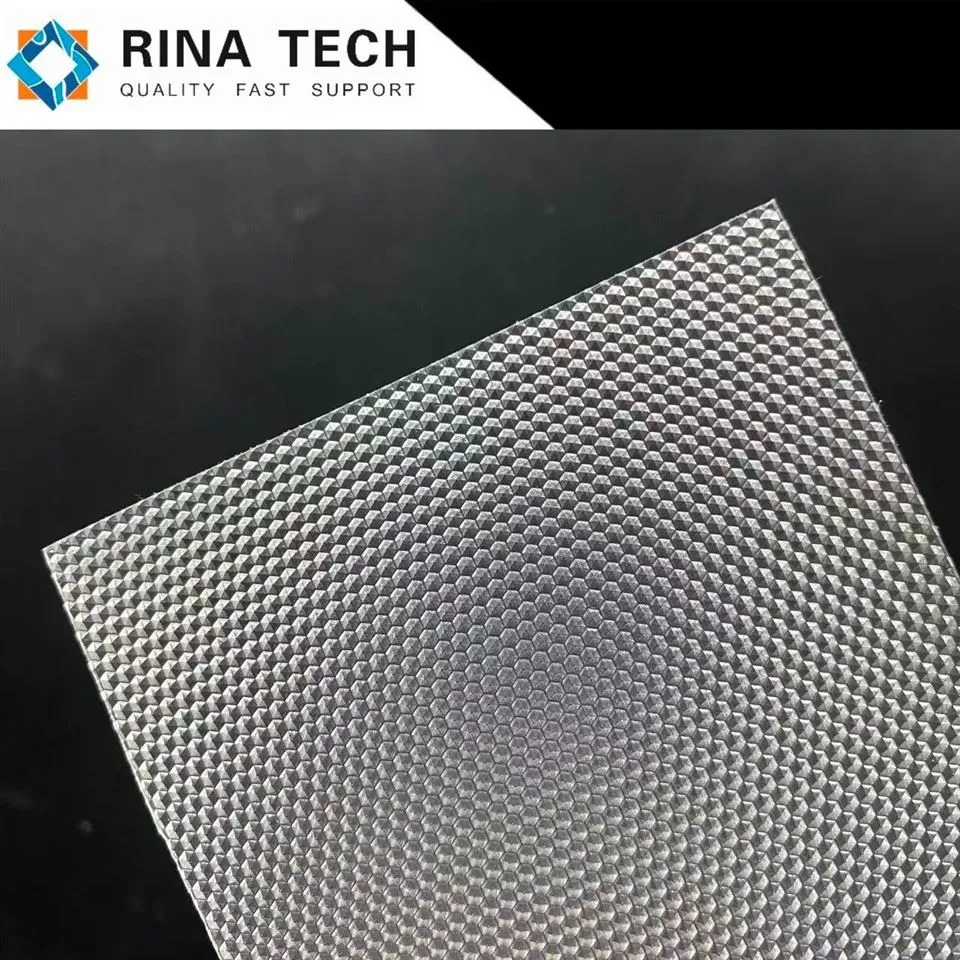
Custom Prism Plate
Product Name: Custom Prism Plate
Material: PS, PMMA, PC
Thickness: Customizable
Size: Customizable
Advantages: Diffuses light, Anti-glare
- Fast Delievery
- Quality Assurance
- 24/7 Customer Service
Product Introduction
Rina Technology Co., Ltd. is one of the leading manufacturers and suppliers of custom prism plate in China. Welcome to wholesale durable products in stock here and get quotation from our factory. All customized products are with high quality and low price.
Products Description
Custom Prism Plate Product Introduction
A Custom Prism Plate is a functional optical component that undergoes precise optical design and personalized processing. Its core functionality lies in creating a prism array with a specific geometry on a substrate surface to achieve optical effects such as directional refraction


This product can be customized based on the customer's specific application scenario, optical parameter requirements, and installation conditions. Customization options include prism shape (e.g., right-angle prism, triangular prism, trapezoidal prism), array density, substrate material, dimensions, and surface treatment processes.
In terms of application areas, Custom Prism Plates are widely used in display technology (e.g., LCD backlight modules, LED display brightness enhancement), lighting engineering (light control for road lighting and indoor energy-saving lighting), optical inspection equipment (light path guidance for optical sensors),


security monitoring (field-of-view optimization for surveillance lenses), and new energy (concentration efficiency enhancement for solar photovoltaic panels), among other industries. It is a key component for improving optical system performance and realizing personalized equipment functions.
Custom Prism Plate Production Process
1. Requirements Analysis and Optical Design: First, we engage in in-depth discussions with the client to clarify their requirements for light control effects , dimensional tolerances, environmental adaptability, and cost budget. Optical engineers use professional optical simulation software to design the prism structure and simulate the optical path, outputting optimal prism array parameters and product drawings.
2. Mold Development and Fabrication:Based on the design drawings, high-precision CNC machining or laser engraving technology is used to fabricate the prism forming mold. The precision of the mold directly determines the product quality; therefore, the mold surface must be polished to ensure a surface roughness at the nanometer level. Simultaneously, trial molding is conducted to verify the forming effect of the mold, and mold parameters are adjusted as needed.
3. Substrate Selection and Pre-treatment:Appropriate substrate materials are selected based on the application scenario. For example, PC material is used if lightweight and impact resistance are required, while optical-grade PMMA or glass is used if high light transmittance is required. The substrate undergoes pre-treatment such as cleaning, drying, and cutting to remove surface oil and impurities, ensuring good adhesion in subsequent processing.
4. Molding and Processing:Different molding processes are used for different materials. For example, plastic substrates are often injection molded or calendered, where molten plastic is injected into a mold or pressed onto the mold surface, and after cooling
5. Post-processing and Quality Inspection:After molding, the prism sheets undergo surface hardening and antistatic coating to improve the product's wear resistance and environmental adaptability. Then, quality inspection is carried out.
6. Cutting and Packaging:The prism sheets are precisely cut according to customer requirements, removing edge waste. Finally, they are packaged with antistatic materials to prevent damage to the product surface during transportation.
Custom Prism Plate Parameter Details
| Parameter Category | Specific Parameter | Description |
|---|---|---|
| Basic Dimensions | Standard Thickness | 1.5mm, 2.0mm, 2.5mm, 3.0mm, 4.0mm; Customization from 0.8mm to 10mm supported |
| Standard Width | 1220mm, 1500mm; Adjustable according to production requirements | |
| Standard Length | 2440mm; Custom cutting supported, minimum cutting size 50mm × 50mm | |
| Optical Performance | Light Transmittance | 85% - 95% (Varies slightly depending on thickness and prism structure; 92% for standard 3.0mm type) |
| Light Uniformity | ≥90%, effectively eliminates LED shadowing and avoids "hotspot" issues | |
| Beam Angle Control Range | 30° ~ 120°, customizable for directional or wide-area lighting effects via prism density and angle design |
Comparison of the advantages of materials used in Custom Prism Plate
| Dimension | PMMA-based Prism Panel | PC-based Prism Panel | PS-based Prism Panel |
|---|---|---|---|
| Light Transmission | Optimal, 93%-95% transmittance, pure and neutral light, excellent optical effect | Good, 88%-92% transmittance, soft light, better anti-aging performance than PMMA | Average, 80%-85% transmittance, prone to decrease over time |
| Physical Strength | Moderate, average impact resistance, easily scratched by sharp objects, but lightweight | Optimal, 6-8 times the impact strength of PMMA, drop and impact resistant, suitable for outdoor and industrial use | Poor, brittle, prone to breaking, low impact resistance, only for low-risk scenarios |
| Weather Resistance | Good, can be used in semi-outdoor scenarios with UV inhibitors, prone to yellowing outdoors without them | Optimal, inherently UV resistant, withstands high and low temperatures, suitable for outdoor and harsh environments | Poor,Not resistant to high and low temperatures, prone to aging and brittleness, only for indoor, room temperature environments |
| Processability | Optimal, easy to cut, bend, bond, high precision prism structure formation, suitable for complex customization | Good, can be cut and bent, but requires higher forming temperature, slightly higher cost for complex structures | Moderate, easy to cut but difficult to bend, average precision in prism structure formation |
| Cost | Moderate, cost-effective, mainstream choice for indoor lighting | Higher, cost is 1.5-2 times that of PMMA, suitable for high-performance requirements | Lowest, price only 50%-70% of PMMA, suitable for low-cost, temporary lighting needs |
| Applicable Scenarios | Indoor commercial lighting, home lighting, flat lights, panel lights, etc. | Outdoor lighting, industrial lighting, explosion-proof lights, children's room lighting, etc. | Temporary lighting, low-cost fixtures, disposable lighting products, etc. |
Advantages of Custom Prism Plate
1. Highly Customizable and Adaptable: Its core advantage lies in its ability to perfectly match customers' individual needs. Whether it's the prism structure, size specifications, or material selection, it can be tailored to specific application scenarios, solving the problem of general-purpose prism plates being incompatible with special optical systems
01
2. Excellent Optical Performance and Controllable Effects: Through precise optical design and manufacturing, the prism array achieves high-precision light control, enabling stable focusing, scattering, or splitting effects. Light transmittance can reach over 85% , effectively improving the light utilization rate and imaging quality of the optical system.
02
3. Diverse Materials and Good Environmental Adaptability: Supports customization of various optical-grade materials. Substrates can be selected based on the usage environment, including those resistant to high temperatures, UV radiation, impact, or chemical corrosion. The product can withstand a wide temperature range of -40℃ to 80℃,
03
4. Stable structure and long service life: After surface hardening treatment, the product's surface hardness can reach H level or higher, making it wear-resistant and scratch-resistant. The material itself also has good anti-aging properties, resulting in a service life of 5-8 years under normal use, reducing subsequent replacement costs.
04
5. High cost-effectiveness and significant mass production advantages: After completing customized mold development, large-scale mass production can be achieved. Batch production effectively reduces unit product costs; at the same time, its excellent optical performance enhances the competitiveness of terminal equipment
05
Application Scenarios of Custom Prism Plate


RINA TECHNOLOGY
is a high-tech enterprise specializing in research, development, production ,sales of Optical LED products and provide the one step optical lighting solution for customers.Established in 2011, Hong Kong, after years of rapid development, Rina Tech has settled office and factory in Shenzhen,and has professional senior technicians and qualified managers,has a talented team for product research and designing.
Nowadays, we have laser cutting machines, printers, film cutting machines, injection molding equipments,high-standard assembly workshops, BM-7 clean machines and other advanced equipments.
Our factory daily output is more than 80000pcs. to cater for the market at home and abroad.With years of unremitting effort,RINA TECH has passed get the Registration Certificate ofCustoms Declaration Unit of the People's Republic of China , National Credit Cultivation Certificate and Get our own Brand already.
We has made many breakthroughs in researching and manufacturing and has
obtained lots of good reputation from oversea customers.
Now we has cooperated with and become strategic partner of some famous enterprises such as LG, Samsung, Lenovo etc."Living on Sincerity, following with Market, Advancing by Specialty" is our eternal philosophy,and the company motto is "Good at Production, Good for Society".
We look forward to cooperating with you to make the world better and future brighter!
FAQ

1. What prism shapes can be customized for a Custom Prism Plate?
The Custom Prism Plate supports customization of various prism shapes, including basic shapes such as right-angle prisms, equilateral triangular prisms, isosceles triangular prisms, and trapezoidal prisms. Non-standard irregular prism structures can also be designed and manufactured according to specific customer optical requirements. During customization, customers only need to provide their light control objectives and optical path parameters; optical engineers will recommend the optimal prism shape based on simulation results.
2. What is the approximate production cycle for a Custom Prism Plate?
The production cycle for a Custom Prism Plate is affected by the complexity of the customization, order volume, and material selection. Specifically, it falls into two categories: If the customer requires a standard prism structure and uses standard materials (such as PMMA or PC), modifying an existing similar mold, the production cycle is typically 7-10 working days. If it is a completely new prism structure requiring the development of a custom mold or the use of special materials (such as optical glass), the production cycle will extend to 15-25 working days, with mold development accounting for approximately 60% of the cycle. Bulk orders can have their lead times optimized based on production capacity.
3. How do you ensure the optical performance of the Custom Prism Plate meets requirements?
To ensure the optical performance of the Custom Prism Plate meets standards, we have established a comprehensive quality control system: During the design phase, optical path simulation is performed using professional optical software, and the simulation data is confirmed with the customer before production begins; after mold making, trial molding is conducted, and optical parameters (transmittance, refraction angle, etc.) are tested on the trial production samples; during mass production, 10% of the products in each batch are randomly selected for re-inspection; before delivery, an optical test report for that batch of products is provided to the customer to ensure consistency with requirements.
4. Is the Custom Prism Plate suitable for use in harsh outdoor environments?
The Custom Prism Plate can meet the needs of harsh outdoor environments through material selection and special post-treatment. For outdoor scenarios, we recommend using UV-resistant PC or optical glass as the substrate. These materials effectively resist aging and yellowing caused by sun exposure; at the same time, the product surface is treated with anti-fog, anti-fouling, and hardening coatings to improve its waterproof, dustproof, and scratch-resistant properties. Specially treated Custom Prism Plates can withstand harsh outdoor environments such as high temperatures, heavy rain, and sandstorms, and are widely used in outdoor lighting, traffic monitoring, and other fields.
5. What key information is needed when customizing a Custom Prism Plate?
When customizing a Custom Prism Plate, we recommend that customers provide the following key information to ensure a precise solution: ① Core optical requirements, including light control type (focusing, diffusing, beam splitting, etc.), target transmittance, and refraction angle range; ② Application scenario, such as whether it is used for display backlighting, lighting equipment, or testing instruments, and whether it is for outdoor use; ③ Dimensions and installation requirements, including the product's length, width, thickness, and installation method; ④ Material preferences and environmental parameters, such as whether there are special requirements for high temperature resistance, corrosion resistance, etc.; ⑤ Order quantity and delivery cycle, so that we can optimize our production plan. If customers do not have specific optical parameters, they can provide the usage requirements of the terminal equipment, and our engineers will assist in defining the parameters.
Hot Tags: custom prism plate suppliers, factory, customized, price, in stock, Light Diffuser Plate


