


White Light Diffuser Panel
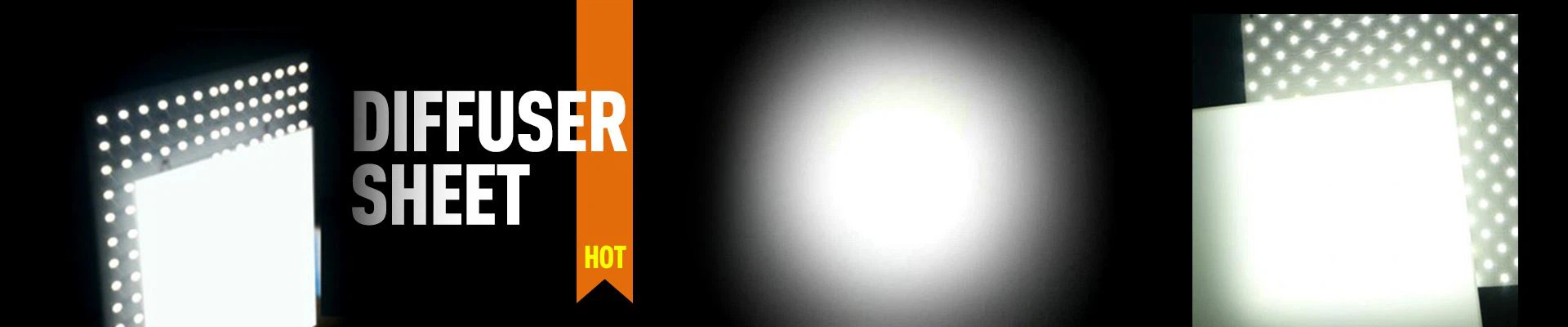
An optical diffuser is a piece of transparent or translucent material with a special surface structure or internal distribution material, designed to disperse incident light, making it more evenly scattered and reducing shadows and bright spots.
- Fast Delievery
- Quality Assurance
- 24/7 Customer Service
Product Introduction
Rina Technology Co., Ltd. is one of the leading manufacturers and suppliers of white light diffuser panel in China. Welcome to wholesale durable products in stock here and get quotation from our factory. All customized products are with high quality and low price.
Products Description
As a key optical component, the core characteristic of optical diffusers lies in their efficient and controllable dispersion of incident light through a carefully designed surface structure or precisely controlled internal material distribution. They typically use a transparent or translucent substrate, which inherently possesses excellent light-conducting properties. Surface microstructures (such as minute bumps, prism arrays, or specialized coatings) and internal functional particles (such as organic microspheres and inorganic scattering particles) together form the core light scattering mechanism.
When light strikes the diffuser's surface, some of it is refracted, reflected, or diffracted by the surface structure, changing its original direction. Other light penetrates the surface and interacts with the distributed material particles within. These particles scatter the light multiple times, causing it to change direction along its path, ultimately exiting through the diffuser on the other side. This process effectively reduces potential direct glare, partial shadows, and uneven bright spots, resulting in a softer, more evenly scattered light.
This characteristic makes optical diffusers important in a wide range of fields. For example, in the display field, it can improve screen brightness uniformity, reduce glare, and enhance the viewing experience. In lighting systems, it can diffuse light more gently, avoiding localized overbrightness or underbrightness, creating a more comfortable lighting environment. In photography, medical equipment, and other scenarios, it can also regulate light distribution to meet specific optical performance requirements. The ingenuity of its design lies in the precise control of surface structural parameters (such as texture depth and density) and internal material distribution (such as particle size and concentration), which can achieve different degrees of light transmittance and scattering angles, thus adapting to diverse application scenarios and achieving precise "reshaping" of light.


How does the material of the optical diffuser affect its performance?

1. Impact on Light Transmittance
Light transmittance is one of the core properties of a diffuser panel and is directly dependent on the light transmittance of the base material.
PMMA (polymethyl methacrylate, acrylic): It is one of the most transparent plastic materials (with a transmittance of up to 90%-92%). Its high purity and low absorption of visible light mean that PMMA-based diffusers typically maintain high transmittance, making them suitable for applications requiring both high transmittance and uniform scattering (such as high-end display screens and precision lighting).
PC (polycarbonate): Its transmittance is slightly lower than that of PMMA (approximately 85%-89%), but the material itself has more stable transmittance for certain wavelengths of light (such as blue light). It is suitable for applications that require high uniformity but are not sensitive to extreme transmittance (such as outdoor lighting).
PS (polystyrene): Its transmittance is approximately 80%-85%. However, due to its low purity, impurities can easily be introduced, leading to reduced transmittance. Therefore, it is more suitable for cost-sensitive, low-end applications (such as standard indoor lighting covers) where light transmittance is less critical. Glass: It can achieve a light transmittance exceeding 90% and has virtually no risk of yellowing. However, it is heavy and fragile, and is therefore only used in specialized high-end applications (such as high-precision optical instruments).
2. Impact on Scattering Effect
The scattering effect depends on the refractive index difference between the substrate and the internal scattering particles, as well as the optical uniformity of the substrate itself:
The refractive index of the substrate is fundamental: different materials have different refractive indices (e.g., PMMA has a refractive index of approximately 1.49, PC has a refractive index of approximately 1.58, and PS has a refractive index of approximately 1.59). The greater the difference in refractive index between the added scattering particles (such as titanium dioxide or organic microspheres) and the substrate, the more intense the refraction/reflection of light at the interface, and the wider the scattering angle (e.g., a PS substrate with low-refractive-index particles exhibits a stronger scattering effect than PMMA).
Material Uniformity: PMMA and PC have more stable molecular structures, resulting in fewer impurities and more uniform light scattering. However, PS is prone to localized refractive index fluctuations due to internal stress generated during processing, which can cause "haze unevenness" and affect scattering consistency.


3. Impact on Weatherability
Weatherability (UV resistance, aging resistance, and yellowing resistance) determines the performance stability of a diffuser panel during outdoor or long-term use:
PMMA: It inherently has a certain degree of UV resistance, which can be further enhanced by adding UV-resistant additives. It resists yellowing after long-term exposure to sunlight and is suitable for applications such as outdoor advertising screens and streetlights.
PC: It offers superior UV resistance to PMMA (especially after UV-resistant modification) and is more weather-stable. It resists aging in high-temperature and humid environments, making it a common material for outdoor lighting and automotive lamps.
PS: Its molecular structure is easily damaged by UV rays, causing rapid yellowing and embrittlement with long-term use. It is only suitable for short-term indoor use (such as disposable lighting covers).

4. Impact on Mechanical Properties
Mechanical properties (impact resistance, hardness, and toughness) determine the durability and installation suitability of a diffuser panel:
PC: It has extremely strong impact resistance (2-3 times that of PMMA) and excellent toughness, making it resistant to breakage. It is suitable for applications requiring impact resistance (such as children's lamps and car displays). PMMA: High hardness (surface wear resistance), but also brittle and prone to cracking under impact. Suitable for applications requiring a high surface finish but without severe impact (e.g., indoor display panels).
PS: Low mechanical strength and prone to brittleness, suitable only for low-impact applications (e.g., lighting covers for temporary exhibitions).

5. Impact on Heat Resistance
Heat resistance determines the stability of the diffuser in high-temperature environments (e.g., lamps near light sources, high-temperature equipment):
PC: High heat resistance (long-term operating temperature approximately 120°C, short-term operating temperature up to 130°C), resists deformation at high temperatures, suitable for applications such as high-power lamps and industrial equipment lighting.
PMMA: Moderate heat resistance (long-term operating temperature approximately 80-90°C), softens easily above 100°C, suitable for lower temperature environments (e.g., home lighting, general display screens).
PS: Poor heat resistance (long-term operating temperature only 60-70°C), prone to deformation and cracking at high temperatures, suitable only for ambient temperature applications.

6. Impact on Processing and Cost
The processing difficulty and cost of the material will indirectly affect the structural design and application scenarios of the diffuser:
PMMA: Easy to process (complex surface textures such as microprisms and frosted surfaces can be formed through injection molding and extrusion) and has high molding precision. It is suitable for diffusers requiring fine surface structures (such as high-uniformity diffusers for display screens), but its cost is relatively high.
PC: Slightly more difficult to process than PMMA (requiring higher temperatures and pressures), but it can be formed into thicker sheets or complex structures. Its high mechanical strength makes it suitable for integrated designs (such as a lamp housing + diffuser integration), and its cost is moderate.
PS: Simple to process and low in cost, but prone to internal stress after molding, making it difficult to create high-precision structures. It is suitable for low-cost, standardized, general-purpose diffusers.

About Us
RINA TECHNOLOGY CO. LIMITED (BRAND: GOOUNION ) is a high-tech enterprise specializing in research, development, production, and sales of Optical LED products, smartphone accessories, TV parts and SKD. Established in 2011, Hong Kong, after years of rapid development, Rina Tech has settled office and factory in Shenzhen, Guangdong, China.
RINA TECH has professional senior technicians and qualified managers, has a talented team for product research and designing. Nowadays, we have laser cutting machines, printers, film cutting machines, injection molding equipment, high-standard assembly workshops, BM-7 clean machines and other advanced equipment.
We have nearly 300 members of staff in our factory. Our daily output is more than 80000PCS. to cater for the market at home and abroad.
With years of unremitting effort, Rina has passed ISO9001: 2008 International Quality Management System Certification. We have made many breakthroughs in researching and manufacturing and has obtained lots of patents on advertising light boxes and computer peripheral products. Now we have cooperated with and become the strategic partner of some famous enterprises such as LG, Samsung, etc.
"Living on Sincerity, following with Market, Advancing by Specialty" is our eternal philosophy, and the company motto is "Good at Production, Good for Society". We look forward to cooperating with you to make the world better and future brighter!

Company Detail


Our Certificates

Shipping and Payment

FAQ
Q1. If I have a question I would like advice on how to contact you?
The best way is by e-mail. Tel, wechat, WhatsApp, Skype, contact us on our website online service worker are good ways to reach us also.
Q2. What is your company return policy?
It breaks the contract of any agreement on price, quality and any other terms and conditions on the contract, the buyer can return the goods back to us and we will send the money back to buyers. Force majeure and god act are excepted.
Q3. What will you provide services?
Solution providing, engineering, system design, best products suggestion, quality control, delivery, after sale service and many others. You can get our feedback during 24 hours.
Hot Tags: white light diffuser panel suppliers, factory, customized, price, in stock, Diffuser Plate Led, White Diffuser Sheet Optical Plate, Lighting Diffuser, White Diffuser Plate, LGP Diffuser Plastic, White Light Diffuser Panel