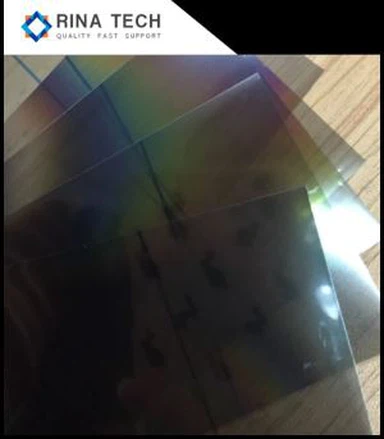



Polarizer Films
Product Name: Polarizer Films
Thickness: Standard 0.13–0.16 mm
Dimensions: Cut-to-order; supports standard sizes and custom shapes
Angle: Customizable transmission axis angle (common angles include 0°, 45°, 90°, 135°, etc.)
Material Composition: PVA polarizing layer + TAC protective layer + optical pressure-sensitive adhesive + release film
Advantages: Excellent polarization effect with effective anti-glare properties; uniform light transmission and superior color reproduction; temperature and aging resistance suitable for diverse applications; strong adhesion and high optical stability.
- Fast Delievery
- Quality Assurance
- 24/7 Customer Service
Product Introduction
Rina Technology Co., Ltd. is one of the leading manufacturers and suppliers of polarizer films in China. Welcome to wholesale durable products in stock here and get quotation from our factory. All customized products are with high quality and low price.
Products Description
I. Introduction to Polarizer Films

Polarizer films are functional optical thin-film materials capable of precise light modulation and serve as indispensable core components in the fields of optoelectronic displays and precision optical equipment. Unlike standard light-transmitting films, polarizer films utilize a specialized oriented polymer structure to

selectively filter non-polarized light-such as natural light and stray reflections-by blocking light waves vibrating in specific directions while allowing only light polarized in a single direction to pass through, thereby achieving precise control over the light's polarization state.

While polarizer films were initially limited to niche applications like optical experiments and polarized eyewear, the evolution of display technology has led to their widespread adoption across diverse sectors, including LCDs, OLEDs,

automotive displays, photographic optical equipment, and wearable devices. Based on manufacturing processes and materials, polarizer films are categorized into two main types: iodine-based and dye-based.
II. Core Functions of Polarizer Films
1. Light Polarization Filtering and Conversion
Natural light is unpolarized, vibrating in multiple directions, and cannot meet the imaging requirements of liquid crystal displays (LCDs) or precision optical inspection. Through their oriented molecular structure, polarizer films absorb or block light wave vibrations perpendicular to the transmission axis, converting chaotic unpolarized light into orderly linearly polarized light. This provides standardized light conditions for LCD panel imaging and optical instrument inspection-representing the most fundamental and core function of polarizer films.
2. Elimination of Reflections and Glare
In everyday environments, surfaces such as glass, metal, water, and screens generate significant stray reflected light and glare, leading to visual blurring and washed-out images. Polarizer films precisely filter out this irregular reflected polarized light, effectively mitigating environmental glare. This function is widely applied in products such as mobile phone screens, automotive center console displays, polarized sunglasses, and photography filters, significantly enhancing visual appeal and image clarity.
3. Regulation of Display Brightness and Contrast
In display devices, the alignment and switching of the transmission axes of the two polarizer film layers (applied to the top and bottom) control light transmission and blockage, enabling the transition between bright and dark screen states. By precisely regulating light transmittance, polarizer films effectively enhance screen color contrast, resulting in more distinct color gradations and superior color reproduction. Simultaneously, they prevent visual fatigue caused by excessive screen brightness, striking a balance between display performance and viewing comfort.
4. Optical Protection and Device Adaptability
High-quality polarizer films feature UV resistance, aging resistance, and tolerance to high and low temperatures; they block harmful ultraviolet rays, thereby protecting the internal optical modules of the screen and the user's eyes. Furthermore, their thin, lightweight, and flexible nature allows them to adapt to non-standard device forms-such as curved screens, foldable screens, and micro-displays-meeting the design requirements for various lightweight and portable optoelectronic products.
Specifications for Polarizer Films

III. Structural Composition of Polarizer Films
1. Core Polarizing Layer (PVA Film)
This is the central layer responsible for the polarizing function, made of a polyvinyl alcohol (PVA) polymer film. During production, the PVA film undergoes biaxial stretching to align its internal polymer chains, followed by dyeing with iodine or dye molecules to create an ordered structure for polarized light transmission. This layer performs the essential functions of light filtering and polarization conversion, directly determining key optical parameters such as light transmittance, degree of polarization, and color accuracy.
2. Double-Sided Protective Layers (TAC Films)
The core PVA polarizing layer is soft and lacks stability, making it susceptible to moisture, deformation, and damage from external forces. Consequently, triacetyl cellulose (TAC) protective films are laminated onto both sides of the PVA layer to form the basic protective structure. TAC films feature high transparency, water resistance, aging resistance, and high mechanical strength; they allow effective polarized light to pass through without compromising optical performance while blocking moisture, dust, and friction, thereby preserving the structural integrity of the core polarizing layer and extending the film's service life.
3. Pressure-Sensitive Adhesive (PSA) Layer
A layer of highly transparent optical pressure-sensitive adhesive is evenly coated on the outer side of the TAC protective film, serving as the bonding interface. This adhesive layer offers strong adhesion, bubble-free application, high transparency, and resistance to delamination. It allows the polarizer film to bond securely to substrates-such as LCD glass or optical lenses-without causing optical distortion, ensuring the integrity of light transmission and meeting the bonding requirements of various devices.
4. Release Film (Protective Layer)
A transparent release film covers the outermost side of the adhesive layer, serving as a temporary protective structure. During transport, storage, and prior to installation, the release film protects the adhesive from dust contamination, premature sticking, and oxidation-induced failure. During actual installation, the release film is simply peeled off, allowing the polarizer film to be precisely applied to the device surface; this process is convenient and does not compromise the adhesive's performance.
Application Scenarios for Polarizer Films


RINA TECHNOLOGY
is a high-tech enterprise specializing in research, development, production ,sales of Optical LED products and provide the one step optical lighting solution for customers.Established in 2011, Hong Kong, after years of rapid development, Rina Tech has settled office and factory in Shenzhen,and has professional senior technicians and qualified managers,has a talented team for product research and designing.
Nowadays, we have laser cutting machines, printers, film cutting machines, injection molding equipments,high-standard assembly workshops, BM-7 clean machines and other advanced equipments.
Our factory daily output is more than 80000pcs. to cater for the market at home and abroad.With years of unremitting effort,RINA TECH has passed get the Registration Certificate ofCustoms Declaration Unit of the People's Republic of China , National Credit Cultivation Certificate and Get our own Brand already.
We has made many breakthroughs in researching and manufacturing and has
obtained lots of good reputation from oversea customers.
Now we has cooperated with and become strategic partner of some famous enterprises such as LG, Samsung, Lenovo etc."Living on Sincerity, following with Market, Advancing by Specialty" is our eternal philosophy,and the company motto is "Good at Production, Good for Society".
We look forward to cooperating with you to make the world better and future brighter!
FAQ
Q1: What is the fundamental difference between polarizer films and ordinary light-transmitting films?
The key distinction is that polarizer films possess the ability to filter light based on polarization; ordinary light-transmitting films merely allow light to pass through without altering its oscillation state or filtering out glare and stray light. Polarizer films utilize an oriented molecular structure to select light waves of specific orientations and convert polarization states. This enables them to optimize display images, eliminate reflections, and provide specialized optical control-core characteristics that ordinary light-transmitting films lack.
Q2: Why do issues like screen blackouts or dimming occur with polarizer films?
This problem primarily stems from a misalignment of the transmission axes between the polarizer films. Display devices require precise alignment of the transmission axes of the top and bottom polarizer layers. If the angles are misaligned, the film is applied incorrectly, or the transmission axes of the two layers are perpendicular, effective light cannot pass through. This results in screen blackouts, dimming, or color distortion. Additionally, exposure to moisture or high temperatures can deform the film and disrupt its internal molecular structure, leading to abnormal light transmission.
Q3: What are the main types of polarizer films, and how do their application scenarios differ?
Mainstream polarizer films on the market fall into two categories: iodine-based and dye-based. Iodine-based films offer high polarization efficiency, excellent light transmission, accurate color reproduction, and high cost-effectiveness; they are primarily used in consumer electronics such as mobile phones, computers, televisions, and tablets. Dye-based films offer superior resistance to high and low temperatures, UV radiation, and weathering, along with more stable optical performance; they are typically used in demanding environments such as outdoor displays, industrial control screens, high-end automotive displays, and precision optical instruments.
Q4: Can polarizer films be removed and reused?
Standard industrial and consumer polarizer films are not designed for removal and reuse. They rely on optical pressure-sensitive adhesive (PSA) for bonding; once applied, the adhesive bonds firmly with the substrate. Attempting to remove the film often results in adhesive residue, stretching or deformation of the film, and damage to the molecular structure. These issues directly degrade polarization performance and cause light transmission abnormalities, rendering the film unusable; therefore, precise, one-time application is required during installation.
Q5: How can one simply assess the quality of polarizer films?
Testing can be performed in three simple ways: first, visual inspection against a light source-high-quality polarizer films exhibit uniform light transmission without discoloration, bubbles, or scratches, and allow for a clear transition between light and dark states when rotated; second, an anti-glare test-when rotated while facing a light source or reflective surface, high-quality products effectively eliminate glare without causing the image to appear washed out or blurred; and third, a temperature resistance test-within the range of room temperature to 80°C, high-quality polarizer films remain stable in optical performance and do not suffer from deformation, discoloration, or adhesive failure.
Hot Tags: polarizer films suppliers, factory, customized, price, in stock