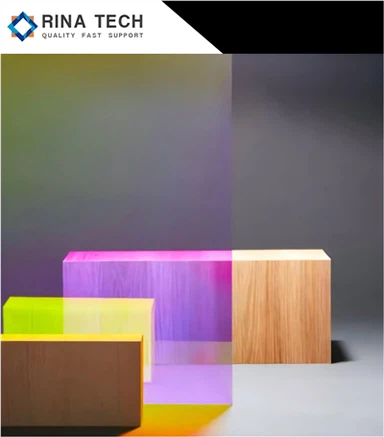


Tint Optical Film
Product Name: Tint optical film
Material: PET, BOPP, PVC
Reflective commonly used thickness: Customize
Color: More than 20 colors for customization
Size: Regular size/Custom size
- Fast Delievery
- Quality Assurance
- 24/7 Customer Service
Product Introduction
Rina Technology Co., Ltd. is one of the leading manufacturers and suppliers of tint optical film in China. Welcome to wholesale durable products in stock here and get quotation from our factory. All customized products are with high quality and low price.
Products Description

What Is Tint Optical Film? A Clear Definition for European Clients
Before exploring its benefits, it's critical to clarify what Tint optical film is-and how it differs from generic window tints flooding the European market. At its core, Tint optical film is a advanced, multi-layered optical material designed to modify light transmission, reduce heat gain, enhance privacy, and block harmful UV rays-all while maintaining optical clarity and aesthetic appeal. Unlike cheap, single-layer window tints (which fade, peel, or distort visibility within 1–2 years), Tint optical film leverages precision engineering and high-grade materials to meet the rigorous demands of European clients.
Key characteristics that define our Tint optical film include:
Adjustable light transmittance: Available in 10–80% light transmittance (customizable per client needs), allowing flexibility for different scenarios-from 10% transmittance for museum exhibit cases (to protect artifacts from light damage) to 80% transmittance for office windows (to maintain natural light while reducing glare).
Superior heat rejection: Blocks 50–80% of solar infrared (IR) radiation, reducing indoor cooling costs by 25–35% (critical for Southern European countries like Spain and Italy, where summer temperatures often exceed 35°C).
Material Composition of Tint Optical Film: Engineered for European Climates & Needs
PET (Polyethylene Terephthalate) substrate: Ideal for indoor and mild outdoor use (e.g., office windows, residential glass, retail displays). It offers exceptional dimensional stability (thermal expansion coefficient: 7×10⁻⁵/°C), ensuring the film does not warp or shrink in Europe's temperature-fluctuating environments (e.g., heated offices in winter, air-conditioned stores in summer). It's also lightweight (density: 1.38g/cm³) and easy to install, reducing labor costs for project clients.
PC (Polycarbonate) substrate: Designed for heavy-duty outdoor or high-impact use (e.g., automotive windshields, public transport windows, industrial equipment enclosures). It boasts superior impact resistance (notched Izod impact strength: 60kJ/m²), making it resistant to hail (common in Northern Europe) or accidental collisions (critical for train windows in busy European cities like Paris or Berlin). It also withstands extreme temperatures (-40°C to 120°C), ensuring stability in Scandinavian winters (-25°C) and Mediterranean summers (40°C+).
Functional Coating Layer: Heat Rejection & UV Blocking
Metalized nano-layer (aluminum or silver): Creates a barrier that reflects infrared (IR) radiation, reducing heat gain by 50–80%. This layer is precisely calibrated to avoid signal interference (critical for European cities with dense 5G networks-unlike cheap metalized tints that disrupt mobile or Wi-Fi signals).


Market Applications of Tint Optical Film in Europe: For Project & Custom Clients
Applications for European Project Clients
Project clients in Europe often undertake initiatives that require consistent, high-performance tinting across thousands of square meters-such as commercial construction, urban renewal, or public infrastructure. Tint optical film meets their needs for volume, speed, and compliance:
Commercial Building & Office Projects
European cities like London, Frankfurt, and Madrid are home to thousands of commercial buildings, where energy efficiency and employee comfort are top priorities. Tint optical film is used to:
Reduce energy costs: A 2024 study by the European Commission found that buildings with heat-rejecting tint film cut cooling costs by 30%. For example, a Frankfurt-based construction firm installed Tint optical film on 8,000 square meters of glass in a new office tower- the building owner reported annual energy savings of €45,000.
Enhance privacy: For open-plan offices or meeting rooms, 30–50% transmittance Tint optical film allows natural light while preventing outside visibility. A London law firm used 2,000 square meters of film for its conference rooms-employees noted a 40% increase in "meeting privacy" satisfaction.
Our Factory Advantages: How We Deliver Premium Tint Optical Film
Strict Quality Control: Meet European Standards
European clients cannot afford to compromise on quality-especially in regulated sectors like construction, automotive, and cultural heritage. Our factory has a comprehensive quality control (QC) system that covers every stage of production:
Incoming Material Inspection
All raw materials undergo rigorous testing before production:
Substrate testing: We check thickness (tolerance ±0.005mm), light transmittance (≥90% for clear substrates), and impact resistance (for PC substrates). Any substrate that fails these tests is rejected-we never use low-quality materials to cut costs.
Coating material testing: The functional coating is tested for heat rejection rate (50–80%, per client specs), UV blocking (99%), and color consistency (Delta E < 1.0, per ISO 10526).
In-Process Monitoring
During production, we use real-time tools to ensure consistency:
Heat rejection testing: A spectrophotometer measures the film's IR blocking rate every 15 minutes. If the rate deviates by more than 3%, we adjust the coating process immediately.
Color accuracy testing: A colorimeter checks hue and saturation every 30 minutes, ensuring no batch-to-batch variation-critical for large projects like office towers where consistency matters.
Surface inspection: Automated cameras scan the film for defects (bubbles, scratches, uneven coating) - any defective sections are marked and cut out before packaging.

product key technologies

How Tint Optical Film Solves Europe's Key Industry Pain Points
Pain Point 1: High Costs of Local European Products
European local suppliers charge 35–45% more for tint film (due to high labor and rent costs). Our Tint optical film is 25–35% cheaper:
Factory-direct pricing: No distributors or middlemen-we sell directly to European clients. A Berlin construction firm saved €60,000 by buying 50,000 square meters from us vs. a local supplier.
Bulk discounts: For orders over 10,000 square meters, we offer 5–12% discounts. A Madrid retail chain saved €15,000 on their 20,000-square-meter order.
Pain Point 2: Long Lead Times for Custom Orders
European local suppliers take 6–8 weeks for custom Tint optical film-too slow for product launches or project deadlines. We deliver in 7–15 days:
Dedicated custom lines: 8 production lines focus solely on custom orders, ensuring speed.
In-house cutting: We have 15 laser cutters/3D cutters in-house-no outsourcing, no delays.
Pain Point 3: Poor Durability in European Climates
Cheap films fade in Southern Europe's sun or crack in Northern Europe's cold. Our Tint optical film lasts 8–12 years:
Addressing European Clients' Top Concerns About Tint Optical Film
"Does Tint Optical Film Meet European Standards? We Can't Risk Regulatory Issues."
CE certification: Our film meets EN 12600 (impact resistance for building glass) and EN 60598 (safety for lighting applications). We provide a CE certificate with every order-critical for project approval (e.g., a Frankfurt office tower used our certificate to pass local building inspections).
RoHS compliance: We test every batch for lead, mercury, and 8 other restricted substances. Our RoHS reports are recognized by European customs and retailers (e.g., Amazon EU).
REACH compliance: We update our material formulas annually to avoid REACH SVHC substances. In 2024, we replaced a coating additive that was added to the SVHC list-ensuring Tint optical film remains compliant.
"What If the Film Fades or Peels? How Do You Handle Warranties?"
Pre-shipment inspection (PSI): Clients can request a PSI-we send photos/videos of the film, or arrange a third-party inspector (SGS/BV) to visit our factory.
10-year warranty: If Tint optical film fades, peels, or loses heat rejection capacity within 10 years, we replace it for free-including shipping from China to Europe.


RINA TECHNOLOGY
is a high-tech enterprise specializing in research, development, production ,
sales of Optical LED products and provide the one step optical lighting solution for customers.
Established in 2011, Hong Kong, after years of rapid development, Rina Tech has settled office and factory in Shenzhen,
and has professional senior technicians and qualified managers,
has a talented team for product research and designing.
Nowadays, we have laser cutting machines, printers, film cutting machines, injection molding equipments,
high-standard assembly workshops, BM-7 clean machines and other advanced equipments.to cooperating with you to make the world better and future brighter!
FAQ

1. Does the Tint optical film easily fall off?
2. Does the Tint optical film affect the signal quality of electronic products?
3. Can the Tint optical film be customized?
4. How to clean the Tint optical film?
Hot Tags: tint optical film suppliers, factory, customized, price, in stock