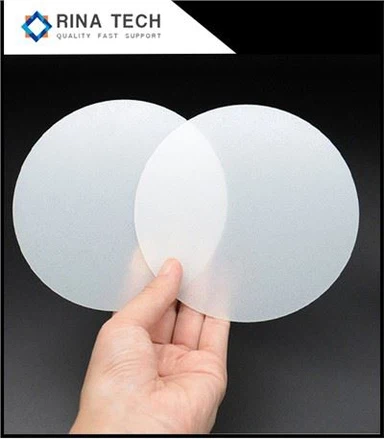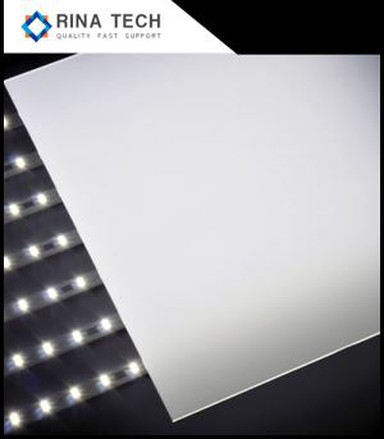

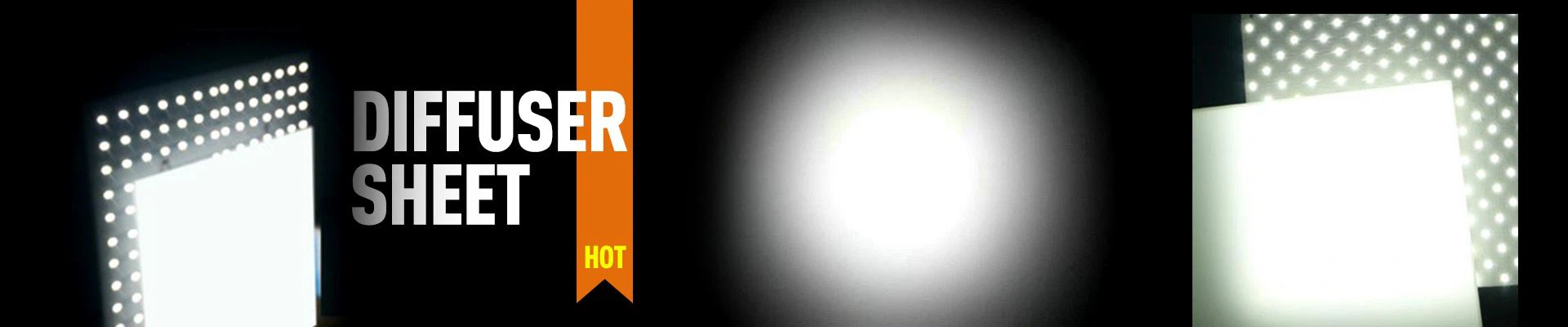


Diffuser Sheet For Lighting
Diffuser sheet for Lighting for LED panel light
RINA TECH Diffuser sheet for Lighting made from special materials, you achieve optimum light diffusion and maximum transmission,
all without visible hotspots. With light-diffusing sheets, you are sure to find the right plastic sheets for your project . Do you have questions,
- Fast Delievery
- Quality Assurance
- 24/7 Customer Service
Product Introduction
Rina Technology Co., Ltd. is one of the leading manufacturers and suppliers of diffuser sheet for lighting in China. Welcome to wholesale durable products in stock here and get quotation from our factory. All customized products are with high quality and low price.
Product Name:
Diffuser sheet for Lighting for LED panel light
1. Raw material preparation and formula design
Base resin selection
Base resins are selected according to application scenarios (such as temperature resistance, fire resistance, and light transmittance requirements). Common ones are:
Polycarbonate (PC): high temperature resistance and impact resistance, suitable for outdoor or high temperature environment lamps;
Polystyrene (GPPS): low cost, good light transmittance, suitable for indoor low-power lamps;
Polymethyl methacrylate (PMMA, acrylic): high light transmittance and strong weather resistance, suitable for high-end lighting;
Polypropylene (PP): good chemical resistance, suitable for special environment lamps.
Diffusant addition
Diffusant is a key component to achieve optical diffusion effect and needs to be evenly mixed with the base resin. Common types include:
Inorganic diffusers: such as silicon dioxide (SiO₂), calcium carbonate (CaCO₃), etc., which scatter light through particles;
Organic diffusers: such as acrylic microspheres, which are more compatible with resins and can reduce transmittance loss;
Composite diffusers: combining the advantages of inorganic and organic materials to balance diffusion rate and transmittance.
The proportion of diffusants in the formula (usually 3%-10%) and particle size (1-10μm) will directly affect the final optical properties and need to be precisely controlled through experiments.

2. Mixing and granulation process
Mixing and stirring
The base resin particles, diffusants, and additives (such as antioxidants, UV absorbers, flame retardants, etc.) are put into a high-speed mixer in proportion and stirred at a certain temperature (usually 60-100℃) for 10-30 minutes to ensure that the components are evenly dispersed and avoid uneven optical properties due to excessive local concentration.
Melt granulation
The mixed materials are melt-blended and granulated through a twin-screw extruder:
The screw heats the material to a molten state (different resins have different melting points, such as PC about 220-280℃, PMMA about 180-230℃);
During the melting process, the shearing action of the screw further disperses the diffusant to form a uniform "diffusion masterbatch" (granular semi-finished product) for subsequent molding and processing.

3. Molding process (core link)
Currently, the mainstream molding process of optical diffusion plates is extrusion molding. Some high-end products will use injection molding (suitable for special-shaped parts). Take extrusion molding as an example:
Melting extrusion
The mixed resin particles (or masterbatch) are put into a single-screw or twin-screw extruder, and the materials are made into a uniform melt through barrel heating (staged temperature control to ensure that the materials are gradually melted) and screw pushing. The screw speed and temperature gradient of the extruder need to be precisely controlled to avoid material degradation (affecting light transmittance) or uneven mixing (causing fluctuations in optical properties).
Mold molding
The molten material is pressed into a plate shape through the flow channel of the mold:
Mold design: A flat die (T-type die) is used, and the die lip gap determines the thickness of the plate (usually 1-5mm). The internal flow channel must be smooth and symmetrical to ensure uniform distribution of the material and avoid stress lines;
Forming control: After the material is extruded from the mold, it immediately enters the shaping device (such as a three-roll calender), and the shape of the plate is fixed and the surface flatness is controlled through the rolling and cooling of the cooling roller (with cooling water inside). The cooling speed needs to match the extrusion speed to prevent the sheet from shrinking and deforming.

4. Surface treatment process
In order to improve the optical and mechanical properties, the formed sheet needs to be surface treated. Common methods include:
Texture processing
Using embossing rollers or molds to form uniform textures (such as leather grain and frosted grain) on the surface of the sheet can not only enhance the light scattering effect, but also reduce surface reflection and glare, while improving wear resistance and scratch resistance. The depth and density of the texture need to be designed according to the diffusion requirements. Too deep may reduce the transmittance.
Antistatic treatment
Antistatic coating or antistatic agent is applied to the surface to reduce dust adsorption and ensure optical stability in long-term use, especially suitable for clean environments (such as operating room lamps).

5. Cutting and testing
Cutting processing
According to customer needs, the large-size sheet after forming is cut into specific sizes by precision cutting equipment (such as laser cutting machine, CNC cutting machine) to ensure that the edges are flat and burr-free to avoid affecting the optical effect during installation.
Quality inspection
Optical performance inspection: Use a transmittance meter and a haze meter to test transmittance (usually 70%-90%) and haze (usually 80%-95%) to ensure that the design standards are met;
Appearance inspection: Check whether there are defects such as bubbles, impurities, scratches, etc. on the surface;
Physical performance inspection: Test impact resistance, high temperature resistance, fire rating (such as UL94, GB8624), etc. to verify whether the application scenario requirements are met.
VI. Special process (for high-end products)
Microstructure design: Some high-end diffusion plates will use microlens arrays or nano-level diffusion structures, and form micron-level concave and convex structures on the surface through precision molds to further optimize the uniformity of light diffusion, which is suitable for scenes with extremely high requirements for light spots (such as LCD backlight modules).
Composite lamination process: The diffusion layer is compounded with other functional layers (such as brightening layer, UV protection layer) to achieve multi-functional integration and enhance product added value.

Images of Diffuser sheet for Lighting:


Diffuser sheet for Lighting Application:
| 1), Roofing skylight for office building, department store, hotel, stadium, school, hospital. |
| 2), Soundproof shields on express ways. |
| 3), LED diffused, Advertising lamp boxes, sign board.Telepohne booths. |
| 4), Anti-riot shield, bullet resistant material, Bank ATMs. |
| 5), Agricultural greenhouses, zoos, botanical gardens. |
| 6), Swimming Pools roofing/cover/sheet |
| 7), Lighting for corridors, balcony, passages and subway entries, walkways. |
| 8), Walls, roofs,windows,screens,shower enclosure and other indoor decoration material. |
| 9), Instrument and machine windscreen |


Our factory:


Package&Shipping


RINA TECH Diffuser sheet for Lighting made from special materials, you achieve optimum light diffusion and maximum transmission,
all without visible hotspots. With light-diffusing sheets, you are sure to find the right plastic sheets for your project . Do you have questions,
or need help selecting the right sheet? Our sales team will be happy to assist you.
Hot Tags: diffuser sheet for lighting suppliers, factory, customized, price, in stock, Ceiling Diffuser Plate, LCD Backlight Diffuser Film, LGP Acrylic Diffuser Plate, PS Diffuser Plate TV diffuser, Backlight Diffuser Sheet, Light Diffusion Sheet